Dr Shock searches for some enlightenment in the strange world of string theory in the hope that he may stumble across some great food and interesting experiences on this preposterous quest (England - Beijing - Santiago de Compostela - Munich - Melbourne - Cape Town)
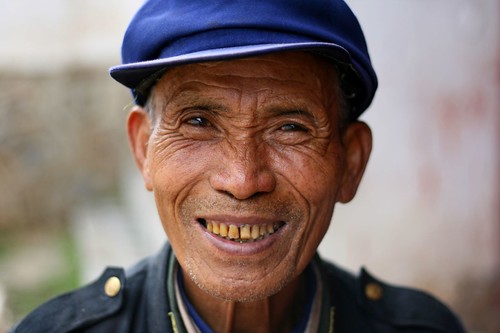
I spent five days in a predominantly rainy Lijiang, in Yunnan province, just before coming to Spain. It was perfect for sitting in cafes and reading, although this did mean that I didn't get to see Tiger Leaping Gorge, which is supposed to be spectacular. There was a single day when it was mostly clear and I took the chance to get as many photos as possible. I'm still not happy to take photos of people without asking their permission and this often gives rather unnatural effects, but sometimes it works out pretty well. I would always try and chat with the people first. They would generally be very happy when they found I could speak a little Chinese and this usually lead to a reasonably high percentage of people willing to let me take their photo. I chatting with this guy who was chopping wood outside his house. He had a wonderful smile and seemed incredibly happy to talk with me. He invited me in for dinner but unfortunately I was already meeting some other people and had to decline. He did however pose for a couple of photos and this was one of my favourites of the time I was away. (taken using the Canon 50mm f/1.8 II):
I arrived in China, two years ago, knowing that my new life was going to hold things which I had never previously imagined. Time does funny things to memory and of course I've left things out of the blog which it didn't feel right to talk about, but I don't remember having any sort of culture shock as I settled into life in a city of 14 million, in a country of 1.3 billion, with cultures, and social practices I had never come across.
Inevitably as I settle into life in Santiago de Compostela I will have to draw comparisons with my past two years, some of which will be good, and some of which will not. Exactly the same thing happened in Beijing.
I arrived here on Saturday and had the weekend to myself to explore and get to know my surroundings. On Sunday as I walked around in the afternoon and evening, having spent the morning getting down to some Spanish grammar in a cafe, I started to feel the closest I've come to culture shock on my travels.
Santiago de Compostela (which I shall from here on call SDC) is a city of 90,000 and the main city areas can be walked across in around half an hour. The centre is made up of an old town, with windy streets, built around the Cathedral, and a new area, with shops, cafes and flats traversing the sides of the hills upon which the city is built.
My feelings of shock are rather hard to explain and have gone away ever since I arrived in the office on Monday morning, met the group and have since learned much about life here.
Sunday it turns out is a bit of a strange day in SDC. Shops are of course all shut, people are it seems mostly with their families, and those who are not (predominantly men) are filling the bars to bursting point, watching the football.
I certainly didn't want to spend my second day sat in the residence reading so I walked around the area, not particularly wanting to join the football fans (I regularly shocked people in China by explaining how I was an Englishman who genuinely had no interest in football). So, I just wondered, rather aimlessly, covering the same ground again and again, feeling rather a lot like I was rattling around in a cage, with nothing to do and nowhere to go.
By 7 I wanted a bite to eat and so started trying to find a suitable cafe or restaurant to indulge, but none seemed to be serving. I went into one where the woman (one of the few people in the city who has admitted to speaking English) called me sweetheart for being so naive and told me to come back later.
So, I continued to walk around the same area, getting more and more hungry, until eventually restaurants started opening their doors and I dived in to get some food in me (I'd missed the fact that the clocks went back and so had last eaten some 9 hours previously).
Anyway, the lesson it seems is that on Sunday this city is dead, and my tour was not illustrative of the place in general. My worry as I walked around was that I was going to spend 3 years in a place with nothing going on except football and a cathedral, but I have since learnt that this is far from the truth.
All of November sees the SDC film festival in a variety of cinemas around the city, the modern art scene seems to be flourishing, as does the music (both classical and contemporary) and the guests who come to visit are impressively varied (this goes both for the town itself and the department - David Berenstein will be out here shortly, among a list of people I look forward to meeting).
Yesterday evening saw a talk given in the museum of modern art by Peter Lax, recent winner of the Abel prize in mathematics. He spoke for an hour on the life of John Von Neumann, a fascinating and important character in many areas of mathematics, physics and engineering. I would rather have liked to hear something about Professor Lax himself, but hearing his stories of Von Neumann was interesting too. In a week or so we will have John Nash coming to give a talk which I'm extremely excited about and will try and report on that in detail.
Anyway, along with slightly claustrophobic feelings over the weekend which have now gone away, the language issue turns out to be rather stranger than I had expected. As I arrived in China I was entirely cut off from any Chinese conversation. Here however I can understand what people are talking about perhaps half the time (though I miss most of the details), yet can't say anything back. This feeling of vocal paralysis is extremely frustrating for the time being, but I imagine it's something I will get used to in the time before I can actually interact properly.
And finally, tomorrow is officially a holiday for all of Spain so I shall be looking out for an appropriate cafe to sit and get on with some work, now that administrative duties are quieting down.
----------
Photos from Chengdu and Jiuzhaigou are slowly coming online. (Apologies for the first two which those who don't like strange foods may not enjoy). At some point I'll pick a few to post up here.
Thanks to Bee at Backreaction comes this fantastic video illustrating how a sphere can be turned inside out. It's around 20 minutes long and you're not actually going to learn much solid mathematics, but the process is very very well explained and the animation is excellent.
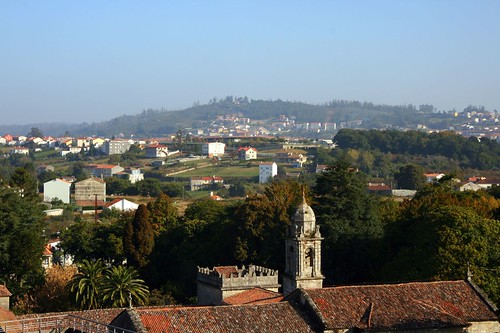
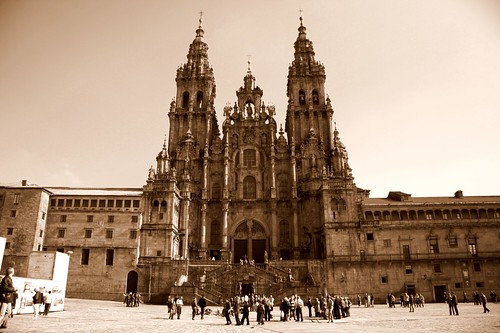
A couple of quick photos from my first day in Santiago. Things are pretty busy now, sorting out all the administration and getting back into work. It's now a little past 1 in the morning and I have another packed day tomorrow. Sunday's writeup will have to wait I'm afraid.
For now, this is a view from my current flat (until Sunday): And the Cathedral which is the hub of the city:
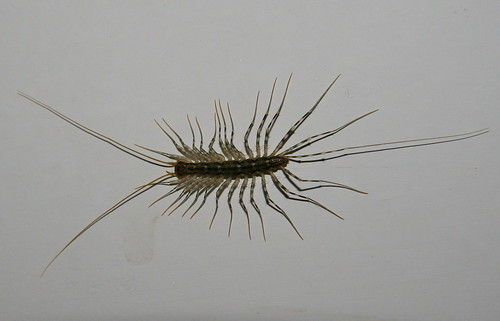
I haven't posted a video for a while, but this one has rather startled me. I had a room mate while I was staying in Jiuzhaigou in the form of a large myriapod:
(Larger versions available) It seemed friendly and never bothered me so I let it move about. I'm scared of few animals, but I really don't like the way centipedes and millipedes move, somehow it just creeps me out. In fact this one was ok, but the huge one I saw in the Australian outback still haunts me.
Anyway, I was taking a look around to find out more about the beast above and came across some information about the Amazonian Giant Centipede which can grow to over 30cm. This video from Youtube is pretty graphic and shows what such an animal can do to a small mammal. It's startling to say the least, and frankly gives me the creeps.
It's a little after midnight on my first day in the office, having spent the afternoon looking for flats and having just come back from dinner at the house of a couple of students. Eating at 11 in the evening is something which I will have to get used to having spent the last two years regularly finishing dinner by 6!
I wrote the following on Saturday, the day I flew here, but have not had internet access until now.
------------
I flew into Santiago de Compostela today with stories of rain and gloom and was greeted not only with stunning blue skies and temperatures around 20 degrees but also with simply one of the most beautiful cities I've ever seen. I spent the day walking round the old windy streets up and down the narrow alleyed hills, buying replacements for all the things I had to leave behind and throw away because of Ryan airs pitiful baggage allowance (total of 25 kilos for carry on plus stowed. My laptop and camera probably approach 10 kilos alone).
I had been told by Spaniards that this city was lovely and I was going to like it a lot, but I wasn't prepared for quite how stunning it is. It reminds me of Florence, of the back roads of Montmatre in Paris, and of small Tuscan villages. I sat having a lunch of chorizo and good bread - I've missed good bread so much in Beijing, though the wealth of other wonders never made me crave for it - in the Cathedral square as the sun moved around to illuminate the front of the wonderfully ornate building which Santiago is famed for. People having just completed El Camino - 'the way' - on foot or by bike made for a constant stream of tired but happy pilgrims.
Trying to find information on Santiago on the web is rather difficult because almost everything focuses around the Pilgrim trail and the Cathedral, so in my time here I hope to find out what else the city of 90,000 has to offer. Stunning countryside (excellent for hiking and cycling) is one thing which made itself abundantly obvious as the plane descended this morning.
After lunch I made my way to a small cafe, ordered an excellent coffee and started writing the extensive list of things to buy. I've yet to get a flat so I'm staying in the residence on campus until I have my own place, but there's still much to get in the meantime.
It being Saturday, only half the shops are open and I'm promised that all of them will be closed tomorrow - the man in the computer shop rolled his eyes, made the sign of the cross and tutted - clearly not one of the large percentage of the population who are still practicing Catholic.
The small restaurants stuck in the back alleys around the cathedral square decorate their windows with displays of some of the most impressive seafood I've ever seen and, though I thought I'd never say this, I think that Galicia may just give Japan a run for its money on the fish front! (Having now tried the octopus I can safely say that this is the best I've ever eaten).
One other thing which has greatly surprised me has been the scarcity of people who speak English. This isn't just the older people in the shops, but the administrative staff in the reception for my residence and even the students - I've been attempting to connect to the wifi and have asked half a dozen students, all of whom tell me they don't speak English. I think that having spent time in a scientific institute in China I have been somewhat spoiled for ease of getting around. It was compulsory for all of the students at the ITP to obtain a reasonably high standard of English to get into the PhD program and so all of them could hold at least a basic conversation, most of them a lot more. Here I have simply been greeted with 'no' from all those I've asked on campus if they could speak English. It seems that Spanish is going to be even more vital to learn than Chinese was. Thankfully it should also be somewhat easier!
---------
There's a follow up post from Sunday but that will have to follow at some point tomorrow.
I'm back safely in the UK, which having not been here for 15 months is rather strange. I'm staying here for a couple of days before heading on to Santiago de Compostela.
The last couple of days in Beijing were filled with paperwork needed to be completed before I could officially leave. Boxes had to be ticked left, right and centre in order to prove that I was up to date with bills, canteen payments, doctors, finance offices, keys, internet, books, office space and more but in the end , after much running around (literally) all appropriate duplicates were filed and after a final dinner with my boss and his students I had my final night in Beijing.
Packing was somewhat panicked as I realised that my bags were well over weight and had to throw out or, in most cases give away, a large percentage of my belongings. So, two pairs of oldish shoes, all my novels, toiletries, stationary and various weighty pieces of winter clothing have to be repurchased at some point. There was a nervous moment when I was told my carry on was too large and would have to thow much of that out too, but some gentle pleading pursuaded those concerned that the extra couple of centimeters were allowable.
I'm now in an even tighter position as I find that although my flight with Ryan air to Spain is very cheap, I'm only allowed a total of 15kg stowed luggage and one bag weighing 10kg carry on luggage (I took around 28kg carry on and 20kg or so carry on back from Beijing). Seeing as I'm going to be living in this, probably until Christmas, this is really not a lot, given that the computer and the camera plus a pair of shoes (I wear something akin to canoes on my feet) probably take up a fair percentage of that weight!
Today I've spent in London getting various bits and pieces done and popping into the Tate Modern to see the Louise Borgeois exhibition, which is very interesting (the earthquake crack in the main turbine room does little for me). As I walked around I was struck by many things, probably the largest being the racial diversity which is in general not visible in most parts of Beijing (there are exceptions). This included the number of foreign languages I heard on the trains, in the cafes and on the street. I was pleased to be able to chat briefly in Chinese as I heard the waitress in a cafe talking on the intercom in Mandarin.
People, expats especially, complain bitterly about how crowded the trains are in Beijing but I was rather taken aback that the London underground is far worse. Taking a train back to Wimbledon (where I'm staying with some friends, my parents currently being out of town) I was forced to see four trains go by without being able to get on them. Football fans in the front two carriages of one of the trains singing and shaking the car didn't do much for my feelings of patriotism either.
Still, cups of tea and baked potatoes have bought back feelings of homeliness and yesterday's wonderful blue skies over London have made it lovely to come back home, if only for a couple of days.
Much to get done in the meantime so best be off for now...
I'm back from my travels about Southern China, feeling refreshed and raring to get back into work. There are a few things which come first though, including crossing continents. As I came back to this polluted, crowded, noisy place which I have called home for the last two years and will be calling home for another 36 hours or so, from the idylls of the South I had some time to reflect on the last two weeks and the last two years. Two years ago I could never imagine that it would be this difficult to say goodbye to China, but getting on the plane is not going to be easy. Nevertheless I am hugely looking forward to the new start in Spain which I'm sure has many things in store for me, both academically and culturally.
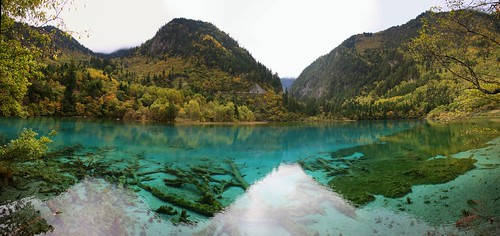
Anyway, there are a dozen blog posts buzzing round in my head at the moment since the last ten days traveling but as it's almost 1 am and I have my last day in the office tomorrow, these will have to wait. There's a lot to write in particular about Jiuzhaigou and I have at some point in the future to go through the 500 photos I took there but for now I shall just post one to show why this place is famed for being paradise on Earth: Click for larger versions. Many more to come when time allows.
I've spent the last few days in a frequently rainy Lijiang, in Yunnan province, home to the famous Tiger Leaping Gorge, which has been rained off most of the time I've been here.
Despite the Disneyesque feel, the overwhelming crowds and the constant drizzle, this classical Chinese town with it's many minority influences (Naxi minority in particular) has proved to be a lovely place to spend a few days. I've been wandering around most of the time snapping happy with the nifty fifty (my new fast lens), and getting some fun shots of the local residence who beam as I chat with them in broken Mandarin (in fact some of the locals don't speak Mandarin at all, but one of the many minority dialects which I nod along to with a bemused smile).
I've been staying in a wonderfully calm, wooden guest house for a grand total of around 2 pounds a night, warming myself around their little coal burner and reading in the covered courtyard. I'll attempt to track down a website for this place (Panba guesthouse) as it's well worth a stay, being situated in the old town but far enough away from the crowds to feel very peaceful.
Tonight I head to Kunming, capital of Yunnan province, not particularly out of choice but simply because I need to head here before taking my flight tomorrow night back to Beijing, as my trip draws to a close.
Some point when I'm not sitting in a freezing cafe with wet clothes I will update the blog with posts about Jiuzhaigou and Chengdu, take II. For now I will head out and try and track down something interesting to have for lunch (grubs are frequently on the menu, though the local cuisine is not a terribly inspiring one).
Greetings to those who are warmer and drier, but possibly not as relaxed as I currently am.
I'm currently writing in an internet bar in Jiuzhaigou, in Northern Sichuan province, where I've spent the last 3 days. It's a truly spectacular area but I'll get onto that later. (Update - I wrote this a few days ago and am now in Chengdu, about to fly to Lijiang in Yunnan. Blogging has been difficult.)
On Sunday I flew into Chengdu for the start of my journey after a rather tired 5am start. I'd heard good reports about the laid-back lifestyle in Chengdu and so was looking forward to relaxing after a hectic few months in Beijing. As I took the bus from the airport I was a rather disappointed. Despire the addition of more greenery Chengdu seemed to be constructed of the same concrete blocks, cars and crowds that I see everyday in Beijing, accompanied by the same grey sky and smell of pollution. Getting off the bus I wasn't entirely sure where I was in the city though I knew that I needed to get to Renmin park, nearby which my couchsurfing host lived. I was wearing a heavy backpack (mostly books and camera kit) but was happy to wonder round the area till I found someone who could tell me where I should be heading. The sounds of Sichuan hua (the local dialect) drifted over me reminding me of how I felt in Beijing two years ago. There are in fact enough similarities to regular mandarin that I could pick up a little of the local goings on.
I asked a young couple at a traffic lights if they knew where the park was and they told me that they were heading that way and could walk me there. I'm now no longer convinced that they actually were heading that way as I've learnt how friendly the Sichuanese are. It was a 15 minute walk in which time we chatted casually, pushing the limits of my Chinese. I was given their numbers and told that any time I needed any help I could give them a ring. They dropped me off at the park and I quickly found myself a little noodle shop where I shed my many bags and got myself a fine bowl of beef noodles. I ate slowly, taking in the looks of those around me staring at the strange sweaty laowai with the big nose and the big book on China, which I was casually consulting. I sent a text to my couchsurfer to see if it was good to head to his place to dump my things but got no immediate reply.
I made my way into the park to take a wonder around and quickly found myself sat at the oldest teahouse in the city, an outdoor but covered area where people were sitting, playing cards, reading the paper, having arguments, massages and their ears cleaned out, all while drinking tea which was constantly refilled by the house fuwuyuan. I got myself some bitter green tea and sat to wait for the text and watch the locals. Soon a couple of women passed by, one with a camera similar to my own which I took a glance at. She came over and introduced herself saying that she was a photography student and had studied for several months in Bolton. I invited the two to sit down and we spent the next few hours chatting about photography, the local area, travels in China and teahouses in Bolton (her major interest was photographing people in tea houses around the world).
With no reply to the text I tried phoning my host but was greeted with a message saying that the phone was no longer in operation. This left me with no way of contacting him and nowhere to stay, so I asked for some advice from those around me and was directed to a relatively cheap hotel a few minutes walk away.
By this time I felt homeless, yet completely at home, the friendliness of the locals and the completely relaxed atmosphere masking the concrete jungle that it was all set in. Finding the hotel I booked myself in, settled my bags and went out for a walk around the area. Finding a night market I marvelled at the chillis and cuts of meat and got myself a bag of zhi er gen (stinking fish grass) and some local snacks for later. A nearby restaurant saw my first taste of genuine sichuan mapo dofu which was excedingly numbing (packed with Sichuan pepper) but very tasty.
Sated and happy I headed back to the hotel and got a reasonable night's sleep, despite the muzak piped in the corridor directly outside my room.
Early the next morning I was off again and took the plane the forty minutes to Jiuzhaigou, with no plans other than to see the sights which I'd read and heard much about and knew were not too many hours from the airport. As we descended, the tops of the mountains poked through the cloud line and the scenerey slowly opened itself to our view. This looked to be a spectacular place and I haven't been disappointed. I found a local bus which would first take me to huanglong, another scenic destination with calcified pools set in a large valley patched with wooded areas. The 2 hour bus ride to the site was spectacular as we wound our way up the mountain rodes and it was wonderful to finally be breathing some unpolluted air, the first since January where I spent a week ill at a conference set at a ski resort in Korea. The only problem with this pure air was there wasn't enough of the damn stuff. At over 10000 feet the air was thin and trekking up to the valley I found myself struggling to catch my breath. The elderly carried around portable oxygen cannisters which they would regularly puff from as I wheezed and ached.
-------
I'll post photos of Huanglong and of my next few spectacular days trekking the Jiuzhaigou valley when they are organised back home. I'll also continue with tales of spending days without meeting another English speaker, eating brain hotpot, having my ears cleaned out and more when I get a chance. It's been a wonderful trip so far and the last few days spent in Chengdu has entirely made me forget that I'm in another Chinese concrete jungle....
-------
I've been continuing, when possible to add blog posts of note from other blogs into the tab in the top left of this one, of which there have been many. In particular, go and vote for Shelley at Retrospectacle for the student blogging scholarship. Shelley and I started blogging at about the same time and she is one of the most diverse, entertaining and informative bloggers on Scienceblogs - well worth both a read and a vote.
Just a quick post to say that all is well, though I haven't had a chance to blog while away. I've spent 3 amazing days in Jiuzhaigou trekking through the valleys(google it to see pictures, though mine will follow when I've sorted through the many hundreds) and I'm now in Chengdu, capital of Sichuan province and without a doubt the most relaxed city I've ever been in. Spent lots of time sitting in tea houses watching people go by and catching up with reading which has not been happening in the last few months of busy work. I'll be here for another few days and then go to Lijiang in Yunnan province for some more trekking and some more relaxing before getting back to Beijing.
Most likely there won't be much serious blogging for a few days.
Another fantastic talk from the TED conference. This is from Carolyn Porco on the results from the Cassini mission to Saturn which bought us the incredible photos from Titan and continue to give us new insights into the other major moons. Well worth a watch to see an inspirational speaker talking about where we are at the frontiers of space travel. In some ways incredible, in others rather depressing given where we were 50 years ago.
I've linked to it before but Burt Rutan has many interesting thoughts on the history and future of space travel.
I was rather hoping to be both learning about and simultaneously blogging about string cosmology this month as the KITPC program started up (and continues for the next two months). Sadly, because I was the only non-Chinese speaker for the first two weeks of the conference, all of the lectures introducing the subjects were held in Chinese. I gave up after just a couple of days.
Tom Banks came out for the third week and gave some excellent lectures on holography and De Sitter space, a subject which I've been reading up on since. From now on all of the lectures should be in English, but I will not be here to report on them (leaving on Sunday to Chengdu). There are many things I will miss about China but the lack of input from talks in English is one thing I'm really looking forward to getting back to. As I speak with my collaborators who have been racing around Europe all summer to conferences I see that there is still some considerable way to go in the true integration of West and East on a scientific basis. Things are at least steadily improving and the KITPC is a good step in the right direction.
UC Berkeley has just started putting video lectures up on Youtube. It's a great start but there's a long way to go in making education truly open source.
Scitalks continues to add more to their database and the new version of the site is very much in the making.
Work is winding down as I finish off some odds and ends (all nonetheless important) and I try and work out how much I am going to be ripped off by as I send my books to Spain by ship. Packing up of the flat is currently consisting of friends coming round to relieve me of the piles of DVDs and books which I won't be taking with me. Somehow I need to find an extra zero in the British Airways baggage allowance.
I head off on Sunday to Couchsurf in Chengdu and then go straight to Jiuzhaigou to hike for a few days. I've just bought myself a prime lens (Canon 50mm f/1.8 II) to get me some fine pictures in the dawn and dusk, along with a relatively cheap tripod (I've no large telephoto lens to worry about stabilising) and a remote control. (Taken at the 2007 Midi festival, Beijing)
(Trivia - Kubrick's Barry Lyndon uses a NASA built f/0.7 lens for the candlelit scenes - perhaps the largest aperture lens used in film history.)
This is tough, really, this is a lot harder than I was expecting it to be. I'm currently in my flat, surrounded by piles of papers, foreign coins and clothes. I have a little over a week to go before I leave Beijing but I have to get things packed up as soon as possible. I'm shipping some of the heavier items to Spain and so this all needs to get done now.
I was expecting it to be physically tiring, but it has become emotionally quite draining. As the days tick by and my time in this amazing city diminishes fast I stop to wonder where the time went, how so many things happened in the last two years, yet it seems only last week that I stepped off the plane, into a country and a culture I had never previously experienced, with eyes wide and mouth constantly open to the amazing sights, sounds and smells about me.
Lots of things have happen, as can be attested to by the 300+ blog posts since I arrived here. I've written about ups and downs, more, thankfully of the former, but of course there have been many things I haven't written about, many friendships, many meals, many insights, many cultural faux pas, many nights spent wondering what I was doing here in the first place, and days spent wondering how I would ever leave.
And somehow it's all coming to an end, rather abruptly, or so it feels. I never decorated my apartment. I know it's rather strange but two years didn't really seem long enough to bother (plus, on a Chinese wage, spending money on household adornments isn't the first priority) and so it has stayed as a rather impersonal space, adorned only by my books, films and clothes. This, perhaps is why it's so strange packing everything up. Though the space seems to have no character, somehow the walls are ingrained with memories of the last two years and the piles of clothes are, at least, my piles of clothes.
I came to China not knowing a soul. I've made some lifelong friendships and there are people who will be very hard to say goodbye to. Ties will not be cut, but I don't know the next time I will see these good friends again. I certainly will be coming back to China some point in the not too distant future, but Beijing will no longer be my Beijing, I will be a casual visitor. I know this because I know how fast this place changes. The Beijing I see next time will not be the same one I leave.
I will miss many things about this place. I had planned to write a list of what I would be sorry to leave behind and what I would be happy to turn my back on, but that list would be far from complete and would trivialise so many ideas. If you want to know some of these details then I hope that the last 300 blog posts nicely summarise my feelings about this place.
I'm hugely looking forward to getting to Spain and starting something new, but the last two years has, as was inevitable, changed me in many ways I am unlikely to know until I return to a reality that I'm more used to. I'm not sure when that will be, and I'm not sure how the effects will manifest themselves.
I've promised myself that I wouldn't let my Chinese slip, but I don't know how practical that will be when I put Spanish in with the mix and have piles of work to be doing in Santiago. Thoughts of sitting in quiet cafes with a coffee getting on with my research temporarilly replace the waves of nostalgia I have sitting, writing this. We are the lucky few who land in a job that we get so much from.
Before I leave China I will be travelling for almost two weeks. Next week is a national holiday which I will work through, then I fly to Chengdu, in Sichuan province, on the 7th, to make my way to Jiuzhaigou national park where I will spend three days walking round the incredible scenery. Then back to Chengdu to sit in the tea houses and wander by the river before going down to Yunnan province to see some of the diversity of minority cultures in this country as well as the amazing South China scenery. It's going to be a packed trip, but it should be a lot of fun. Then back to Beijing for two days before flying to England and then almost straight away to Spain.
So, much to be getting on with, and this may well not be the last post about my feelings on leaving China.
A busy weekend, both work and play. I made it to the Beijing jazz festival on Saturday afternoon, which deserves more time than I have to write. I went for a wander around the park, into the gardens and took some photos of the nature on show there so will leave you with this snap for now:
A short post as there's still lots of work to get done before I leave here in just over two weeks.
Last night I finally got around to trying a dish I'd been promised by a Korean friend for a while. It turns out that it's not difficult to find around Wudaokou where there is a huge population of Korean students.
The dish is called San Nak Ji and is an octopus based dish, in fact it's just raw octopus. Nothing particularly strange about eating raw octopus which I've had many times in Japanese restaurants. However, San Nak Ji is still moving, on the plate, in your chopsticks, in the dipping sauce, in your mouth. The suckers make it pretty difficult to pick up off the plate, especially with the Korean style metal chopsticks. You dip the pieces in a chilli sauce and then eat. You don't feel them moving much in your mouth but they do stick to your tongue and palate as you're eating them. The suckers can be really rather strong.
Because the tentacles are detached, I certainly wouldn't count this as eating a living creature. Though some may think this is a particularly barbaric act, I would claim that the more you remember that your food was once a living being and don't take this fact lightly, rather than prepackaging everything so that you don't have to think of the horrors of the slaughterhouse or the terrible conditions that your Sunday lunch has had to endure, the better. I am in favour of choosing free-range where possible. Sadly in China this is not an easy task and would certainly mean that I would never eat out.
Anyway, San Nak Ji is worth a try and goes well with a good cold Soju. My camera batteries didn't work so no video from me. I will try and return before I leave and get a personal video of the events. In the mean time you can take a look at a Youtube example of a similar meal. (Obviously do not watch this if you think the sight of writhing tentacles may cause you to be put off your next meal).
I haven't spoken of food for at least a week. Usually when I do it's about gastronomic exotica. Many of the things below will seem a little closer to home but should be taken no less lightly. It's taken me a year (since it started) to get around to heading to the Westin hotel for their Sunday brunch deal. It's the sort of thing I've generally stayed away from, attempting whenever possible to go for the oriental options. However, a deal like this can only be avoided for so long. There are several hotels offering all you can eat deals for around £20 a head here in the city. In the UK if you happened upon such an offer you would be greeted by a selection of fairly uninspiring dishes which, on the third return would look ultimately unappealing.
Things in Beijing are somewhat different. The Westin hotel in Beijing offers an extravaganza of luxury foods for this price. Champagne flows freely, as do cocktails, fine wines and spirits and beer, to accompany everything from caviar, sushi and lobster, through steak tartare, cured meats, fresh barbeque to chocolate fountains, handmade chocolates and imported cheeses. If you happen to like food and have a spare 20 quid lying around on a Sunday morning GO TO THE WESTIN HOTEL AND INDULGE. heart attacks may be included. We stayed there for around 4 hours, chatting, relaxing and eating the most spectacular food. I remained happy with just a glass of champagne, not wanting to spoil the food and had a couple of the finest cups of coffee I've had this side of Italy after the meal. Anyway, a few photos from the day follow:
The chocolate dish with a piece of gold leaf on the top has a layer of olive oil in the middle which was spectacular. The steak tartare in the martini glass was better than any I've eaten in France and the selection of caviar was worth the trip alone. It may fill you with guilt at the sheer indulgence but that will soon be displaced by unreasonable quantities of fine food. The man standing, beaming, in front of the steak tartare stand is the head chef and was extremely happy to chat as he wandered around making sure everything was going well. I probably tried a quarter of the foods on offer and left satisfied but not stuffed. Well worth the trip!
Tales of a spectacular meal yesterday must wait until I can get the photos onto my computer. In the mean time and totally unrelated. Toomanytribbles linked to this video which is worth a watch. Makes you feel pretty insignificant!
I'm almost alone in the building today. Everyone else has gone to Chengde for the weekend. The ITP organises these huge group outings a couple of times a year, but I usually miss the e-mails. It makes for a peaceful day in the office anyway and work is getting done.
--------------------
Anyway, this post is a quick tech note. I use Meebo as my instant messenger client. It's entirely web based, so you don't need another program running in the background constantly giving you adverts or using up more memory. It also allows you to integrate various accounts: Hotmail, Yahoo, Google Talk amongst others (not Skype - yet). I use instant messaging as a vital part of my work, talking with my collaborators in various continents.
The one drawback has always been that file transfer was not possible - until now! I always had to switch back to msn in order to send and receive files but now I see no reasons to use msn any more.
Of course if you're bothered by the design of Meebo there are dozens of Greasemonkey scripts you can use to make the interface more to your liking.
-------------------
Cory Doctorow, from Boingboing was in Beijing this week and spoke at the Bookworm. Sadly I couldn't make it, but the video is up on Youtube. Cory talks about the future of information dissemination, copywrite, Web 2.0, piracy, social networking and more.
This blog is two years old today, and I believe this is the 369th post.
-----------
Work finally calmed down late on Tuesday evening. Over 40 hours of intensive calculation in 3 days left me utterly exhausted. I've never needed to work with quite such fevered intensity as this. I've never been a crammer, exams at undergraduate level were a relatively relaxed affair in terms of timing as the revision was usually well planned. So, the task of pulling a series of very late-nights and early mornings was not something I envisioned enjoying. However, the hours did go between complete fatigue and a strange, work fueled euphoria which was actually rather empowering at times.
Yesterday I was too drained to do anything of any use, so I had a relaxed day in a cafe and then went to see Bergman's Wild Strawberries at D22. An early road trip movie, concerning the realisition of an elderly man about the path his life has taken and what he has lost, both physically an emotionally through the years. It's a reflection not just of the individual, but a look at how we sometimes ignore the mirror of those around us, forming our own crooked picture of the way we appear, and our own moral absolutes. This is perfect Bergman material and well worth a watch. Having seen Through a Glass Darkly, earlier in the year I now realise how adept Bergman was at capturing troubled emotions through simple images - sometimes cliched, but always powerful.
-------------
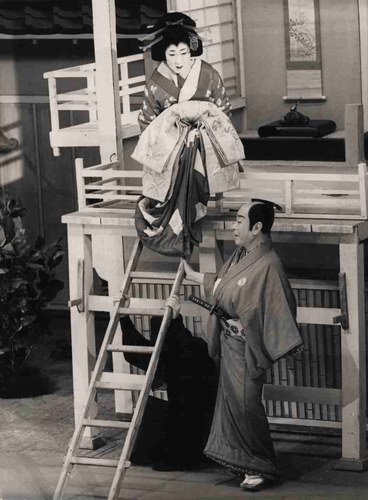
I wanted to add an extra note about the Kabuki, which I watched twice last week. I'd been pondering the use of the onnagata, the men who specialise in playing women's roles (there are no women in kabuki performances, though there used to be).
As I watched the second performance on Wednesday evening I wondered what it was about a 76 year old man (Kabuki legend Nakamura Senjaki III) playing the role of a young woman, a teenager, dancing on stage, that was so captivating to watch. This sounds strange, I'm sure, but in fact it comes off as absolutely natural and beautiful to watch. I was trying to work out why one would have men playing female roles, other than through simple discrimination, but I think I have a clue now, after my fourth viewing of Kabuki. The vision of a man playing a woman's role is an entirely de-sexualised one. There is no thought of the player on stage having anything to do with sexual allure, as it might do if it were a beautiful woman playing the role. What you are left with is a neutered form but still retaining all the elegance and grace which may have been masked by any erotic distractions. The stripping of one aspect of attraction to reveal in much more clear contrast another. It may sound strange, but it really is fantastic to watch.
OK, I think that's probably my input on Kabuki for now, but I'm sure it will crop up again in the future.
-----------
I'm still feeling pretty drained but have plenty of work to be getting on with now. Just three full weeks left in Beijing is a fairly terrifying thought - two years have gone very very quickly - thoughts of Bergman resurface!
I hurt, both in brain and body. 15 hours so far today in front of the computer trying to get this calculation done. I'm guessing another 4 hours at least tonight, but we'll have to see. Thankfully I'm in a bar where the manager has given me free drinks for the month so I'm keeping myself going with green tea. I just want this to be over!
For reasons which I'm not going to go into now I'm working like crazy at the moment. I will probably be up all night at least for tonight, tomorrow we'll just have to see.
I'm taking a five minute break and so will put up a post I wrote a few days ago about the current goings on in Beijing. If work continues like this I'm not going to get to any of it, but I can always hope.
With less than two months left in Beijing I'm keeping a close eye on the things that I haven't done yet which I would like to. There aren't many places that I haven't explored in Beijing that I'm aware of but I'm sure there are many interesting hidden treasures to be found. The ancient observatory I would like to check out when I've time and the underground tunnels which are rumoured to go for hundreds of miles under the city sound intriguing.
There's plenty on over the next month too. There will be a couple of weeks of movies commemorating Bergman on at D22. This week there was The Seventh Seal, which is excellent and I'll definitely see it for a second time when I have a chance. The Bergman season continues with Wild Strawberries and The Magician on the 12th and 13th and finishes with The Virgin Spring on the 19th. Michaelangelo Antonioni's death is not going unnoticed with L'avventura, La Notte and L'eclisse on the 20th, 26th and 27th. Sadly Blowup is not being screened.
At the Box Cafe on the 25th is Au Hassard Balthazar, a very moving story about the life of a donkey, named Balthazar, directed by Bresson. Very very sad but a fine film.
Director Diao Yinan will be talking at Cherry Lane movies before his film Uniform, which I haven't seen but is promoted in That's Beijing.
On the music front there's the Beijing Pop Festival in Chaoyang park this weekend, with a truly bizarre line up of Nine Inch Nails, Public Enemy, Brett Anderson, New York Dolls, Marky Ramone and a few decent Beijing bands (Joyside and the Scoff being the two who I've seen and enjoyed). Carsick Cars, Beijing's favourite band to make it outside China (currently on tour with Sonic Youth in Europe) will be back in D22 on the 29th which is bound to draw a big crowd.
I'll definitely be heading to the Beijing Jazz Festival (beijingjazz.com). For jazz in the meantime the Red Hand Jazz band every Sunday at D22 are well worth coming to listen to. I was very pleasantly surprised when I saw them for the first time a few weeks ago, though with D22's reputation and a manager who used to own a bar in New York, I shouldn't be.
Beginning of next month sees Faithless and Talib Kweli with Ozomatli on two consecutive nights at the Star Live. Ozomatli are supposed to be superb live.
For big nights out Armin Van Buuren is coming to Ba Hao at Chaoyang park on the 30th of September. The Tuesday night experimental electronica also continues at Dos Kolegas which is well worth a trip if you're feeling like something a little more interesting.
Beijing is getting in on the molecular gastronomy game with a relatively new restaurant, the Blue Lobster, which has superb reviews though is very very expensive. Depending on how work and cash flow goes it may be a treat for myself later in the month.
A friend and I have vowed to go to a new restaurant every week. Next week I have been promised by a friend that I will be taken to eat san nak ji (산낙지). (Only click on this link if you're not feeling squeemish - I really really mean it. - no, really!)
ok, that will do, but with many hours ahead I will need a break later...
Things have got marginally calmer though I still have work to do for Monday. I've been sitting in a cafe this afternoon doing some work and reading 'Godel, Escher, Bach: An Eternal Braid' by Douglas Hofstatder, a wonderful book on mathematics, logic, information, music and art. Well worth a read if you're interested in the deep workings of logical systems but a fascinating read even if this has never grabbed you before.
I mentioned Nav, my couchsurfer in my previous post. It turns out that Nav is a rather fine photographer and he spent a good length of time on Thursday evening showing me the basics of using Photoshop, which I had never truly appreciated the power of. My own photography, in its limited capacity owes a lot to a friend and designer explaining a few simple rules. Nav explained a more extensive list of factors which go into making a fine photo. I can see that almost all of my photos fail on at least one of the six factors he mentioned (often more), meaning that very few of my photos are quite as good as I'd like. This is surely a matter of practice and with these new guidelines I look forward to seeing what I come up with.
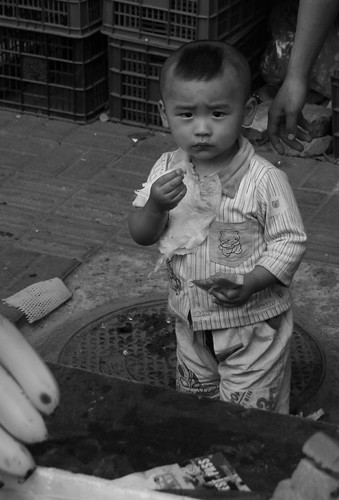
Looking back through some of my photos I noticed this one, which I don't think I've posted before. Unfortunately, the close and blurry foreground detracts from the photo but I am pleased with the look in the child's eyes and the gesture. Yesterday I went for a cruise around the hutongs getting a few more local shots which still need to be seen to.
Things have been crazy this week. I had my first sit down meal since Monday this evening. This has been a combination of trying to fit in a lot of work (often till early in the morning) with some socialising.
I went to the airport this morning to pick up my new Couchsurfer, Nav, who's a very friendly Canadian guy making a four month trip back to his hometown in India. Today was his first day of travel and he's got an amazing trip ahead through Qinghai, Tibet and through to India. He's doing a course in neuroscience at York University in Toronto so we've spent the evening talking about string theory, neuroscience, radical atheism and South Park.
Tomorrow I hope that things will calm down for me and then I'll get back to writing something a bit more substantial.
I was up until 4 this morning trying to get some work finished. We're getting there but still things to polish off. The time delay between my collaborators and myself means that there is always some dead time when one person has finished something and is waiting for a response. In fact I'm in this non-overlap time now while I wait for the others to wake up before I can give them my results from last night.
I took the dead time yesterday evening to go and see the Kabuki performance at the Poly theatre in Beijing given by the famous Chikamatsu-za group. I've gone on about this before on the two previous occasions (here and here) I've seen Kabuki in Tokyo but if you have any interest in the arts at all and in particular of the exotic Eastern variety then you have to go and see this amazing spectacle. It's truly a beautiful thing to watch, and though I didn't understand a word of it bar the Chinese surtitles I could make out I was mesmerised for two and a half hours. In fact so much so that I'm going back today - I'm not expecting to see much Kabuki in Spain!
Anyway, with a very late night to the tune of Sufjan Stevens and Devendra Bernhardt I got some good work done yesterday as I glugged my strongly brewed tea into the early hours of the morning.
OK, back to it...
------
In addition: Anyone else who was at the Kabuki, did the audience get up and leave before the show was over? I believe there was another act to see! I will see tonight, I hope.
Working, can't stop, a post from a couple of days back:
About a month ago I finished the 90 half hour lesson series of Pimsleur's Mandarin Chinese. It is without a doubt the most valuable language resource I've found and makes learning Chinese much much easier than anything else I've tried. It's uses interval repetition, such that you will hear a word first slowly and it will be repeated several times over the first minute. Then you may not hear it for a five minutes, and then 20 and then there will be a gap of a few lessons until it will pop up again in context. This format seems to work extremely well. The other technique which is used is that you are prompted to say words and phrases, not with an exact queue but with a hint of the sort of response you should give.
You won't learn a huge amount of vocabulary (just 400 or so words in the 45 hours) but you will learn them well and be able to get the pronunciation and tones accurate by the end of this. This is no small feat in my book.
Anyway, highly recommended - I just wish there were a further 90 lessons with another 400 words.
-------------
On the subject of languages I had a small, retrospectively obvious epiphany this weekend as I was getting on with learning Spanish. I've spoken in the past about my struggle with Russian and it's only just clicked why this was.
I didn't enjoy learning Russian because I didn't have any motivation.
This has only occurred to me a decade after I scraped a C grade at GCSE. I had always claimed that the language, even after 5 years of learning it, simply never clicked. I only realised yesterday quite what why this was.
Around a year and a half ago I wrote a rant of a post about the fact that some schools in England were going to make pupils learn Chinese. I thought that this would simply be a waste of the kid's time and effort for the great majority who would never use it (unless China has its way in another two decades). This thought was largely because I was struggling with the language at the time and had struggled at school with Russian (having been forced to learn it) and achieved only passable French. I now see the reason for these outcomes in a clearer light.
When I arrived here and started learning Chinese it was hard work. It's hard for just about everyone (Japanese and Koreans seem to have a slightly easier time of it). When I arrived in Beijing I had around 100 Chinese words to my name and could actually get by most of the time, I could go into a shop and get what I wanted, if I had a dictionary. I could get around in a taxi and if anything tough came up I could usually blag my way through with a stranger's assistance or by phoning a friend. Frankly I didn't need any more Chinese than that and so my motivation was low. I also didn't like the language very much. The Beijing dialect can sound like a man coughing up a rusty bicycle chain and the women don't sound much better.
OK, so a year and a half on from that I know perhaps a little over a thousand words, at a guess. I can have a basic conversation with most strangers and have spent on occasion a few hours with Chinese people speaking nothing but. My Chinese is still really, really bad but I actually love to use it. Having got used to it I actually rather like the sounds (sometimes, the radio shows and real locals still grate my eardrums when I'm not in the mood). And suddenly there's the motivation: the motivation is because I can see that my life is improved by learning the language, being able to communicate with people and I like listening to it.
The part about it making my life better is something that I NEVER KNEW AT SCHOOL! I knew that if I learnt French then I could go to France on a French exchange and speak with my host family, but why would I want to do that? I could go to France with my family and there were plenty of people in England I still had to meet. From a cultural point of view I didn't see that I was going to be gaining much (this isn't something I contemplated but I can see now that it didn't register at all). The motivation for learning Russian, so we were told, was that Russia was soon going to be taking off as a genuine superpower and we would be set for life if we could do business in the language - what sort of motivation is that for a 10 year old? I learnt to read Hebrew so that I could duplicate the sounds from the Torah. Something which I soon became bored with and gave up on. So, it seems that my past experience at learning foreign languages was marred by the fact that I didn't see a good reason why I should make the effort.
I got myself into a bit of an awkward position with my arguments about English kids learning Chinese at the beginning of my stay here because on the one hand I had spoken about how much I enjoyed the nature of language and reading great literature and on the other hand was saying that I really didn't want to bother with the hassle when I could do perfectly well without. I think that the point is, I think it's difficult to grasp how much joy can be gained from reading great works in another language or talking with the locals on an even footing until you've done so. The fact is that it opens up such a new dimension to your life. I don't claim to be able to read literature in Chinese, nor even the local papers but I can get a sense from having spoken with people about the depths of great Chinese works that it would be wonderful to be able to read them.
I've just started learning Spanish while keeping up with the Chinese and I so look forward to the day that I can sit in a restaurant in Santiago de Compostela and talk with those around me naturally. I'm smiling now thinking of the first time I will be able to open up a Marquez and read the words in their untouched form.
By all this I don't mean that suddenly language is easy or that I will pick up Spanish in just a few weeks but now I actually want to learn it, not just because I think I should, or I'm told to, but because I'm excited about the prospects of it.
This minor epiphany begs the question: could I have been shown this earlier? Could someone have given me good reasons for learning Russian and French and Hebrew and allowed me to explore the enjoyable parts of learning a language (speaking with the people and reading the literature) to a greater extent. Twice I went to France on French exchanges and enjoyed both occasions, but it rather felt that this was a treat so that I would keep learning the grammar and the vocab lists, rather than the whole reason for learning the language.
Perhaps we just need more enthusiastic teachers but with teachers of all calibers running rather low, at least in the UK, there's little room for such requests I presume.
Anyway, some random thoughts after almost 2 years in a foreign land.
Things have been utterly non-stop recently. I haven't seen the inside of my flat for more than about 5 minutes this week while not sleeping or trying to forget about the day's events and attempting to sleep. This isn't to say that anything has been bad, just very busy. I'm finishing up some work which has to be done really very soon and have written a couple of long posts about how I got to be where I am now (not in the Darwinian sense) and a little background to what I do, or maybe why I do it.
In the mean time I've been helping friends move house and running round the city saying goodbye to people leaving Beijing, teaching, attempting to start learning Spanish and continuing with the Chinese. Tomorrow I go out of town for a party, back on Sunday, take a friend to the airport and then straight back to work. September is looking to be very full with three couchsurfers staying at my place for a continuous period of 10 days. Also we have the string cosmology conference coming up all month at the KITPC, which I'm very much looking forward to. (first week's lectures here).
Today as I ran out of the office and caught a cab to get to my friend's house to help her move house my blood began to boil as the Beijing roads mingled with my already high pressure state.
I usually spend my time in a state of calm chaos, but just occasionally it boils over - in fact in the UK it very very rarely happens but the bloody stupidity on the roads in China just got my goat today. I love cycling and I know that I'm not a very safe cyclist. This has improved since I learnt to drive and realised how much I must terrify drivers as I speed around as fast as possible. Anyway, with however many million non-driving cyclists on the roads in Beijing combined with 3 million cars all of whom think that they have the right to get from A to B faster than everyone else, cutting up all who are in their way and slowing the roads down for all, the situation is often unbearably frustrating.
After several near misses (both my driver's fault and that of others) he got out of the car and had a fight with another road hog - a full on slamming each other against the bonnet fight, red-faced arm waving and general macho nonsense. I was either going to laugh or cry as I waited in the car for the frivolities to end so I laughed at them and they split up and got back in their respective cars.
So, we continued to weave our way through the ever-honking traffic and an hour later had deposited more clothes than you can possibly imagine to their temporary residence. The taxi driver left and I went back to the office.
As we reached the traffic lights I saw something which I so often see here in Beijing. A cyclist somehow forgetting that there are two sides to a road. She looked left, seeing that there was a gap in the traffic and pulled out to cross the road. However, she seemed hypnotised by the lack of traffic on the left, presumably thinking this to be a good enough omen. As she got to the middle of the road without appearing to slow down I looked in horror as the speeding oncoming car didn't notice her behind the central bollard. She pulled out, still looking left as the car slammed on its break, turning the wheel as it did so. The car screamed to a halt, in a haze of tyre smoke centimeters from the girl on the bike, who just sat there, looking puzzled at the car.
The police driving the police car, which had been the offending missile, shouted at her as she sat in the middle of the road, still looking unperturbed but a little angry at being shouted at.
The police car sped off and she stayed, sat in the middle of the road as other cars honked at her to move. Normally I would have put this down to shock, but Beijing cyclists get into these situations so damned often that she just seemed annoyed at the whole affair and couldn't be bothered to move.
I'm writing this having let myself calm down a little. My heart has left my throat and my pulse has dropped below 200.
ok, rant over - it just winds me up no end and sometimes I need to vent.
Things are very busy at the moment, still with a paper on its final stages along with various other responsibilities I'm involved with.
However, today there seems to be major problems with Google, here in Beijing at least. I can't open google.com, blogger.com or Google Reader. This is the biggest block I've seen for a long while and with wikipedia being blocked again last week it seems that somethings up. I'm currently writing this in blogger using the phproxy add on, which is a savior for fast, easy viewing when you don't want the trouble of using Tor.
Anyway, if anyone else knows more details about this then please let pass on any information!
There seems to be a big hole in the universe. A gap where there isn't matter, where there should be. There isn't much that I've found with any explanation simply because I don't think anyone knows. I'd be interested in speculative answers from experts though.
The hole was found by the very large array telescope which sees virtually no stars between 6 and 10 billion light years in one particular direction.
Some wholesale copy and paste from the Scitalks blog which I've been contributing to over the last few weeks. I'll be taking a more active role next week too. In the series of posts on string theory video material, working up from pop-science through to basic introductory lectures, to more advanced topics I gave the following suggestion:
First I will give some ideas for lectures which are mostly in my area, the AdS/CFT correspondence.
Though I would suggest that just about every lecture from TASI is worth watching. I haven't seen them all but most of the lecturers are really very good. I've been watching Mina Aganigic's lectures on topological string theory which are very good. David Tong's lectures on vortices, monopoles and kinks were excellent in 2005 and I would imagine they are still both entertaining and clear.
Also on AdS/CFT those by Mark Van Raamsdonk at the PIMS are good.
But again, the level of this school is just right for those who have are just about familiar with the previous material.
I can't view these lectures by Juan Maldacena who first developed the AdS/CFT correspondence but they may well be good.
I've seen Eva Silverstein talk a couple of times on string cosmology. She's one of the leading researchers on the subject. Again, I haven't seen this particular video of her but she's usually a good, clear speaker:
A little old now (2004) but still excellent is this workshop on QCD and string theory from UCSB, and the conference here.
My work is most closely linked to Rob Myers' talks on holographic mesons.
Trying to give a broad range of stringy subjects, the lectures on string phenomenology are here.
As before I haven't seen all these videos but I've seen a few from each conference and can say that there are certainly some which are worth watching. We really need more, interested people to watch them and then advise which are the best. I'm just giving a general selection of some of the more cutting edge areas of the subject.
Note that there's a big jump between the previous set of lectures and this set. There's really a gulf between learning the basics and understanding the more advanced topics which is why a full length online course would be excellent.
Anyway, I'll be posting something about, eh, me, soon over at Scitalks to give some context to me work in the subject.
I've been swimming a couple of times over the last week, late in the evening before heading home. The Chinese are not known for their queuing skills, something which I, along with every other expat blogger has commented on ad nauseam in the past. However, it turns out the spending time in a swimming pool here allows you to see the lack of queuing skills writ large.
The chaos in a laned swimming pool is just incredible. One may have thought that having a single side of a lane for each direction was a relatively sensible setup, however, not only does this not happen, but when people do self-organise into something resembling a clockwise rotation, the vortex created seems to attract wayfarers who then swim into the middle of the lane, in the centre of the pool and tread water, gently watching as the lane swimmers attempt not to bump into them, sometimes. On the occasions that these self-imposed traffic wardens were hit by a particularly careless swimmer, the swimmer was severely chastised for not watching where they were bloody going. On other occasions swimmers would drape themselves over the lane dividers, letting their legs float in the middle of the lane, completely oblivious to those around them who may find this distinctly awkward.
I got strange looks as I laughed while watching this bizarre spectacle of disorganisation, and the life-guards sat around smoking. I'm happy to say that this sort of thing more amuses than annoys me as it seems to to many other expats. I don't think this is a comment on my higher tolerance levels, but perhaps the fact that I have a low threshold for base humour (Thanks Phill).
Sometimes it's hard to tell the ratio of irony to Chinglish in signs here in Beijing. I'm sitting in a cafe at the moment finishing off a talk for tomorrow and tidying up a paper. The cafe is very quiet with comfy chairs and tables and a few students sitting round working hard (we're next to Qinghua university - the top university in China). The sign on the stairs on the way up to the cafe states boldly that: "A climax a day keeps the doctor away". I'm not sure if this is a tongue in cheek statement talking of eureka moments, or simply the obvious interpretation. These days I simply don't know.
On the topic of language. Today's Wikipedia article (not viewable in China where Wikipedia has again been blocked) is on the Gwoyeu Romatzyh Latinisation of Chinese, in particular an alternative recipe for showing the tonal system. It looks far more complicated than Pinyin, which is relatively straight forward once you are able to reproduce the tones. I'll be discussing learning Mandarin soon as I've just reached a bit of a personal goal.
Over at the Scitalks blog I have given a series of suggestions for more advanced string theory lectures, mostly on AdS/CFT, but on other topics too. I've been watching lots of the TASI courses which are excellent.
I just heard from a friend that on CCTV 9, the English language channel on the Central Chinese Television network, that the trial run to remove a million cars from the roads has worked marvelously. The quote came through to me that:
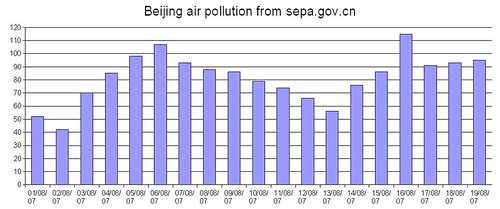
BizChina (CCTV 9) states that "air quality has improved dramatically over the past three days" apparently, the particulate count dropped from 116 (ppm?) on Thursday to 90 yesterday
Well, I thought that this statement needed a little context, so I have created a graph from the month of August, up until yesterday to see what a dramatic effect the removal of so many cars from Beijing's roads has really had. The data is taken from sepa.gov.cn where you can freely look at the countries pollution levels. I've created a graph from Beijing's recent data to see what the announcement really means. The cars were removed from the roads in the last four days of the graph. The sudden drop from 115 to around 90 (similar, as far as I can tell, to the other changes throughout the month) is the result of the cars, or so we're told. I'm sure there's more to it than that, but this sounds like statistics being used without any context behind them.
For more context on the pollution index, take a look at this, though China's own pollution index is not exactly the same as this one, they seem very similar.
Apologies for the hastily created graphics, I'm in the midsts of calculations as I type.
Anybody who has kept up with these travel adventures will understand how pleased I am to hear that Kabuki is coming to Beijing. Just for two days in September, but if you are in the city and want to see a Japanese art form, which is certainly the most spectacularly beautiful stage art I have ever seen, then buy yourself some tickets.
See here and here for my previous encounters with Kabuki in Tokyo.
I just read the sad news that Max Roach died yesterday. Max was one of the most influential jazz drummers of the last century.
Although most seem to claim that Kind of Blue is the best jazz album of all time, I have a definite soft spot for Money Jungle, from Blue Note Records, on which Max created a spectacular album with Charlie Mingus and Duke Ellington.
If you're either a fan of jazz and don't know this great album (I've met several people who passed it off because they figured Duke Ellington was purely big band) or if you haven't heard much, take today to listen to this stunning record. If you know it already, sit back, listen and remember some of the amazing records this guy produced. (M+D, you'll find the album in my collection, do put it on).
Max with Billy Harper, Cecil Bridgewater, Reggie Workman, enjoy.
RIP M.R
Thursday, August 16, 2007
I managed to catch about 3 hours sleep on the train from Wuhan last night, so I'm not very with it today. I've finished a couple of calculations but need to call it a day now. Anything else I do is likely to take even longer to undo.
The workshop in Wuhan was good. Just as the previous quark matter workshops I've spoken at, it's really nice to have an audience who are listening to your lecture because they want to learn and use what you're talking about. The people with a background in RHIC physics are really keen to get in there and use the new tools available to them to study more about the different phases of strongly coupled systems. Of course it's also good to speak with the researchers there and there were a couple over from the States too.
I didn't get to see a great deal of Wuhan this time either. We got to the gate of the famous Yellow Crane Temple but it had shut by the time we got there. I have a rant about Chinese ancient architecture which has been brewing for a while, but I'll save it for a time when I'm rather more awake.
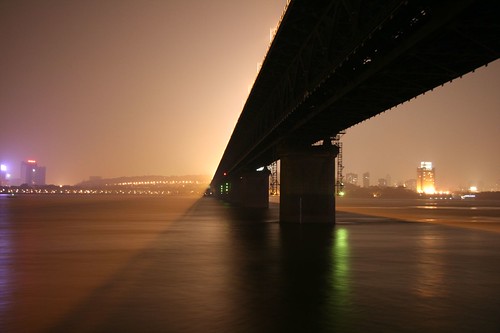
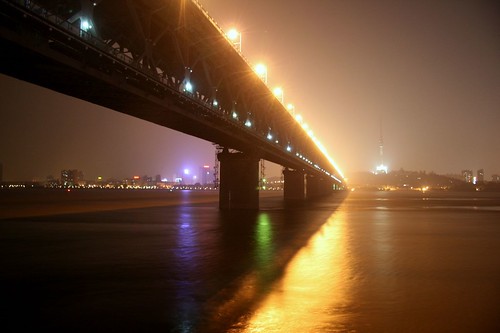
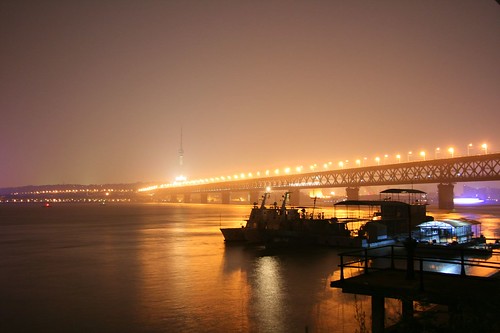
From the closed temple we made our way through a night market, selling all manner of tat, and got to the banks of the Yangtzi river. Wuhan has the first bridge which was built over the Yangtzi, and I managed to get a few photos of the rather pleasing lights and shadows of this impressive piece of 50 year old Russian engineering. I'll leave you with the photos for now and go get some sleep. Larger photos can be seen by clicking on these.
Still in collaboration with Scitalks I'll post my suggestions for introductory level string theory videos. These are lectures for physicists with a grounding in quantum field theory. I count introductory as the most obvious step up from the previous videos which were popular science level.
Most of these courses are just three or four lectures long, so I want to make a request here.
There are many universities, mostly in the US, who run one semester, or even one year courses on string theory (amongst many other interesting topics). If you know somebody who gives a good course on this subject then I would urge you to suggest that the course is videoed next time it's run. It's a waste not to. For those who aren't lucky enough to be at universities who run long term courses in this subject then please try and share this as an open source course. This doesn't just go for string theory, but for all other subjects too. It just so happens that string theory is the current example. I've said this before and I'll probably say it again.
So, find out of your department will allow this, find a willing lecturer, video the course, upload it to your department web server (this may be a lot of material but servers are pretty huge these days) and send the link to Scitalks.
Anyway, here are some of the best introductory materials on string theory that I could find:
Over at Scitalks there are now two sets of lectures at the appropriate level. One by Barton Zwiebach and one by Clifford Johnson. See below for a set of lectures on perturbative string theory from Clifford too.
There’s another series of lectures by W. Lerche here. I have only been able to read the transparencies, which look broad ranging and reasonably detailed. In the cafe I’m in at the moment I can’t download the video. I would imagine it’s good, but couldn’t guarantee anything.
There is a nice colloquium by Shamit Kachru, who is an excellent speaker, talking about string theory and cosmology here:
If you go to this page, and look on the left for ” Summer School: Strings, Gravity & Cosmology” you will find a host of great videos. Unfortunately it’s really difficult to try and view these independently from their special player (you need IE, too!). The lectures on perturbative string theory, again by Clifford Johnson, are probably excellent and just the right level for first year grad students. I just wish I could rip them and watch them at my own comfort and time. I’ve watched a few, but I just don’t like this format of streaming.
Again, what would be perfect at this point would be a full graduate course in the subject available online.
Next week I'll post links to lectures at a more advanced level, mostly in my field.
I'm posting an e-mail that I sent to Lee at Scitalks which was added as a blogpost on the scitalks blog. Sounds a little circuitous, but having written it I wanted to add it here, with the little video I made.
Having mentioned that the video explanation of extra dimensions was in no way accurate, I wanted to add my two cents about extra dimensions and so sent the following message:
------------------
In fact it’s pretty easy to understand higher dimensions from some simple visualisations. The video on Scitalks was fine, up to the fourth dimension, and then things started to get a bit cryptic.
One thing I should mention first is that trying to visualise objects in higher dimensions is good to feel comfortable with what you’re studying. However, sometimes if we try and visualise the things that we are calculating, we may stifle, or bias our calculations. In my opinion it is usually best to become familiar with the mathematics, the purest descriptions of our theory and try to ‘visualise’ in this language rather than trying to use common sense from what we see around us. A good example is quantum mechanics. If we try and visualise what is going on on very small length scales we will quickly tie ourselves in knots and not be able to progress as far as we can by exploring the mathematics of our system. Of course it’s important to be able to translate the mathematics back into what you will actually see in your experiment.
So, given that caveat I will explain how we can build ourselves a hypercube (or at least the frame of a hypercube), the higher dimensional generalisation of a cube.
The way we will do this is to start with less than three dimensions and see what rules we have to follow to go up in dimensions. We will see that we can extrapolate these rules to however many dimensions we want.
Start with a point, a zero dimensional object.
Take this point and turn it into two points. Now pull one of the points apart from the other one, say a distance L away, and join the two points with a piece of elastic. Now you have a line, a one dimensional object.
Now do a similar thing, but this time turn the elastic into two pieces of elastic (on top of each other - now you have four points given by the two ends of the pieces of elastic). Pull the pieces apart in the direction perpendicular to their length. While you’re pulling them apart keep the two ends joined by more elastic which will grow to length L. Now you have a square, something with four edges (pieces of elastic) and four points, or vertices. This object is two dimensional.
Now repeat the process. Take your square and replicate it with another square, on top of the first one. Join the vertices of the two squares with four pieces of elastic which will be stretched in the direction perpendicular to the face of the square. Pull the squares apart to a distance L. Now you have a cube. This object lives in three dimensions. It has six faces, 12 edges and eight vertices.
So, what rule have we developed? We have taken our previous object, replicated it, joined the vertices of the two objects together and pulled them apart in a direction perpendicular to the directions they lie, until the two copies are a distance L apart.
Let’s do that again.
Take your cube and replicate it. Join the vertices of the twin cubes to each other, again by elastic, and pull them apart to a distance L in the direction perpendicular to the direction they are living. There seems to be a problem though, in the last example, the square could live on a piece of paper and you could pull the two squares apart vertically to create the cube, we seem to have run out of directions. We need to pull the two cubes apart in the fourth dimension to a distance L.
Though we can’t really picture this realistically (at least I can’t) we can draw the projection of this onto 2-dimensions, just as easily as we can draw the projection of a cube onto a piece of paper.
When we pulled the one square from the other, we did this in the third dimension, say height, from your paper. So we don’t have another direction to go to pull the cube apart any more. This is where we have to imagine, as best we can, that we take the cube, split it into two and, joining the vertices of one cube with the other pull the two cubes apart to a distance L in the fourth direction, to create an object with 16 vertices and 40 edges. It’s almost as easy to draw the projection of this object onto a two dimensional piece of paper as it is to draw the projection of a three dimensional cube onto a piece of paper.
I've created a short animation of the above construction using Mathematica. We see the projection onto 2-dimensions. When I have time I'll let the objects rotate and slow it down a bit too.
In terms of mathematics, it’s even easier to go to higher dimensions. As an example, we might want to know the length of a line in two dimensions, going from some point (0,0) to (x,y). The length, as we know is the square root of x^2+y^2.
In three dimensions for a line going from (0,0,0) to (x,y,z) the length is the square root of x^2+y^2+z^2.
Well, let’s stop labelling directions as x,y,z etc and label them x_1, x_2, x_3,x_4, etc. (1,2,3,4 are simply labels). Now it’s easier to keep track of them.
Now a line in four dimensions stretching from (0,0,0,0) to (x_1,x_2,x_3,x_4) has a length of the square root of (x_1)^2+(x_2)^2+(x_3)^2+(x_4)^2.
Well, if you can work out the 2-dimensional example, I would suggest that it’s pretty easy to calculate the 4, 10, or any dimensional example. Imagining it isn’t easy, but as long as you have a mathematical handle on the objects that are living in your higher dimensional theory, you should be doing fine.
I would suggest having a read of Flatland, a romance in many directions - not for it’s political correctness, but for an idea of how things would be if we didn’t live in 3 dimensions. Chapter 16 is particularly relevant.
A ten hour train ride, four hours juddery sleep, a stationary traffic jam and a definite lack of coffee has seen me safely, if tired from Beijing to Wuhan where I will be talking in a couple of hours. Wuhan is at 32 degrees and climbing fast so we're all inside, trying to cope with the high strength air-con. No videos from this workshop, but Scitalks continues to add to the now impressive catalogue. I'll report back when I have more eyelid strength and another talk finished off.
This evening I'll head off on a ten hour train ride to Wuhan, capital of Hubei province, famous for being one of the four furnaces of China and also for having some excellent spicy duck's neck (superb as a snack with a cold beer). There is more to Wuhan than this, though last time I spent more time on the plane and road getting to and from the university than actually seeing it or any of the researchers.
This time I'm staying for a three day workshop on quark matter and again presenting on QCD from the AdS/CFT correspondence. I hope to see a bit of the city as well as discussing with some excellent researchers, both from China and the US, who will be at the workshop.
I spent most of yesterday stuffing myself in the all you can drink for 18 kuai (a little more than a pound) cafe near my flat while working on a current project and getting my talk for tomorrow polished off. I do find the buzz of a cafe inherently conducive to good work and almost without fail have more breakthroughs in these relatively noisy places than in the rather sterile environment of my office.
After spending all day in the cafe, a few of us headed over to Sanlitun in the East of the city, went to Kokomo (up on the roof of one of the taller buildings in the area), ordered a beer, sat back and watched for the Perseids. A strange sight for the others in the bar perhaps but we wanted to take advantage of the fact that Beijing is pretty cloudless at the moment (I speak a little too soon, I fear) due to last week's artificially induced storms and reduced traffic. We saw a few throughout the night, coming from the East, though you really need to be up in the early hours of the morning to catch the height of the showers, as the part of the Earth you are on is travelling towards the patch of dust and rock.
Anyway, for now I'll leave some photos from last weekend, when I took a good friend for a birthday meal at Haiku, one of Beijing's top Japanese restaurants. Well worth a trip for the atmosphere and service. The food is good but sadly by my sushi standards which have been permanently affected by my stay in Tokyo, the food was excellent but not mind blowing.
The first photo is of the Beijing national gallery, currently housing an exhibition of works from the Prado. An excellent collection from Titian to Goya, with lots in between. Well worth a trip (though check online if it's still on). We went there in the afternoon before going for dinner. I attempted to get a good view of the new, amazing structure which will be the CCTV headquarters. These two, leaning towers which will meet in a tangle at the top should be great for photographing, but from our position we could only get a hint of them. and some photos from Haiku: OK, got to go finish getting ready for the train ride ahead.
A good number of string theory videos are appearing on Scitalks now. I've given long lists of videos and there are many still to be put up on the site. There are now many good movies from Clifford Johnson and Barton Zweibach at the introductory level and lots more advanced talks by Ashoke Sen, Matthew Strassler and others.
For the pop science level I think that Brian Greene's video series The Elegant Universe was excellent, and the book is also superb. It's what got many undergrads, including myself, interested in the subject.
From Strings 2005 the talks by Robert Dijkgraaf and Leonard Susskind are good presentations to the general public on a variety of stringy issues.
Some nice lectures by David Gross on a fundamental theory of reality. Parts I, II and III.
Soon I will be discussing slightly more advanced videos for which at least a degree in physics is expected.
I should note that not all of these videos are up on the Scitalks site yet. When they are I urge you to contribute, first in the initial stages of this site where you can vote for a video, but secondly when the tagging and social networking aspects of the site come online later in the year.
(I can't claim to have seen all of the above movies completely, I have seen some of them in their completeness and others I have watched samples from different sections to see that they are appropriate for this level. They are also all from very well known researchers in string theory. If people find problems with the videos then either tell me, or get in contact with the people at Scitalks).