Showing posts with label photography. Show all posts

Monday, August 27, 2012

Of air and water and light - solar halos over China

My flight to Japan was a remarkably comfortable one. Last week saw me in the sky for over 70 hours and thoughts of DVT played heavy on my mind as I got ready for the last leg of a rather mammoth few days. Days that I would however repeat, travel included, given the chance. Thankfully on changing at Amsterdam airport the ground staff took pity on my grizzled face and booked me into a seat with two spares next to it so I could finally stretch out.

I managed a couple of hours sleep on the 11 hour journey which is not a bad proportion for me, given that I normally manage none at all. After a recent flight where, on asking for a whiskey, I was presented with a good half pint of the stuff, I have been staying away from alcohol on flights. The whiskey did knock me out, but it also gave me a horrendous hangover for the waking hours of the journey.

Anyway, I was up to watch the sunrise over China and managed to see the faintest of green flashes, though sadly didn't get it on camera this time.

Later on in the flight however as we neared Japan the air at 30,000+ ft became filled with ice clouds and the interplay of light and ice made for a truly spectacular display.

The conditions were very interesting. Around the plane was a thin layer of cirrus clouds, with a high density of ice crystals, and below us where much thicker clouds, also packed full of ice crystals, many of them plate-like. Plate-like hexagonal ice crystals like to lie flat in the sky and act like mirrors to the sun. These are the crystals that cause sun pillars:
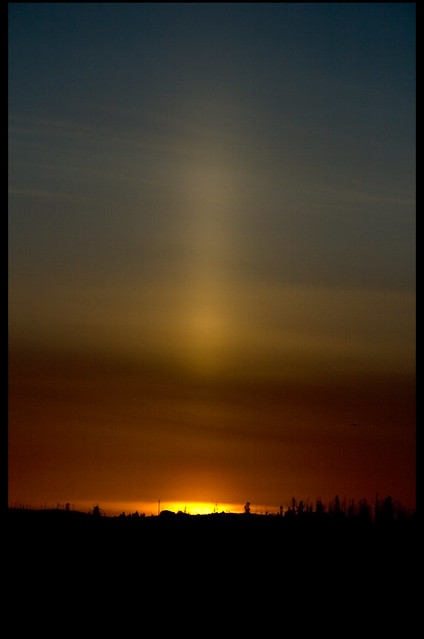
ice pillar
and sub-suns (the reflection of the sun off ice crystals in the clouds below):
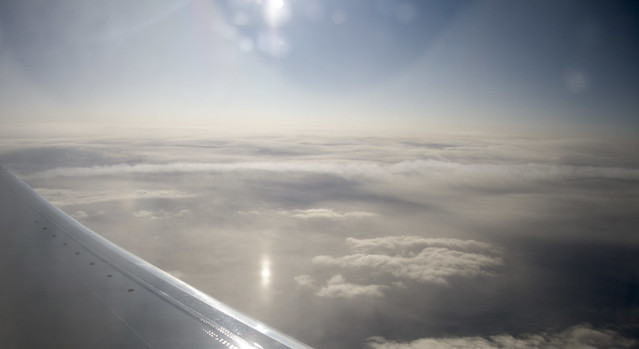
halo and subsun from a plane
This time however the display was a lot more complex. The column crystals in the clouds around us caused a 22 degree halo while the plate crystals gave a faint sundog (also known as a parhelion). In the thick clouds below however things got more interesting. The plate crystals below gave an effect that I'd never seen before. Not only did the light refract as it was passing through the sides of the crystals, but it also bounced off the bottom face, and back up, acting like a mirror to give a so called subparhelion. Moreover, because of the high density of crystals in the lower layers there was a strong 46 degree halo coming from a rather rare dynamic of light through the end of column crystals. It seems that this may not have been photographed before.

Here is the almost undoctored photo:
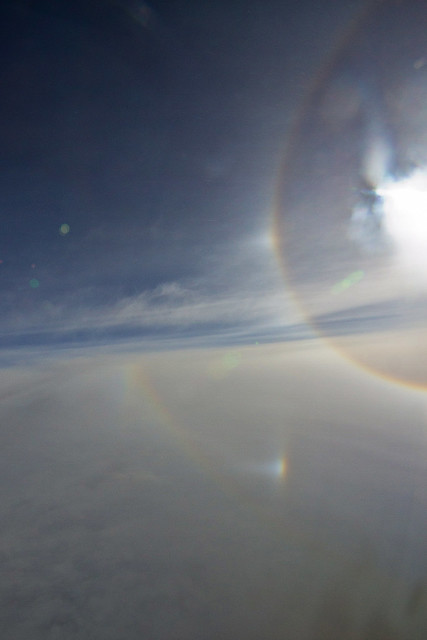
sundog of subsun and Lowitz arcs with supralateral arc
and here is a rather more doctored one just to enhance the effect to see the different arcs more clearly:
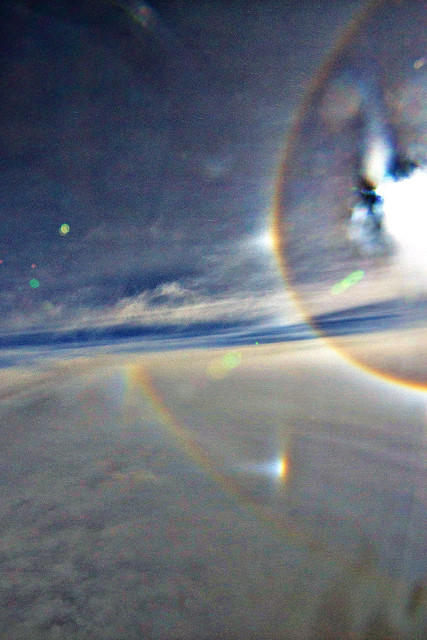
sundog of subsun and Lowitz arcs with supralateral arc


The reason that the circle around the sun is so distorted is because it's from the edge of a very wide-angle lens (Sigma 10-20mm at 10mm).

I sent this through to Les at Atopics who has been my source of knowledge and inspiration in the subject over the last few years and he sent me back a ray-trace computer simulation of what was going on. This is the simulation of the particular conditions so you can compare with the images above (click to view the full image):

The 46 degree arc in the clouds below seems to be an extremely rare event and the infralateral arc is also something rather special. All in all one of the best halo displays I've ever seen.

I've seen halo displays a few dozen times when flying now. Take some sunglasses with you, look out the plane and see if you can spot them next time...they're are there to be marveled at.

Now in Japan for the next 3 weeks. 2 weeks at a machine learning summer school and then a few days at the Yukawa institute where I will be giving a talk and hopefully chatting with some of the experts on entanglement entropy in holography. There are some ideas I need to talk with them about...


Tuesday, May 15, 2012

The meal of a lifetime at NOMA

Things are beginning to slow down, with a couple of the major Coursera courses coming to an end. I will write up a post when possible about the Natural Language Processing course which has been spectacularly well taught/paced and executed in just about every way.

I've been wanting to write up a post also about my trip to Denmark a week or so ago, on a gastronomic pilgrimage which lead us to the best restaurant in the world (whatever that means). A trip three years or so in the making, with all the possibilities for dire disappointment, but eventually a trip which was with out a doubt the highlight of my life's food experiences so far. Much of this may seem a little Emperor's new clothes, but to be honest I don't mind. If 90% of the enjoyment was in my head, rather than in the tastes themselves, then fine, that still resulted in a great deal of enjoyment.

Noma was the destination, and being my first time in Denmark I planned on making a few days of the trip. We had booked the table at the beginning of the year, having tried and failed for the last 3 years, ever since it took El Bulli's place at the top spot of the gastronomic hierarchy.

I was lucky enough to have hosted a very friendly Dane through Couchsurfing when I was living in Spain and this gave me the perfect chance to crash his place. This worked out fantastically as well as it gave me, as couchsurfing always does, a view of the city which I almost certainly wouldn't have seen had I stayed in a hostel.

Having returned from South Africa to a very sunny Munich, the weather continued to follow me and the first day in Copenhagen was a spectacular 25 degrees. We spent the afternoon sightseeing and sitting with a drink in Christiania, catching up on the last couple of years of our lives and watching the world go by.

Konrad, who had booked the table, turned up on the Wednesday evening and we went for dinner and a drink in the centre, sampling Copenhagen's only CAMRA rated pub where the price of the pints was as much the cause of weakened knees as the strength. Retiring after a couple of pints we cycled back through the city at night, ready for the feast which was to come the next day.

Booked for lunch at one, Konrad, his friend and I headed at a leisurely pace through the city (having warmed up our stomachs with a fine breakfast), still in full spring haze to the North Atlantic House, the ground floor of which houses NOMA, done up in relatively unpretentious decor

The second you step through the door you are made to feel special. You forget about the fact that the place itself is special, but the waiters are immediately interested in you, asking questions and making you feel like you've just met a best friend of a best friend.

They introduce the concept of the restaurant: Nordic inspired cuisine, with Nordic ingredients in highly seasonal, frequently unusual combinations. This is not another El Bulli, where the food was all about the processes - a lot of incredible molecular gastronomy, but is really about the freshness and purity of flavours and the subtlety of their combinations.

I know very little about music and I wouldn't claim to know all that much about food, but, at a piano concert a few years ago, a friend who really does know a great deal about music told me that the brilliance of the particular performance was not about getting the notes in the right order, or at the right time, but was about the subtlety and exactness of the strength of those notes.

In the same way, at NOMA you are not going to be blown away by whizzes and bangs in your mouth, there is not the satisfaction of a great steak or burger, or the sugar and fat buzz of a tiramisu that may satisfy for a few moments, but there is an incredible harmony of flavours that are so finely woven together that one follows another follows another, each one creeping up as the other fades, just as the notes of a brilliant piece of music follow in perfectly weighted succession.

For me the pinnacle of this melody was a dish of scallops, sepia ink and biodynamic grains in a pea puree. The sepia ink gives a background platform which carries the first hit of the scallops, which have been processed for around a day, purifying their flavour and turning them almost into caramel wafers, and finds its way into your mouth before the scallop is even there. The flavour of the scallop slowly fades as your mouth habituates to it, at which point the grains and puree are building to a head and take over, the chemical similarities between the scallops and peas allowing this to happen seamlessly:
Dried scallops and beech nuts, biodynamic grains and watercress

The very first dish was actually sitting on the table when we arrived, in the form of malted bread sticks, hidden within the flower pot and dusted with juniper (these are in the back, the strange rather furry looking things sticking through the foliage).
Malt flatbread and juniper
Along with the 23 courses came 9 incredible wines, all white, bar one rosé, all from Europe and there were some outstanding pairings with the meal, including a wine which was almost calvados in its depth.

After almost 4 hours we were left wonderfully satisfied, slightly drunk and enormously happy. Konrad and I went to a bar after this and sat in the sun, giggling like little kids about individual bites, about surprise flavours and about the experience as a whole, sipping a cold beer and lapping up the waves of emotion.

The day continued in much the same vein until around 6 o'clock the next morning, when I returned exhausted to collapse asleep for a few hours before having a very easy day the next day.

I shall simply leave you here with a slideshow of the meal. It is an expensive meal, but I can say that for anyone who loves food experiences, this is truly one of the greats, and for me, as a once every few years extravagance, I am willing to forgo a long holiday for a journey like this.
 
I should also add as an important postscipt, that I was hugely taken by Copenhagen and by the Danes in general. I would certainly love to return some time and spent a bit more time exploring that part of the world.

Tuesday, May 01, 2012

An attempt at a Cape Town catch up

Time simply doesn't allow to do all things I want to do, and to write about them. As of the last post my life has been taken over by the online courses I mentioned, and this means working till 2 most mornings to get through the material while having a normal time in the department during the day. I wrote the following when waiting for my plane in Cape Town, and while it's by no means a polished blog post, I want to post it before I disappear again tomorrow morning for Copenhagen. The next 3 days are part of an absurd trip which has been in the planning for several years and will come to its climactic conclusion on Thursday with lunch at NOMA.

-----------

I find myself once again sat in a cafe, in an airport, waiting for another 12+ hours of plane flights. This time I'm in Cape Town, waiting to go via Johannesburg back to Munich. Another overnight flight, another night of watching others loll in and out of sleep as I wander the aisles trying to get tired enough to ignore the discomfort of folding my frame into a spasm-inducing gap.

Anyway, the above sounds a bit negative perhaps and the rest of the post, I hope will not be. I've met enough interesting people on flights now to know that flights have the possibility to be as enjoyable as they are ghastly.

I've spent the last three weeks in Cape Town, my second time here, and each extra day I spend here makes me realise even more what a wonderful place it is. Scenically it is almost unrivalled for a city. With the sea surrounding it and the mountain defining its geography, you are never away from a spectacular view. I've been for a couple of sundowners (a phrase I'd not heard before but means, unsurprisingly, drinks drunk during sunset, generally with a majestic view to accompany them) which have been wonderful evening highlights, a time to really sit back and appreciate.


The city itself is made up of an incredible diversity of populations and cultures, the mixing of which is often not present but always available. I've met some incredible people here, in taxis, in shops, in cafes, from refugees of Rwanda to ex-militants who fought in Umkhonto we Sizwe, the spear of the nation, the group that was the force behind the ANC when talks and peaceful action only managed to tighten the grip of Apartheid. Everyone here seems to have a story to tell and I've met so many people who are actively pushing to make the situation better. In many ways South Africa has come a long way since Apartheid, but in others it has gotten nowhere. There are many embarrassments of the current social and political situation but there are people out there who are really trying to make a difference in a non political context. One of the taxi drivers I met also worked as a coast guard guarding the local ecology from abalone poachers, who often come armed with guns during the night. This is a man who puts himself in a place of enormous danger because he cares - lessons to take from this, for sure.

I am in no way qualified to make judgement calls on the current situation but I can recommend these books that I've read over the last couple of years to give some picture of South Africa's history and recent developments. Sadly time does not allow for in depth reviews of any of them but I can say that from the point of view of someone who knew very little about Africa or its politics, these are great starters (Thanks to Ben for all of these recommendations):

The State of Africa - a history of the states of Africa since independence
Country of my skull - a journalist's eye view of the truth and reconciliation commission
My traitor's heart - a white man with a difficult family pedigree coming to terms with his place in Africa
The shackled continent (don't read this without reading The State of Africa as it will give you a terribly biased view) - a view of why things have not improved since independence. As I say, this does not give anywhere near the whole story and for the reason behind these reasons you have to read more.
Long walk to Freedom - Mandela's pre-freedom autobiography.
The autobiography of Ghandi also gives some very interesting insights into the relatively recent history of South Africa.

The trip has been as eclectic a mix as the city is and I've been both giving seminars as well as starting some collaborations with the string theory group. I gave my atmospheric optics talk to the undergraduates which is always a pleasure, though I still struggle at times not to include too much material in this talk. After this I gave a series of lectures on a particular method of machine learning as applied to neuroscience. This was my first time lecturing on a non-physics subject and it was a great experience. The subject is fascinating and thankfully there were a huge number of questions which I find always make a lecture course a lot more enjoyable. It also makes me, the lecturer, understand the topic much better when you have a lot of intelligent people giving you questions that perhaps you would never have considered.

Some light photo relief:
 The outrageously beautiful University of Cape Town campus
Ivydene guest house, where I would sit and work at the weekends under the tree with the dogs and cats resting in the garden. This is without a doubt my favourite guest house having stayed at many over the last decade or so. Lucille, who runs it is absolutely fascinating and introduced me to a slew of amazing people while I was there. Her daughter Jackie and son-in-law Rob also make the place feel like family.

And finally I gave a couple of talks about one of my last string theory papers which again was a lot of fun. The group ranges from those working in emergent geometry (how space and time can emerge from some other theory which don't include space and time as input) to AdS/QGP - how we can use string theory as a tool to understand the internal constituents of the nucleus in particular conditions. It's always good to have a diverse audience like this because, again, you get a great range of questions, from the abstract to the very practical. The outcome of this was some really nice ideas for future investigations which I hope to continue remotely.

and apart from a little socialising my life has been almost entirely overtaken with the online courses that I discussed in the previous posts. As an information addict these are truly fatal. How can I turn down a perfectly good course on automata theory given by a world expert, even if it means sleeping a few hours less a week.

The first round of courses on computer science finished a couple of weeks back which I can highly recommend, CS101 for those without much experience in programming and CS373 for the more advanced and those who may be interested in control theory and dynamical programming.

The course on natural language processing (NLP) is now over half way through and is the best taught and most instructive from the point of view of programming assignments and problem sets, of the Coursera courses I've been taking. Right now I'm struggling, along with most of the rest of the class to write our own English language parser (how do you write a computer program which can work out the logical structure of a sentence - ie. which nouns do which verbs and prepositions relate to - in the sentence "fish people fish tanks" does the word people correspond to a verb or a noun - does the second 'fish' correspond to a very or a noun, etc. These are the sorts of question that an automatic parser would try to answer in a probabilistic fashion (ie. it will find various ways to break down a sentence and give probabilities for each possibility)).

The NLP course also ties in very nicely with material in the automata course and the programming languages course from Udacity. The link being finite state machines and Markov networks.

Probabilistic Graphical Models is also very good, but it really does need 10-15 hours a week to truly understand the material. This is a large investment and something that I will probably split over two runs through the material.

In other news, the publication I was working on about Malaria has now been accepted for publication which is great to have finished. More work is ahead on this front and there are some very exciting possibilities in the pipeline. Through the same link that gave me the Malaria connection (many thanks Victor!) we've started also on another investigation into an area called medical ethnography - a subject whose existence I was unaware of until I dove into some data analysis on a related project. This area is related to the interaction between society, ethnological behaviour and medical practice and is so far very interesting to work on.

So, with the above I have very little time for a normal life right now. I work until late at night including at weekends on these projects and courses, which is great in terms of learning and in terms of the excitement of pursuing new areas of investigation but I am aware that this is not a sustainable pace. I am also aware that I am out of a job in 7 months and am desperately trying to mold a future which will be interesting, sustainable, economically viable and will allow for some constancy in my life. Most of these factors are falling into place, it's just the small matter of economics which may be the biggest hurdle. It's easy to find people with whom I can work on interesting projects, it's not so easy to get them to pay me for it. The thinking cap is on and I have a few ideas as to how to construct this Rube-Goldberg machine of a life out of gaffer tape and fuzzy felt.

Saturday, November 05, 2011

Solar halos and autumn leaves

The weather is getting colder and the skies these days are filled with cirrus clouds - perfect for ice halo displays. Especially now that the density is low, the patterns can change by the minute and you never know what's going to show up next.

I took a couple of photos flying over Poland a few weeks back and haven't had a chance to put them up until now. These are parhelic circles, and I've only seen these once before. If you're lucky they can wrap the whole sky, with a number of special nodes like these. Anyway, these were the shots I got from the plane, as we descended through the lower layers of cloud.


I went out for a photography session a few days ago in the English garden and as I was heading out I spotted the tail-end of a circumzenithal arc, like an upside-down rainbow wrapping the zenith. This soon disappeared, but as the sun set further a couple of strong sundogs appeared. Walking around with the fantastic colours of the leaves, I headed to the lake in the hope of seeing a reflection of the sun and sundogs and was not disappointed:
sundog reflection

sundog reflection

and a close up:
Reflection of a sundog

sun dog

Heading back to the English garden with friends and colleagues yesterday afternoon the light was perfect and I got a few nice Autumnal shots:
leaves and path in the English garden

reflection in the English garden

late afternoon autumn light

Autumn explosion
I'd love to head back there at night to take some reflection shots in the moonlight, but I'm not sure that I'm going to have time in the coming days. Busy times...

Sunday, October 30, 2011

Cycling Highway 1 - last day of the Steinbeck pilgrimage

I'd been told many times that Big Sur was unmissable and I definitely wanted to visit it as I was already so close. As I wasn't driving in the US I was left with two options. The first was to catch a bus, or more accurately busses down the coast but this was going to take several hours and a number of changes and so, in the end it didn't seem worthwhile. The second option was to cycle along the historic Highway 1. I'd spoken with the guy at the front desk in the hostel who told me that it was a pretty easy ride, perhaps 20km or so in total. I haven't cycled much over the last few years but this sounded like a nice day out, so I headed out in the morning and took the bus to Carmel to start the ride. It took me an hour of walking around to find the bike rental store, as US towns are not built for pedestrians, but eventually I left, with my newly rented bike and my bag full of camera gear. I asked the guy in the shop for confirmation of the length of the ride and was a little surprised when he told me that it was more like an 80 km round trip, but up for a challenge it seemed like it was going to be a fun day.

I headed out into the cold ocean fog and felt fantastic cruising the roads down onto the coast, blood pumping and me quickly warming up even without much sunshine on me (though given the state of my sunburn this was a good thing).

Highway 1 wends up and down the hills of the coastline, rising up into the fog and down to sea level every few kilometers. Sadly the fog was too strong most of the time to make photography very worthwhile but I got one shot of the famous Buxby Bridge, which, with its lack of high sides and strong winds made cycling across it a rather sketchy experience

Bixby bridge

The rucksack with my Canon 7D and four lenses was pretty heavy and as I got closer and closer to Big Sur it quickly got painful and I had to stop every ten kilometers or so to stretch the muscles in my back which were beginning to spasm with the constant exersion. Along the way there are a few reasonably big hills and one enormous beast which just keeps going on and on. The main problem though is that there's almost nowhere along the route which is flat:

EDIT: Somehow I just lost the rest of this blogpost. I'll start again...


Anyway, the hill in the middle of the ride was hard on the way to Big Sur, and truly horrendous on the way back. It took me two and a half hours or so to get to Big Sur and by this time I was already exhausted and my back was in almost constant spasm. With the wind blowing North to South I was rather worried about the route back, and indeed after a quick lunch and a stretch I was back on the bike, and even on the relatively flat start I struggled with the incoming wind. I was worried that the big hill in the middle was going to finish me off and I pondered about how easy it would be to flag down a ride if I was really struggling.

Thankfully I managed to push through and didn't stop on the ride up the middle hill, but instead took my mind off the pain by counting down from 100 over and over again through each peddle stroke. The ride the other side was fantastic, though my back was giving me such big pains by this point that nothing was terribly enjoyable.

I should note that despite all the complaining above the ride was spectacular, and it has often been said to be one of the most picturesque routes in the US. I have to say though that I've done similarly spectacular rides in England, Scotland and Wales and would recommend anyone taking a ride along the Cornish coastline, or the Northernmost reachest of Scotland to see similarly breathtaking views.

Six hours after starting out I found myself back in the bike shop and still had another hour's walk plus the bus ride to get back to the hostel. I spent as much time stretching my upper back as possible, but the spasms by this point had turned to a monotonous tension that wouldn't go away. Before crashing into bed I guzzled up two burgers, a huge milkshake and a big bowl of clam chowder. By 8 in the evening I was in bed, and soon after had passed out completely.

The next morning I woke up expecting to be in agony, but in fact was feeling fine, though with a general feeling of muscle fatigue. My back on the other hand had turned from pain to complete numbness and I had no feeling at all in the upper left part of my back. I worried that I'd done myself some spinal damage, the rucksack somehow pressing into a vertebrae and it wasn't until I could see a doctor in Munich a few days later that I was told that it was probably just local nerve damage from the pain in the muscles and that it should be fine in a matter of a couple of months. One month later the feeling is slowly coming back and all should be fine again in a few weeks. Yet another tick for Jon's stupidity when it comes to pushing myself!

The morning after the ride I was due to head back to San Francisco and had put up a note in the hostel asking for a rideshare. A guy was heading to SF airport and offered to give me a lift there. He had been living on the East coast of the US for 30+ years but had origininally been born and raised in Steinbeck's hometown of Salinas. He asked me, very apologetically if I wouldn't mind if we took a quick nostaligic tour through his old haunts. On the contrary I assured him, it was about as much as I could have hoped for to have a personal tour of the town I'd read so much about. It was frankly the best hour of the whole time in the Monterey area and I couldn't have asked for a more perfect Steinbeckian tale to end the journey.

We went back to the old streets of his childhood, 40 or so years previously, and he recounted tales of his schooldays, and of getting in trouble in the surrounding hills and valleys, of local misfits and life in the factory for his father - in fact the same factory that Steinbeck worked for some time - the local Spreckels Sugar Beet processing plant. He told me about historic brawls and of the two Mexican kids in his class, of what has come of his old school friends and of how things had changed in the intervening years.

The dry hillsides surrounding Salinas and the gently rolling hills fulfilled every image I'd had of this part of the world, and frankly no biography or local history book could have given me more of a taste of where his stories had come from. We finally stopped off for half an hour at the National Steinbeck Centre which is well worth a visit if you're in the area and are a fan of his writing.

Anyway, I made it back to San Francisco and the next few days were a relaxed last Californian breather before heading back to Europe. I went to see friends in Palo Alto and spent time hanging out with my good friend Alex and his daughter Sahtah before diving headlong into work.

Since I arrived back in Munich a month ago I've been for one week in central Germany with a collaboration, a few days in Poland in both Warsaw and Krakow at a Marie Curie conference and giving a talk, and then, after five days back in Munich, I was in Beijing for two weeks giving a half a dozen talks and starting a new collaboration with a soon-to-be office mate in Munich. I'll try and update these stories in the coming week, though right now it looks like just about every minute is taken up with projects of various kinds.

To be continued...

Monterey - a Steinbeck pilgrimage - day 2

So, we're still in Monterey and taking in the sights and sounds of a town I've imagined going to for 15 years. Having walked the boardwalks and taken in the lingering smells from Cannery Row's history I was ready to do some more exploring.

I spent the morning back in the aquarium which has enough to keep anyone occupied for a good few hours. The current highlight is the 4ft great white shark in the main tank and there's a constant crowd watching to catch a glimpse as it slowing glides around the enormous tank. The tank includes sun fish, hammer head sharks, tuna and a miscellany of other smaller fish.

As an aside, somebody sent me the following video when we talked about the speed of fish. Watch until the end, I can just about guarantee astonishment:


Anyway, given the low light levels in the aquarium I was having trouble getting sharp shots of the fish through the glass and so went for a long exposure, atmosphere picture, rather than something super sharp. The neon light shining through the water gave a lovely tinge to the fish trails and so I took a few shots of the crowds watching over a 20 second exposure:

aquarium
The fog was still hanging over the bay at this time which made for some fantastically surreal scenes, looking out from the jetties at Cannery Row:
ocean fog
That afternoon I had no plans and so headed out on one of the whale watching boats to try my luck. Although the time of year is good for whale watching, there hadn't been much success that morning and so we were warned that we may not see anything. Our guide, a hugely enthusiastic woman transmitted her love for all things maritime with shouts and whoops of laughter along with a good dose of fascinating information about whale migratory patterns, the topography of Monterey bay, and the scientific research she does into a variety of cetaceans.

Our first find was a sun fish which came to eye us warily. These fish (also called Mola Mola) can grow to up to 2 tonnes and be 4 meters across . The one we came across was only a baby, at perhaps a meter or so across and quickly tired of our photo taking and took off. Shortly after we found a seal, hiding in some kelp, disguising itself from hungry killerwhales:
hiding seal

We carried on for another hour or so without any luck. We were about ready to head back when a scream from our guide told us that something had been spotted and we raced off out into the ocean to see what it was. Before any of us could see anything at all she was screaming excitedly that it was a humpbacked whale and indeed our first sight of it was the burst of vapour from its blowhole. For 20 minutes or so we watched as it came up for air and then dived down for a couple of minutes before we had to search around to work out where it would next surface.
humpback whale

The whale only breached once while we were watching it, and sadly with the zoom lens I didn't manage to find it, focus and take the picture before it was gone, but it was a truly beautiful thing to see the tail come out of the water and slip silently down. The highlight for our guide was that the wind direction was right to send the plume of vapour our way on one breath and so we were, for a few seconds, surrounded by the stench of whale breath. This is certainly not one of the experiences I'd expected from the California trip.

Another highlight and perhaps for me a bigger surprise was the sighting of a black-footed albatross. These mythical birds have always held a fascination for me since I read at a young age that they could grow up to 10ft across. The occupants of the other boat which came out to see the whale when we radioed the surrounding tour groups, seemed to miss the albatross, but I got a nice shot as it sailed by their boat.

Albatross

After all the excitement we headed back inland and I made my way to the hostel that I was going to stay in for the next couple of days. Getting into the hostel was a great disappointment frankly. Though it was a beautiful hostel, things have changed hugely from a decade ago when I was  frequently staying in hostels. It used to be that you'd arrive in a hostel and there would be people from all around the world, sharing stories and making new friendships. Arriving into the hostel in Monterey (and I understand that this phenomenon is now largely universal) I found a half a dozen people sat silently, each one of them plugged into a computer somehow, talking on facebook, typing on skype, reading the news, but not a single person interacting with anyone else.

This seems like a really sad state of affairs but rather inevitable as we become more and more used to having our lives split between the real and the virtual world. This is precisely the reason that I don't have the internet at home (or at least not easily accessible). When I have couchsurfers, or friends around, it's all too easy to get sidetracked from real interactions by the internet and I much prefer to make it as hard as possible to get online when I'm at home. I have neither TV nor wifi at home and so spend a lot more time talking, cooking, reading and generally feeling like I'm interacting physically rather than virtually with the world around me. This isn't to say that I shun such things - it's pretty clear that I don't, but I make a big effort to leave parts of my life where these forms are less pervasive.

I stayed in the hostel for three nights in the end and met three interesting people in that time. Back in the day it would have been a constant stream of interesting meetings, but now I felt like i was being intrusive if I tried to start a conversation with someone who was plugged in, so I sat and read my book in the evenings while everyone else typed away.

Anyway, next comes a mammoth adventure on highway 1 but I'll leave that for the next post.

Sunday, September 25, 2011

San Francisco Green Flash

This was half written a week or so ago but things have been far too busy to post it until today. I'm now in Warsaw, getting ready for a three day Marie Skłodowska event. I took a stroll around the city this morning and caught up on some papers in a cafe before coming back to get ready for the events which start this afternoon. Anyway, here is the finished post from last week:

-----------

A non-stop week, but I've ducked out of a dinner tonight to catch up on emails which I haven't had a chance to go through for a few days, and to update a few details from the SF trip.

The first few days of the holiday were spent in San Francisco, relaxing and reading in cafes and working out what the next days should hold. I'd been to San Francisco a few times before, the previous two for work at SLAC and hadn't had much chance to explore the city so this was a good, relaxed few days taking in the atmosphere.

I headed out to the piers to find the Golden Gate Bridge, only to remember that it couldn't be seen from there. The fishermen there made for some good compositions though so I took advantage of the contrasts and spent some time chatting with the Chinese fishermen.
fishermen in San Francisco
I did at least manage to get the bay bridge:
fishing rods over the bay bridge
In fact by far the most exciting photo opportunity for me came towards the end of the first week, when I was couchsurfing in Ocean Beach, an area that I'd never explored previously. It turned out to have a completely different atmosphere from the rest of SF that I know and it's even more laid back than the rest of what is known to be a pretty chilled place. The weather was perfect and I'd scouted out the line on the beach previously from where I was hoping to catch the sunset. I headed there with my couchsurfing host and sat on top of a sand dune watching the sun descend. The sky was clear, but the convection currents of rising warm air made for layers in the sky above the ocean of more and less dense air. These different layers, called temperature inversions because the temperature does not go linearly down with altitude, cause the sun's rays to be refracted in complex ways and force the otherwise circular image to be distorted as it sets. These are the perfect conditions for green flash sunsets. Before it had gotten into its final stages of descent a flock of birds flew past, signalling the beginning of what was to be an exciting atmospheric optics session:
sunset and bird formation
As the sun set further, the distortions grew stronger and, because of the uneven nature of the temperature inversions, you can get some strange, lop-sided images:
sunset distortion
The green and red light from the sun naturally get refracted by different amounts as they travel through the atmosphere and the temperature inversion layers act to magnify the effect. As the top of the sun passed through the boundary between two layers the green light was momentarily magnified and caused a brief mock-mirage green flash:
green flash sunset
As it set further the lower reaches of the sun can appear to be pulled from the rest and you see a strange, hugely distorted second image of the sun on the horizon. Really this is a mirage of the sun above. Another disconnection in this one had also appeared above the sun:
sunset
Further down and more distortion, with hints of green around the upper limb of the sun, birds accompanying the shot:
sunset with hints of green flash
By a lovely coincidence the one boat that was on the horizon, also enhanced by a mirage effect was exactly in the setting sun's path
sunset distortion
and stayed there until the sun made its final warped movements:
sunset and ship
I took around 50 photos during the sunset, and the above, to me were the most interesting. I've seen perhaps five or six green flash sunsets now and every one has been completely different. As I tell people regularly, these effects are not rare, you just have to know when and where to look. On that note, of course one has to be extremely careful and even at its lowest level I will only ever glance in the direction of the sun momentarily and never stare through the viewfinder. This is the perfect time to use liveview on the camera, but one has to be very careful not to damage the lens or sensor of the camera. The best hint I think is that if you are going to try and take these sorts of photos, only let the camera focus there for the briefest time possible. For more information, as always, go to the fantastic Atmospheric Optics website.


Anyway, from San Francisco I went on a three day trip to Yosemite, but these stories and pictures will have to wait...

Monday, August 15, 2011

Berlin by bike

So, we finally got our paper out last week, after a huge amount of discussion, confusion and a few months of calculations and so I treated myself to a long weekend...

I arrived back in Munich yesterday evening from a few days in Berlin seeing a couple of good friends from Santiago days (Konrad and Merlinda, with whom I traveled to South Africa and Mozambique as well as Beijing last year). I arrived home yesterday at about 6 in the evening and quickly cleaned up the remaining mess from Wednesday night's Korean dinner I'd cooked for 8 friends (from Korea, China, Taiwan, Bolivia and Germany). I'll add some details about the Korean meal soon I hope when I get a few photos through, but for now I'll just note that Maangchi saved the day with her amazing videos! Samgyetang was one of the new dishes I tried:


Having not had much more than a half hour's sleep in Berlin on Saturday night (details also to follow) I was in a pretty dazed state but had to pull myself together as I had five guests arriving last night - all couchsurfers. I restarted hosting in Munich a few weeks ago and things have been pretty hectic on that front. Last night the new arrivals were a Finnish woman and her son plus three Swedes who had been in Munich for the European Juggling Convention - something I would have loved to have joined had I been in the city. They were all pretty pooped having spent the last week in a tent, but gave me some good tips on five ball juggling which helped immediately - I've been struggling with five for the best part of ten years!

Anyway, I'll backtrack a bit now to the Berlin trip before these memories disappear in the current chaos (incidentally, today is a holiday here - helpfully translated by the waitress in the cafe as "Maria drives to heaven day").

Car sharing is big in Germany so I searched out a lift from Munich to Berlin on mitfahrgelegenheit and found myself heading North in a Mercedes van with six others. I was rather looking forward to the 600km trip, ready to meet some new people and possibly to practice some German, but when I tried making conversation with the woman I was sitting next to I was quickly cut-off as it was made clear that she'd rather we made the journey in silence (not with those words, but her tone was pretty clear). So we sat, three in the back of the van, in silence for the next 5 hours! Still, it was a nice chance to see some of the scenery through central Germany.

I arrived around lunchtime, was picked up by Merlinda and we headed to dump things back at the flat before heading on a walk around the city. I shan't go into the details of the gastonomic tour we went on over the next couple of days, but somehow we managed to fit in trips to eat Iranian, Ethiopean, Mexican, Turkish and Thai restaurants, throughout the city - all great and a few photos will follow.

After Konrad turned up the next morning from Sweden we scooted around the city on bikes, though there had been a little misunderstanding and I was on what felt like a child's bike so spent the whole time standing up on the pedals so as not to get cramps - anyway, away from the gym I was still able to get a decent workout.

We started the tour with a trip to the Martin Gropius-Bau museum to see the very extensive André Kertész exhibition, went via Alexanderplatz and the parliament building, check-point Charlie, the Holocaust memorial and a dozen other points in between, finally ending up in a cafe escaping from the deluge of rain which had rolled in quicky in the late afternoon. After the downpour had become a drizzle we got back on the bikes and headed to an Ethiopian restaurant where we guzzled exotic beers and munched away at a great meal of Injera and curries before heading back to the flat in the late evening, legs tired but having seen a good chunk of the city in a short time.
IMG_3578

Here are some shots from the holocaust memorial, a very powerful piece indeed.
IMG_3549IMG_3537

and a few from the rest of the day:
IMG_3531IMG_3551_tonemappedIMG_3582

Woken at 6 the next day by the bright sunlight we had a hearty breakfast and headed out again into a much warmer, sunnier day than the previous had been. We made our way along the river for a while, stopping off at cafes and flea markets as thirst and interest deemed appropriate.
IMG_3581

After a busy few hours cycling around, Konrad and I headed off to the Jewish museum while Merlinda went home to recover for a few hours.

I think that the Jewish museum deserves a post for itself, so I'll not write too much about it now, but at least I'll note that it's one of the most interesting, best designed museums I've ever visited.

After a good few hours in the museum we went for an excellent Turkish dinner before heading to a club for a night of Balkan beats. The likes of this:

The nightlife in Berlin feels completely different from that of Munich and it was great to have a good experience of the Berlin way of doing things before I headed back South. We had a good few hours of getting thoroughly exhausted, dancing into the early morning light, getting a sauna/aerobic workout combination in the process. Arriving back home at 5am via a currywurst we had about half an hour until being woken again by the sunlight.

The next/that day, exhausted and somewhat hungover I made my way back to Munich via another car-share - this time slightly more communicative than the previous, but still somewhat awkward. Arriving home, by 9 my flat was again full with two acrobats, a juggler, a Finnish speech therapist and a bioinformatics major.

This week I want to get a couple of projects well underway before heading off next week for a long summer break in the US. More updates to follow on the Jewish museum and the Korean meal when time allows...

Saturday, July 30, 2011

Lightning and thunder and drum and bass

Blog posts remain half written and history becomes irrelevant. I've got a dozen minor stories from the last few weeks written up but they all seem rather parochial on re-reading them. A trip into the Alps a couple of weeks back with two friends, cycling through the forests and mountains was the highlight of the last few weeks. The weather has however been unseasonably bad and so good intentions to repeat the trip have fallen on soggy ground. The bad weather did at least bring one positive note which has been plenty of powerful storms. One of them came as I was safely at home and though the view from my window is mostly of trees and the block of flats the other side of the road, I carefully set up my camera with a 10mm wide angle lens and so was able to capture some of the lightening with long exposure takes:
lightning over Munich 5
lightning over Munich 3
Lightning over Munich
lightning over Munich 4
Apart from this, the photography has been on hold for the moment, though I've found a shop who is keen on selling some of my work so I'll head out on a picture hunt this weekend for some more Munich scenery.

Work has been very busy and I really need a break, which thankfully is coming in about 3 weeks - I've got to the point where my attention span is seriously lacking and I have to lock myself up in a room somewhere, out of the way of any electronic devices in order to concentrate on reading. In the mean time I got a new paper out last week and have a new one due in the coming days. The one coming has been a big effort, of numerics and of understanding but in the end we're very happy with the result.

On the going out and having fun front I discovered a new place last night. Planning on spending a quiet night in I got a last minute text from a friend, suggesting we head to a drum and bass and dubstep event - This was not to be missed, and in the end it was as much fun as I'd hoped! I've been going out about once a weekend recently, last weekend to the tenth anniversary party of a magazine that a friend writes for - lots of good music, lots of fun, especially with the two Russians and one Ukrainian Couchsurfer who were staying at my place. Most of the events I've been going to are full of the pretty fashionable strata of the Munich scene, and frankly I can't keep up. I get the idea of fashion, and I'd hope that compared to the stereotype (not necessarily the reality) of a physicist I do just about ok. But I find myself questioning the meaning and motivation behind fashion frequently and frankly I find myself confused most of the time. A very fashionable friend lent me some of his clothes when, after a dinner party, I was considered not well-dressed enough to go out to the place we were heading (this wasn't as harsh a decision as it may sound - I just wasn't dressed right for the place we were going). I was given some great clothes and headed out. The result was that I got a fair few complements on my clothes - but this did nothing more than dissuade me. I was the same person as always, just with some different colours and cuts. I didn't see why I was deserving of a compliment, or, put another way, why I was supposed to be somehow 'better' than my normal self. Although I do understand it, the whole thing feels more or less meaningless when I try and analyse it and I end up frustrated with the seeming weight that is given to the different facets of those we meet. That said, yes, I'm human, and yes aesthetics are important to me too, I guess though that on the fashion front I just don't attach that much value, though I also, hypocritically, appreciate it when someone dresses well. Perhaps this is all a self-pitying statement trying to excuse my lack of fashion senses - who knows?!

Anyway, the whole point about the above schpeel is that the event last night was completely the opposite. At a drum and bass event nobody cares what you're wearing and this felt really refreshing. People are there to dance and have a good time and this lack of pressure is wonderfully refreshing. I'll continue to go to the more trendy places, as some of my good friends here are fashionable enough and kind enough to not only go there but to invite me along too, but it's nice to have found a good contrast to this part of the Munich scene as well.

Anyway, I have 1000 Chinese flashcards to catch up on, two papers to write and a dozen other tasks to finish before I can head to the gym - better get on with it!

Thursday, July 14, 2011

Some new perspectives on food and perspective

Any excuse to get out of the office these days is quickly pounced upon. Due to the status of the Max Planck Institute building we don't have air conditioning, and so on hot muggy days with computers buzzing and the heat of brains athinking on all sides, all I can do is try and keep from falling asleep at my desk.

Two papers are in their last throes right now and I'm wondering how best to approach another two very interesting projects, though now is the planning stage which just means lots of reading rather than shut-up-and-calculate time. Right now I'm just digesting and so thought I'd take a bit of a break to write up about the last couple of weeks' worth of events.

Most recently, last Tuesday we had the latest Chinese speakers' meetup which saw a group of 10 of us getting together and relaxing in a beer garden, chatting away in Chinese, while the tables around us looked on a little perplexed as to quite what this was all about. I started the group expecting to get mostly non-native speakers who would want to practice their bad Chinese, but in fact it's perhaps a 80:20 native to non-native ratio, good for us, painful for them! This week though we had a couple of French students who having spent just a year studying Chinese in Shanghai, already speak it pretty well (at least from my perspective). Next time we're going to try and get 40 people for hotpot and karaoke which should make for an awesome night!

On the cooking front we had the second gastronomic experimentation evening which was hugely fun. The menu was:

1) Steak tartare, salmon tartare and tuna ceviche
2) Guacamole made with some of the left-over ingredients from the above (I garnished the tuna ceviche with a very simple avocado salad) and an excellent lasagne from the next door neighbour - who it appears has some amazing Persian recipes up her sleeve.
3) Clams, quickly seared and served with two sauces. One was with a mango and curry sauce while the other was a tarragon bearnaise - I used a little white wine vinegar with the reduction and this was a mistake, as using lemon instead would have been a lot fresher.
4) Rosemary creme brulee, thyme creme brulee and an orange creme brulee - next time we'll add cardamon to the orange mixture and try to perform proper essential oil extractions from the herbs rather than just adding them to the custard mixture.

On the cooking front also I've just finished watching the Harvard course on science and cooking, which is a wonderful look at modern gastronomy techniques and the science behind food. I have to admit that the format of the lectures doesn't work very well for me, as the first ten minutes, an introduction to some of the equations that have been used in class time, either you know it already, or it'll probably go too fast to catch anything terribly useful. So, I've been downloading the movies and going through with variable speeds (easy to do with VLC)

Some of the recipes and techniques in this one are outrageously beautiful:

In this, the head chef from Alinea talks through some incredible ideas to get season and multi-sensory experience integral into cuisine

In this, Jose Andres talks about gelation and the incredible things that one can do with modern gelling agents. He's also one of the most passionate foodies you're ever likely to watch and talks a little about the use of solar cookers in the developing world in the last part of his talk.

and this one I still haven't worked out whether it's appalling or brilliant - a bit of both I think!


Also on the food-front there's the talk by Nathan Myhrvold here talking about his book Modernist Cuisine. I think that although it's a fun talk, you don't get the idea of quite how important this book is going to be. This is the new McGee and given that McGee is the book related to cooking that I read most religiously, I need to get hold of a copy of Modernist Cuisine!

Ok, enough for now, but I'll post up a picture I took last weekend in the church by Odeonsplatz here in Munich which I popped into with a Couchsurfer who was staying for a few days:

church ceiling in munich

Monday, June 20, 2011

A little food experimentation

The weekend has seen heavy downpours interspersed with blue skies and spectacular cloud cover. The rains have meant that I've been in the cafe, the gym, or at home reading and cooking.

Saturday afternoon I had a few friends around for an experimental food day. Two of us were cooking while the others assisted as tasters and judges. We'd been planning this for a while, and I'm sure that it will be the first of many.

I'd started things off early in the morning by salting three large Chinese cabbages, ready for preparing kimchi later in the day:
When people started arriving at around 5 we got the cabbages washed off, which in itself is hard work, cooked up the chilli and garlic paste and got our hands (in fact my kimchi gloves) dirty, massaging in the paste between the leaves. This was tasted a little later with the chicken, but really it takes some time to ferment and mature.

Next up was a tomato sauce-off. We'd discussed our recipes previously and realised that we had vastly different methods for making the perfect pasta sauce.

Mine isn't a classic recipe as such, though the basics are there. I start with an unhealthy quantity of olive oil in a pan, heating slowly and with around three large garlic cloves, roughly chopped infusing their flavour. I cook this up for around five minutes, just letting the garlic start to become translucent but never darken. The caramelised garlic flavours are great for some things (roasts especially) but I think that they add a bitter note to a tomato sauce which isn't good. I usually add a little fresh chilli at this point and then throw in perhaps four medium, quartered tomatoes, slowly bringing up the heat until they start to release their juices before putting a lid on and cooking for around half an hour on medium. Towards the end I add a little brown sugar, salt, and freshly ground mixed pepper corns. Once the tomatoes have really cooked down I blend up the whole mixture which becomes creamy and thick with the help of the garlic and the natural thickening agents in tomatoes. The pectins in tomatoes, together with the sugars (which draw the water away from the pectin) and acids, plus the olive oil bring a creaminess to the sauce which goes very well with pasta without the need to add any dairy. The final touch is a good load of roughly crushed pink pepper corns.

My opponents recipe was more classic with (as the technical term would have it) more in the way of visual solids and comes from cooking down a can of tomatoes after heating the garlic quite vigorously with some pine kernels (I'll be adding pine kernels to my recipe next time, they're an excellent touch). Although I've met plenty of Italians who use tinned tomatoes for their sauces, I can't help but taste the tin in these recipes - that being said, my opponents sauce was extremely good. (Sorry for the terrible photography!)
Sadly (or not) there was no victor as we had four judges split equally in the blind tasting. The two sauces couldn't have been much more different and this made the choice all the more difficult. Winners or not, it's great to see someone else's take on a simple recipe.

Next I cooked up thinly sliced aubergine which had been coated in a spice mixture of coriander, cumin, pepper, garlic and a little birds eye chilli, plus a pinch of salt with olive oil and a dash of balsamic vinegar then roasted in the oven on around 150 degrees C for more or less half an hour. I served this with a little sour cream as a dip.

The next recipe (after an intermission of a carrot, apple, ginger and lemon grass juice) was an experiment in pressure marinating. I'd come across this idea about a year ago on a molecular gastronomy blog and had been wanting to try ever since. The original blog in which I read about pressure infusion was here and this had been inspired from this Youtube video.

The idea is that by putting meat plus marinade under pressure, you force the marinade into all the air pockets in the meat, thus making a deep marinade in a very short time (seconds rather than hours).

Edit: In fact this doesn't appear to be the correct theory - though given the lack of success, it's hard to know exactly what is happening.

The marinade was a honey, soy sauce, guilin chilli paste mixture and the meat with chicken breast, thinly sliced (so that they would fit in the soda stream bottle). I gave it a blast for a few seconds to build up the pressure before letting it sit under pressure for around a minute.
In the mean time we had a control experiment, which was the same marinade having been mixed with the chicken and separated into a non-pressure batch. Apart from the pressure, the two dishes were the same (though I now realise that one of them had gone in the fridge for a few minutes while the other was under pressure - this difference in temperature before cooking may also have been crucial).

We got two pans up to heat (sadly very different pans), added a little sunflower oil and gave the two batches a quick stir fry before adding a pinch of salt and a squeeze of lime into each one.

The verdict was interesting, though perhaps a damning inditement of our scientific method. In terms of flavour the two dishes were said to be virtually identical. Unfortunately the two dishes used had been of different materials and this probably masked any effect that could have been seen in the different marinating methods (though it was clear that the pressure marinade hadn't made much difference).

The chicken cooked in a non-stick pan had given off a huge amount more juice, and thus left the chicken a little dryer, while the stainless steel pan seemed to have relatively little juice after the four or five minutes of cooking. As I mentioned above, the different pre-cooking temperature of the meat may also have had a big effect.

The conclusions were threefold:

1) On finely sliced meats, the pressure method seems to have little affect as the marinade penetrates the meat very well at the cooking stage and thus no major difference is seen. The first conclusion is thus that one should try this with thicker cuts of meat to see any difference.

2) The material used to cook the meat seems to be a far more important factor than I had realised and we should do some more controlled experiments cooking the same meat in different materials to find the optimum pan. Included in this conclusion is that given the different materials, different temperatures are reached and this again calls for more experiments.

3) The final conclusion on the recipe itself: The marinate wasn't bad and the sweet, sour, spicy mix of honey, lime and chilli with the salt to set it off was good, but not mouth watering - an umami addition (perhaps even a pinch of msg) may bring it out even more. (See here for research on this).

Note that msg gets a bad rap, though usual for the wrong reason. Frequently msg, which is simply a purified form of the flavours found in seaweed, meat and fish sauce for instance, is used to hide bad ingredients. As a cure-all for cheap products it'll give you more problems than solutions, but as a way of bringing together other flavours when you don't want the pungency of fish sauce or the iodine notes of seaweed, I don't have a problem with it. I do try and add something more natural if the alternative is as good, but sometimes it's the right choice to make.

Next up came some extremely good quality beef fillet cooked with three different sauces. The first was a classic tarragon Bearnaise, the second was a classic fresh green pepper sauce and the third was a dark chocolate, orange and chilli sauce. The first two sauces went fine, but the third, during cooking was almost a disaster as the chocolate split from overheating. I remembered that in McGee, the cooking/science bible, there was a section on emulsifiers (which bring together chemicals which will otherwise not mix - eg. fat and water), and realised that adding an egg-yolk to the cooled mixture should, in theory do the trick. In fact it worked like magic and before our very eyes the mixture came together again and thickened, on heating over a bain-marie into a velvety sauce again.

The fillet, cooked quickly in a copper pan with a little butter and then left to rest for a few minutes was spectacularly good, and the three sauces were frankly very impressive (Note that I can't take credit for these sauces, though I can for the saving of the chocolate and chilli).
Finally, there was a mango sabayon and the calorie content went yet higher with white wine and a little brown sugar cooked over a bain-marie before eggs yolks were added and whisked until foamy. I've always used the Italian recipe (zabaglione) which starts off with a fortified sweet wine, but this worked great on its own.

The garnish was basil, which goes very well with mango, and I added a little spun sugar to top it off.
Anyway, In the end we had two very happy chefs, and what appeared to be four other very happy customers and this is certainly going to be repeated in the near future.