Showing posts with label KITPC. Show all posts

Thursday, December 03, 2009

AdS/CFT and novel approaches to hadron and heavy ion physics - Beijing KITPC program 2010 - an advert

While in Beijing for an academic visit in the summer of 2008 I spoke with my old boss and director of the KITPC, Yue-Liang Wu about the possibility of organising a program on an AdS/CFT related subject. I got the support of the director, got together a team of people for an organising committee (Stanley Brodsky, Nick Evans, Hong Liu, Craig Roberts, Dam Son, Xin-Nian Wang, Urs Wiedemann) and over the last year have been going through several stages of proposals before getting confirmation of support and the go ahead to start inviting people. We've been sending out invitation letters over the last couple of weeks and have a few people now confirmed internally (the names are only viewable currently to the organisers) and thought that now would be a good time to advertise via the blog.

The program will last for seven weeks from the 11th of October until the 3rd of December  2010 and we hope to get as many people interested in AdS/CFT applications to hadron and heavy-ion physics and those involved in these subjects from other perspectives to come along, collaborate, speak, and integrate their ideas in order to advance the field through interdisciplinary works. The idea is for people to come for at least two or three weeks in order that there time can be relaxed and there's plenty of opportunity to build up lasting collaborations.

One of the main problems of the field as I see it is that there are many groups trying to essentially deal with very similar questions but with such different languages that collaboration is often difficult. One of the aims of this program will be to give people the platform and time to reduce this difference and for ideas in diverse areas to be exchanged and discussed in a nice environment, with a good cross-section of international researchers.

The abstract of the program can be found here and I would highly recommend anybody interested in this field to apply to the program, to come and chat with a lot of like-minded people and to explore Beijing, a truly incredible city with a diversity of cuisine, history, language, music, art, architecture and nightlife unlike any I've experienced anywhere else in the world. I love this city, and am hugely looking forward to not only working with a lot of people on a fascinating topic in physics, but to sharing the city with many newcomers.

If you have any questions at all about the program then please ask and I will be happy either to answer directly, or to find out anything you need to know from the staff at the KITPC who are organising all the local details.

Thursday, October 04, 2007

More linguistic frustrations

I was rather hoping to be both learning about and simultaneously blogging about string cosmology this month as the KITPC program started up (and continues for the next two months). Sadly, because I was the only non-Chinese speaker for the first two weeks of the conference, all of the lectures introducing the subjects were held in Chinese. I gave up after just a couple of days.

Tom Banks came out for the third week and gave some excellent lectures on holography and De Sitter space, a subject which I've been reading up on since. From now on all of the lectures should be in English, but I will not be here to report on them (leaving on Sunday to Chengdu). There are many things I will miss about China but the lack of input from talks in English is one thing I'm really looking forward to getting back to. As I speak with my collaborators who have been racing around Europe all summer to conferences I see that there is still some considerable way to go in the true integration of West and East on a scientific basis. Things are at least steadily improving and the KITPC is a good step in the right direction.

Thursday, July 19, 2007

Hot footing it...

Sometimes I fear that my concentration on the scientific disciplines has left me with strong abstract analytical skills but little in the way of common sense. I'm to be seen hobbling around the department today having been for a lovely walk in the warm afternoon sun earlier. Having spent the afternoon shivering in an air conditioned office I took off my shoes and reveled in the powerful heat of the tarmac. I greeted the burning pain with a smile of satisfaction as the rest of my body heated up. Back in the office as I put my flip flops back on and started to walk around the welts started swelling and I now can not let my feet touch the ground.

Anyway, apart from a mild loss of any dignity I may once have had, today has been superb as I've been attending the Complex Systems Summer School. A lecture this morning on the mathematics of genetic algorithms got my mind racing through ideas from topology and the possible studies one could do of the properties of a manifold mapped out as a system evolves through an evolutionary algorithm (the species are defined in terms of a real vector space). It made me realise the power of such interdisciplinary collaborations. I'm sure that I wasn't thinking anything very new but with enough time spent talking with other researchers in other areas, I'm sure that a lot can be achieved.

A second talk about the logarithmic relationship between metabolic rates of animals and their mass which holds over around 15 orders of magnitude of mass was also very interesting. If you measure for instance the heartbeat of animals as a function of their body mass, the data lie on a straight line to incredibly high accuracy over a huge range of animal sizes. What this allows is then the understanding of the differences between animals by finding the subtle deviations from these logarithmic scalings.

By dimensional arguments and studying the behaviour of the cardiovascular system in a relatively simplified model, the observations can be explained very well.

A third lecture on symbolic dynamics and measure theory was also very interesting, though having missed the first lecture I failed to understand the application.

Lots more interesting talks to come. See the Wiki linked from the previous post to read some of the slides from the talks, all very interesting.

I'm spending the rest of my time, apart from trying to finish writing a paper, reading through two very impressive papers: Exploring improved holographic theories for QCD, parts I and II, by Gursoy, Kiritsis and Nitti. I'll be giving a talk on these next week and the 110+ pages have a lot of detail to get through. Some great work though and vital reading if you are interested in AdS/QCD.

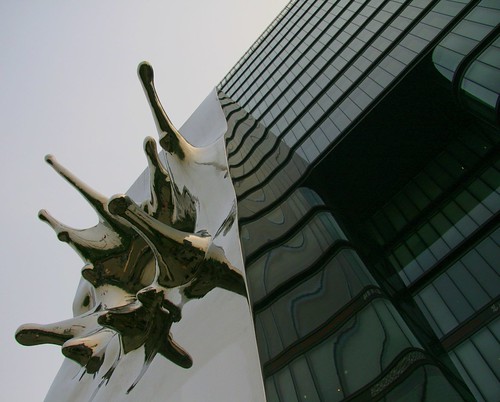
I'll leave you with another view of my favourite puzzling Chinese sculpture outside the Zhongguancun book building.
IMG_2139

Thursday, May 31, 2007

KITPC opening II

(Continued from here)

So, the KITPC is open, on time, remarkably, after only a year and a half of the idea being mooted. The six story building has been formally opened, lectures have been held, students are seen buzzing around, the blackboards are full of musings and equations and though the smell of coffee hasn't yet infused the walls, I'm sure that's only a matter of time.

The opening ceremony was held in one of the grand rooms of the Great Hall of the People. Fred Kavli himself came along and gave a rousing speech, discussing his long term dream to be able to add to the sum total of humanity and indeed with 14 institutes set up around the world allowing for the cultivation and exchange of ideas and theories on both the most theoretical and applied ideas in the sciences, it seems that his dreams are being fulfilled. He spoke of his high esteem for the Chinese, both culturally and from an academic standpoint. At 80 years old, he walks tall and speaks powerfully on a topic which has clearly driven him to do great things, both financially and in parallel philanthropically.

A short extract from Wikipedia:

Already in his early teens while attending Firda Landsgymnas high school in Sandane this entrepreneur had visions of doing something for the good of humanity. A deeply philosophical person he is influenced by his high school studies of Nietzsche, Kant, Hemingway, Steinbeck, Faulkner and Dostoyevsky.

At 14 together with his brother Aslak he began his first enterprise creating wood pellet fuel for cars. During these early years during the Second World War and the Nazi occupation of Norway he experienced dramatic incidents. Due to the lack of fuel he would regularly steal fuel and lubricants from the enemy. Only luck saved him and his brother when they were observed by a German airplane patrol while smuggling weapons to relatives in the mountains.


The following speakers talked not only about the great efforts which have gone into creating the KITPC but also of the future efforts which will be necessary in order to place the institute as a true, international centre for excellence.

Michael Freedman
gave a talk entitled 'How topology will save Moore's law'. This was on the topic of quantum computation and in particular how one can study two-dimensional systems of interacting electrons, the topological states of which can be manipulated to give 'natural' quantum computers. If you get a chance to see Michael speak, this is a good advanced public level lecture and his musings on artificial intelligence emerging from a quantum system are interesting, if not terribly well-founded. Note that this is not the strong conjecture of consciousness emerging from quantum mechanics in the brain (a la Penrose). My uncle, sister and friend came along and with a psychology and two mathematics degrees between them agreed that they understood a lot more than they had expected to.

Around 11 we left the Great Hall of the People and headed into the furnace outside. We knew that it was hot, but hadn't realised that it was the hottest day in Beijing for over 50 years - 39 degrees in Tiananmen. I spent the next few hours going around Qianmen market nearby with my family, dodging in and out of the shadows and haggling for gifts to take back home.

I didn't have a chance to see the lectures which resumed on Saturday afternoon in the KITPC. The two day conference on frontiers in physics included talks on extra-planetary life, string cosmology, quantum computing, laser powered particle acceleration and much more.

The Powerpoint files can be found here and videos should follow.

Now the first of the programs, 'quantum phases of matter' is starting officially tomorrow and I will try and give an update when video files start to be uploaded.

Again, I urge people to come along to these programs and please contact me if you have any questions about coming to China.

Tuesday, May 29, 2007

KITPC opening

Photos from the opening ceremony of the KITPC at the Great Hall of the People. Amongst others there were speeches from Fred Kavli, David Gross, Shing-Tung Yau and Michael Freedman. The first photo is of the KITPC itself. A post with more content is in preparation.

Tuesday, May 15, 2007

More on the KITPC

The two day opening ceremony for the KITPC is coming up in a little over a week. After the official opening at the Great Hall of the People (with talks from Fred Kavli amongst others) there will be two days of lectures at the KITPC from many highly eminent scientists. The morning of the 26th will see a public lecture given by Michael Freedman, winner of the Fields medal for his part in the solution of the Poincare conjecture. Title:

'How Topology will save Moore's law' - Some thoughts on the human condition expressed through the history of the concept of "number." This concept carries us finally into the interface of topology, quantum mechanics, and computer science.

After this there will be lectures on subjects from quantum information, the search for habitable planets, laser technology, dark matter, the origin of the universe (from Henry Tye) to the future of physics, both worldwide and in China.

The closing speech will be by David Gross on Sunday the 27th. I'll report on what I get a chance to go to. I'll try and get some photos of the building too to give those who are thinking of coming to the future meetings a bit more of an idea about the place.

Saturday, April 28, 2007

Upcoming KITPC events

It was almost a year ago that I first wrote about the KITPC (Kavli Institute for Theoretical Physics in China) when David Gross came out here prior to Strings 2006 to announce officially the deal to build the KITPC. (original piece here).

Well, the building is completed, there are people milling about in there and the interviews which I mentioned a couple of posts back were for management and computer staff for the department.

At the end of May the KITPC will officially open with a ceremony filled with the great and the good. Fred Kavli himself will be out here as will David Gross, Shing-Tung Yau and many other eminent physicists and mathematicians from around the world. We'll be heading back to the Great Hall of the People for this and I'll report on events as they happen.

Anyway, one of the reasons to write this post is as a piece of advertising. This year there will be two programs running at the institute.

The first is a two month program starting in June on "Quantum Phases of Matter" and the organisers for this conference are Sankar Das Sarma, Eugene Demler, Yu Lu, Fu-Chun Zhang and Xiao-Gang Wen. It says the deadline is over for applications for this program but it's always worth a go.

The second program is more relevant for my work and looks like a superb event. "String Theory and Cosmology" will run from September 1st to December 15th and is being organised by Miao Li, Shamit Kachru, Eva Silverstein and Henry Tye. The blurb reads as follow:

String theory is the best motivated theory that can address fundamental issues like physics beyond the Standard Model, the origin of our universe, the quantum nature of gravity, the mystery of black holes, dark energy, supersymmetry and the dark matter.
Studies of the cosmic landscape, model/vacuum building and time-dependent solutions are making contact between theory, phenomenology and cosmology in new and exciting ways. WMAP and PLANCK, together with LHC, have begun to usher in a new era of string cosmology and string phenomenology.

This program aims to take advantage of all these recent and coming developments, with a slight emphasis on cosmology. The program hopes to bring together string theorists with an interest in phenomenology and/or cosmology, and cosmologists, particle astrophysicists and phenomenologists who are interested in new ideas coming from string theory. Mathematical string theorists who are interested in these issues are most welcome.


There isn't much more information up there yet but the idea will be to have lecture series and workshops running through the three and a half months with people staying in residence at the KITPC for varying lengths of time.

This is a great chance for China to represent itself once more on the world stage in its scientific capacity and a part of that is for others to come and see Beijing at work.

I wrote a piece just before the strings conference last year as a Beijing survival guide which people responded well to. I'm very happy to answer any questions, either by e-mail or in the comments if people have queries about coming here. That includes information about China and information about the workshops. I can ask for the website to be altered or added to as people see fit (not that I have any great power over it but that those in charge are down the hall).

It's been my pleasure over the last couple of years to help several people make up their minds to come to Beijing either for a long time or for a holiday and then to settle in. Many people don't realise that Beijing really isn't such an alien world and is certainly a highly developed city, with both running water and electricity - and more internet connectivity in the cafes than I witnessed even in Tokyo.

Anyway, I think that these events will be a fantastic chance both to bring together some of the top scientists working in these research areas and to see Beijing as it readies itself for the 2008 Olympics.