Showing posts with label scitalks. Show all posts
Showing posts with label scitalks. Show all posts
Thursday, October 04, 2007


Friday, August 31, 2007
Near misses
Things have been utterly non-stop recently. I haven't seen the inside of my flat for more than about 5 minutes this week while not sleeping or trying to forget about the day's events and attempting to sleep. This isn't to say that anything has been bad, just very busy. I'm finishing up some work which has to be done really very soon and have written a couple of long posts about how I got to be where I am now (not in the Darwinian sense) and a little background to what I do, or maybe why I do it.
In the mean time I've been helping friends move house and running round the city saying goodbye to people leaving Beijing, teaching, attempting to start learning Spanish and continuing with the Chinese. Tomorrow I go out of town for a party, back on Sunday, take a friend to the airport and then straight back to work. September is looking to be very full with three couchsurfers staying at my place for a continuous period of 10 days. Also we have the string cosmology conference coming up all month at the KITPC, which I'm very much looking forward to. (first week's lectures here).
Today as I ran out of the office and caught a cab to get to my friend's house to help her move house my blood began to boil as the Beijing roads mingled with my already high pressure state.
I usually spend my time in a state of calm chaos, but just occasionally it boils over - in fact in the UK it very very rarely happens but the bloody stupidity on the roads in China just got my goat today. I love cycling and I know that I'm not a very safe cyclist. This has improved since I learnt to drive and realised how much I must terrify drivers as I speed around as fast as possible. Anyway, with however many million non-driving cyclists on the roads in Beijing combined with 3 million cars all of whom think that they have the right to get from A to B faster than everyone else, cutting up all who are in their way and slowing the roads down for all, the situation is often unbearably frustrating.
After several near misses (both my driver's fault and that of others) he got out of the car and had a fight with another road hog - a full on slamming each other against the bonnet fight, red-faced arm waving and general macho nonsense. I was either going to laugh or cry as I waited in the car for the frivolities to end so I laughed at them and they split up and got back in their respective cars.
So, we continued to weave our way through the ever-honking traffic and an hour later had deposited more clothes than you can possibly imagine to their temporary residence. The taxi driver left and I went back to the office.
As we reached the traffic lights I saw something which I so often see here in Beijing. A cyclist somehow forgetting that there are two sides to a road. She looked left, seeing that there was a gap in the traffic and pulled out to cross the road. However, she seemed hypnotised by the lack of traffic on the left, presumably thinking this to be a good enough omen. As she got to the middle of the road without appearing to slow down I looked in horror as the speeding oncoming car didn't notice her behind the central bollard. She pulled out, still looking left as the car slammed on its break, turning the wheel as it did so. The car screamed to a halt, in a haze of tyre smoke centimeters from the girl on the bike, who just sat there, looking puzzled at the car.
The police driving the police car, which had been the offending missile, shouted at her as she sat in the middle of the road, still looking unperturbed but a little angry at being shouted at.
The police car sped off and she stayed, sat in the middle of the road as other cars honked at her to move. Normally I would have put this down to shock, but Beijing cyclists get into these situations so damned often that she just seemed annoyed at the whole affair and couldn't be bothered to move.
I'm writing this having let myself calm down a little. My heart has left my throat and my pulse has dropped below 200.
ok, rant over - it just winds me up no end and sometimes I need to vent.
Friday, August 24, 2007
More advanced string theory lectures
Some wholesale copy and paste from the Scitalks blog which I've been contributing to over the last few weeks. I'll be taking a more active role next week too. In the series of posts on string theory video material, working up from pop-science through to basic introductory lectures, to more advanced topics I gave the following suggestion:
First I will give some ideas for lectures which are mostly in my area, the AdS/CFT correspondence.
Eric D'Hoker's lectures from TASI are great.
Though I would suggest that just about every lecture from TASI is worth watching. I haven't seen them all but most of the lecturers are really very good. I've been watching Mina Aganigic's lectures on topological string theory which are very good. David Tong's lectures on vortices, monopoles and kinks were excellent in 2005 and I would imagine they are still both entertaining and clear.
Also on AdS/CFT those by Mark Van Raamsdonk at the PIMS are good.
But again, the level of this school is just right for those who have are just about familiar with the previous material.
I can't view these lectures by Juan Maldacena who first developed the AdS/CFT correspondence but they may well be good.
I've seen Eva Silverstein talk a couple of times on string cosmology. She's one of the leading researchers on the subject. Again, I haven't seen this particular video of her but she's usually a good, clear speaker:
A little old now (2004) but still excellent is this workshop on QCD and string theory from UCSB, and the conference here.
My work is most closely linked to Rob Myers' talks on holographic mesons.
Trying to give a broad range of stringy subjects, the lectures on string phenomenology are here.
More on stringy cosmology here.
and some of the more mathematical aspects here.
As before I haven't seen all these videos but I've seen a few from each conference and can say that there are certainly some which are worth watching. We really need more, interested people to watch them and then advise which are the best. I'm just giving a general selection of some of the more cutting edge areas of the subject.
Note that there's a big jump between the previous set of lectures and this set. There's really a gulf between learning the basics and understanding the more advanced topics which is why a full length online course would be excellent.
Anyway, I'll be posting something about, eh, me, soon over at Scitalks to give some context to me work in the subject.
Wednesday, August 22, 2007
Expatois
Sometimes it's hard to tell the ratio of irony to Chinglish in signs here in Beijing. I'm sitting in a cafe at the moment finishing off a talk for tomorrow and tidying up a paper. The cafe is very quiet with comfy chairs and tables and a few students sitting round working hard (we're next to Qinghua university - the top university in China). The sign on the stairs on the way up to the cafe states boldly that: "A climax a day keeps the doctor away". I'm not sure if this is a tongue in cheek statement talking of eureka moments, or simply the obvious interpretation. These days I simply don't know.
On the topic of language. Today's Wikipedia article (not viewable in China where Wikipedia has again been blocked) is on the Gwoyeu Romatzyh Latinisation of Chinese, in particular an alternative recipe for showing the tonal system. It looks far more complicated than Pinyin, which is relatively straight forward once you are able to reproduce the tones. I'll be discussing learning Mandarin soon as I've just reached a bit of a personal goal.
Over at the Scitalks blog I have given a series of suggestions for more advanced string theory lectures, mostly on AdS/CFT, but on other topics too. I've been watching lots of the TASI courses which are excellent.
Thursday, August 16, 2007
Introductory level string theory videos
Still in collaboration with Scitalks I'll post my suggestions for introductory level string theory videos. These are lectures for physicists with a grounding in quantum field theory. I count introductory as the most obvious step up from the previous videos which were popular science level.
Most of these courses are just three or four lectures long, so I want to make a request here.
There are many universities, mostly in the US, who run one semester, or even one year courses on string theory (amongst many other interesting topics). If you know somebody who gives a good course on this subject then I would urge you to suggest that the course is videoed next time it's run. It's a waste not to. For those who aren't lucky enough to be at universities who run long term courses in this subject then please try and share this as an open source course. This doesn't just go for string theory, but for all other subjects too. It just so happens that string theory is the current example. I've said this before and I'll probably say it again.
So, find out of your department will allow this, find a willing lecturer, video the course, upload it to your department web server (this may be a lot of material but servers are pretty huge these days) and send the link to Scitalks.
Anyway, here are some of the best introductory materials on string theory that I could find:
Over at Scitalks there are now two sets of lectures at the appropriate level. One by Barton Zwiebach and one by Clifford Johnson. See below for a set of lectures on perturbative string theory from Clifford too.
There’s another series of lectures by W. Lerche here. I have only been able to read the transparencies, which look broad ranging and reasonably detailed. In the cafe I’m in at the moment I can’t download the video. I would imagine it’s good, but couldn’t guarantee anything.
There is a nice colloquium by Shamit Kachru, who is an excellent speaker, talking about string theory and cosmology here:
If you go to this page, and look on the left for ” Summer School: Strings, Gravity & Cosmology” you will find a host of great videos. Unfortunately it’s really difficult to try and view these independently from their special player (you need IE, too!). The lectures on perturbative string theory, again by Clifford Johnson, are probably excellent and just the right level for first year grad students. I just wish I could rip them and watch them at my own comfort and time. I’ve watched a few, but I just don’t like this format of streaming.
Again, what would be perfect at this point would be a full graduate course in the subject available online.
Next week I'll post links to lectures at a more advanced level, mostly in my field.
How to work with extra dimensions
I'm posting an e-mail that I sent to Lee at Scitalks which was added as a blogpost on the scitalks blog. Sounds a little circuitous, but having written it I wanted to add it here, with the little video I made.
Having mentioned that the video explanation of extra dimensions was in no way accurate, I wanted to add my two cents about extra dimensions and so sent the following message:
------------------
In fact it’s pretty easy to understand higher dimensions from some simple visualisations. The video on Scitalks was fine, up to the fourth dimension, and then things started to get a bit cryptic.
One thing I should mention first is that trying to visualise objects in higher dimensions is good to feel comfortable with what you’re studying. However, sometimes if we try and visualise the things that we are calculating, we may stifle, or bias our calculations. In my opinion it is usually best to become familiar with the mathematics, the purest descriptions of our theory and try to ‘visualise’ in this language rather than trying to use common sense from what we see around us. A good example is quantum mechanics. If we try and visualise what is going on on very small length scales we will quickly tie ourselves in knots and not be able to progress as far as we can by exploring the mathematics of our system. Of course it’s important to be able to translate the mathematics back into what you will actually see in your experiment.
So, given that caveat I will explain how we can build ourselves a hypercube (or at least the frame of a hypercube), the higher dimensional generalisation of a cube.
The way we will do this is to start with less than three dimensions and see what rules we have to follow to go up in dimensions. We will see that we can extrapolate these rules to however many dimensions we want.
Start with a point, a zero dimensional object.
Take this point and turn it into two points. Now pull one of the points apart from the other one, say a distance L away, and join the two points with a piece of elastic. Now you have a line, a one dimensional object.
Now do a similar thing, but this time turn the elastic into two pieces of elastic (on top of each other - now you have four points given by the two ends of the pieces of elastic). Pull the pieces apart in the direction perpendicular to their length. While you’re pulling them apart keep the two ends joined by more elastic which will grow to length L. Now you have a square, something with four edges (pieces of elastic) and four points, or vertices. This object is two dimensional.
Now repeat the process. Take your square and replicate it with another square, on top of the first one. Join the vertices of the two squares with four pieces of elastic which will be stretched in the direction perpendicular to the face of the square. Pull the squares apart to a distance L. Now you have a cube. This object lives in three dimensions. It has six faces, 12 edges and eight vertices.
So, what rule have we developed? We have taken our previous object, replicated it, joined the vertices of the two objects together and pulled them apart in a direction perpendicular to the directions they lie, until the two copies are a distance L apart.
Let’s do that again.
Take your cube and replicate it. Join the vertices of the twin cubes to each other, again by elastic, and pull them apart to a distance L in the direction perpendicular to the direction they are living. There seems to be a problem though, in the last example, the square could live on a piece of paper and you could pull the two squares apart vertically to create the cube, we seem to have run out of directions. We need to pull the two cubes apart in the fourth dimension to a distance L.
Though we can’t really picture this realistically (at least I can’t) we can draw the projection of this onto 2-dimensions, just as easily as we can draw the projection of a cube onto a piece of paper.
When we pulled the one square from the other, we did this in the third dimension, say height, from your paper. So we don’t have another direction to go to pull the cube apart any more. This is where we have to imagine, as best we can, that we take the cube, split it into two and, joining the vertices of one cube with the other pull the two cubes apart to a distance L in the fourth direction, to create an object with 16 vertices and 40 edges. It’s almost as easy to draw the projection of this object onto a two dimensional piece of paper as it is to draw the projection of a three dimensional cube onto a piece of paper.
I've created a short animation of the above construction using Mathematica. We see the projection onto 2-dimensions. When I have time I'll let the objects rotate and slow it down a bit too.
In terms of mathematics, it’s even easier to go to higher dimensions. As an example, we might want to know the length of a line in two dimensions, going from some point (0,0) to (x,y). The length, as we know is the square root of x^2+y^2.
In three dimensions for a line going from (0,0,0) to (x,y,z) the length is the square root of x^2+y^2+z^2.
Well, let’s stop labelling directions as x,y,z etc and label them x_1, x_2, x_3,x_4, etc. (1,2,3,4 are simply labels). Now it’s easier to keep track of them.
Now a line in four dimensions stretching from (0,0,0,0) to (x_1,x_2,x_3,x_4) has a length of the square root of (x_1)^2+(x_2)^2+(x_3)^2+(x_4)^2.
Well, if you can work out the 2-dimensional example, I would suggest that it’s pretty easy to calculate the 4, 10, or any dimensional example. Imagining it isn’t easy, but as long as you have a mathematical handle on the objects that are living in your higher dimensional theory, you should be doing fine.
I would suggest having a read of Flatland, a romance in many directions - not for it’s political correctness, but for an idea of how things would be if we didn’t live in 3 dimensions. Chapter 16 is particularly relevant.
Thursday, August 09, 2007
Basic string theory videos
A good number of string theory videos are appearing on Scitalks now. I've given long lists of videos and there are many still to be put up on the site. There are now many good movies from Clifford Johnson and Barton Zweibach at the introductory level and lots more advanced talks by Ashoke Sen, Matthew Strassler and others.
For the pop science level I think that Brian Greene's video series The Elegant Universe was excellent, and the book is also superb. It's what got many undergrads, including myself, interested in the subject.
From Strings 2005 the talks by Robert Dijkgraaf and Leonard Susskind are good presentations to the general public on a variety of stringy issues.
Some nice lectures by David Gross on a fundamental theory of reality. Parts I, II and III.
Also from the Princeton centenary lectures Juan Maldacena on gravity, black holes and string theory.
Soon I will be discussing slightly more advanced videos for which at least a degree in physics is expected.
I should note that not all of these videos are up on the Scitalks site yet. When they are I urge you to contribute, first in the initial stages of this site where you can vote for a video, but secondly when the tagging and social networking aspects of the site come online later in the year.
(I can't claim to have seen all of the above movies completely, I have seen some of them in their completeness and others I have watched samples from different sections to see that they are appropriate for this level. They are also all from very well known researchers in string theory. If people find problems with the videos then either tell me, or get in contact with the people at Scitalks).
Tuesday, August 07, 2007
String theory at Scitalks
I'm extremely happy to be working with Scitalks, which I've spoken about in several previous posts (see here for more). Lee Vodra and I have been in frequent contact. I was asked to set up a possible curriculum of video lectures on string theory for them to have as a featured set over the next month. I think this is a great idea and I hope that people will a) become interested in the subject and possibilities and b) ask questions about the material as it comes up.
At the end of the month I will act as guest blogger on the Scitalks blog where I will answer questions that people have raised. I urge others to come over to the blog and add their thoughts too. I hope to find an open-minded discussion developing.
One thing I pointed out was that it's not possible to create a curriculum in string theory which can start you out with the very basics (pop-science level) and in a month of videos work you up to cutting edge results in the subject. I hope however to be able to put together videos which will satisfy all levels. Those who are new to the subject will take most from the first sets of lectures. I hope that those at first year graduate level will gain most from the second week where there will be more prerequisite knowledge and then the final sets of lectures will be chosen as lectures on more advanced topics, for which knowledge of the foundations of the subject are expected.
I must point out that the lecture on 'Imagining the tenth dimension' featured on Scitalks is not one of my chosen videos and has nothing to do with the ten dimensions of string theory. This confusing video by musician and author Rob Bryanton is Rob's ideas of what extra dimensions may mean. Sadly this a) seems to have no mathematical formalism behind it and b) is completely unrelated to extra dimensions in the perfectly well-defined sense, discussed in string theory (though not exclusive to string theory).
In Rob's poll on his blog he is pleased that many people see his ideas as a combination of physics and spirituality. As a physicist, spirituality has absolutely nothing to do with my research and so anyone who claims to be motivated by this automatically loses a large amount of credibility in my book. Sadly this video is a great example of the clash between faith and science.
One thing I should note is that in Scitalks, just as in Wikipedia, though videos will appear which don't tie in with what most of us think of as good science, there will be voting and comment sections where people can voice their opinion about given videos. It will be interesting to see how this plays out, but I feel positive that as long as people take up this great opportunity to build a library and social network of great videos and great minds that Scitalks will be a huge resource for those coming into as well as already established in science. As Flip Tomato points out, watching videos of a conference is not the same as being there, but it's vastly better than having nothing at all. The interactive aspects of Scitalks, due for release in the not too distant future will only add to the possibilities.
Anyway, I hope that this experiment will be a good chance to share some of the excellent videos out there on the subject. I have already suggested a fair few videos but am always keen to learn of more, so please tell me if you know of good recordings of string theory talks, at all levels.
Friday, June 29, 2007
More on SciTalks
I considered the potential for a video lecture repository while spending a month in sleepy Kyoto over the winter, doing research at the Yukawa institute. I discussed the possibility of setting up such a website with a friend: what capabilities would be necessary, what platform we could build it on, how people would upoad videos and what they would be able to say about them. However, lack of time and lots of research got in the way and it stayed as a project on top of the pile of other 'urgent - to be dealt with later - projects'.
I spoke, not about my plans but of the use of video lectures previously here.
Anyway, in the mean time someone else has taken the plunge and created just the platform. Currently it has a basic user interface which allows users to upload the url for a video. Each video has a section for a comment, the time and a voting system.
This is a good start but only a very basic system. I e-mailed Lee Vodra at SciTalks to pose a few of my suggestions and to see how the site would develop and I have been very impressed both with the lengthy response and the possibilities. I think that this is one of the most exciting projects in the academia/multimedia cross-over yet to come out of/onto the web - the possibilities are awesome.
Lee tells me that there is a version 2.0 of SciTalks which will implement many changes to the format and flexibility of the site. This is due to come online in a few months.
My initial questions were on the subject of a more refined system for comments where information about the level, prerequisite knowledge, audio and video quality etc. could be included with the video and added to by more multiple users for each entry. However, it seems that these are only the beginning of something much more far-reaching.
One of the biggest additions is going to be a social networking side to the site. Lee hopes that people will start to put together curricula for courses from the videos and this is really the basis for a powerful form of open-source education. Something which MIT has been trying for a while but because of the lack of videos in many courses, it is little better than having the books to work from.
The possibility to build a list of lectures on string theory, for instance, going from the basic to the very specialised, having only the clearest presentations at each level is very exciting. I must have seen a dozen or so online lectures on string theory but the overlap was huge and trying to find just the right level was not easy. With a team of interested students and academics watching videos from around the world, the appropriate lectures should soon be sieved through.
In my e-mail to Lee I mentioned tagging and the fact that I find the use of folders, both on my desktop and on the internet an inefficient form of data storage. Lee commented:
'User tagging and RSS feeds are the two most common requests so far. I'd love a tag cloud. (I'm fond of them anyway, and yes, folders feel outdated.)'
On the topic of a more organic user-oriented site Lee states that:
Once social networking gets into the mix, the site and its community could turn into something amazing, and I'm sure people will use it in ways we can't even imagine, although I'd really like to see online schools form up. Meanwhile, I'd be really psyched if you'd join and put together a playlist. If you have a bunch of videos that we haven't got together on the site, you can just send an email with a bunch of URLs and I'll see that they get up there.)
-------
There's a whole science to social networks and with each one we build, it becomes a deeper and more nuanced endeavor. I have some videos saved up for when we switch over that deal with social network design. There's a lot to consider and the devil's in the details.
So, please help to spread the word about this and see that it is used and developed in the most effective ways possible. I've sent a list of many links to them but I'm sure there are many that I don't know about so get posting.
Random images
I've been in contact with the people over at SciTalks about extensions and the future of the site. There are some incredibly exciting prospects for it but it deserves my full and undivided attention to write about it.
For now I will just urge you to go over there and start posting videos to build up the database. I'm told that the short URL problem has now been fixed.
For now I'll give you a couple of slightly random images.
The first is from my office window a couple of days ago, taken at about 2 in the afternoon. The sky changed from the usual hazy grey to a dark brooding mass of fast moving clouds, thunder and lightning over the course of about half an hour. This was just before the rain really started pelting down: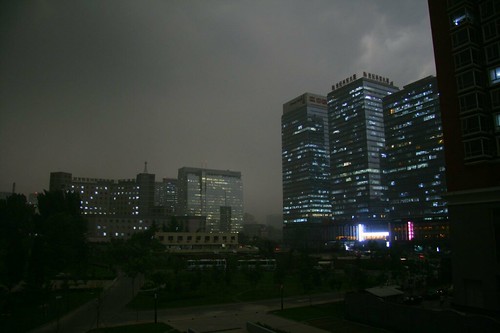
and secondly a picture of a painting from the school I visited with my uncle when he was out here. We went to play parachute games with the kids (photos of the afternoon are here). Following the games we walked around the school and found this painting in the main lobby. It was a little while later that I found that this is a painting of the businesswoman who had founded the school and commissioned the picture. You can form your own opinions.
Subscribe to:
Posts (Atom)


