Monday, March 30, 2009

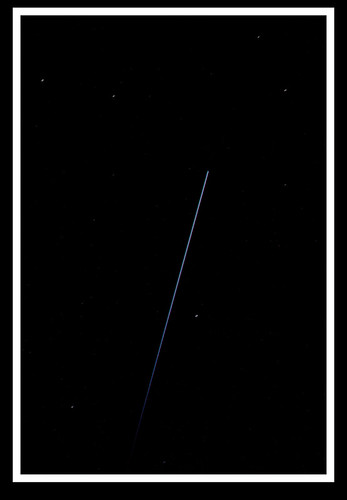
International space station over Santiago de Compostela

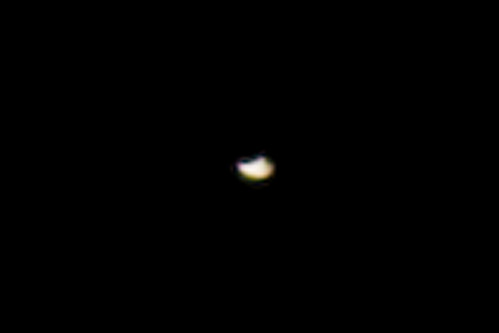
I went out at 10 this evening to find a reasonably secluded spot, set up my camera, and waited till 22.10. I'd not seen the International Space Station before, knowlingly, but as the final set of solar panels have been installed, making it the second brightest object in the night sky after the moon, and tonight looking like a particularly good chance, I thought it was worth a look. As it came into view, the image of a satellite 100 meters across, 350km above the Earth, racing along at 27000 kilometers an hour with six humans on board was really quite a stunning sight.

At magnitude -2.3, it was easily brighter than any of the other stars in the vicinity, and I presume anyone who didn't know better would have thought it a fast moving plane, slightly yellow in colour.

I took a few 20 second exposures and rather like the last one, where you see the space station moving into the Earth's shadow, slowing fading to black. Anyway, check out on Heavens Above for when will be the next good chance to see it from your neck of the woods.

International space station

International space station

Importance of a good caffeine intake in research

Perhaps the brand should have been included in the acknowledgments, but this is the most firm evidence I've yet seen for the place a high level of caffeine intake should take in one's research:

The paper in general looks impressive, but page 19 particularly!

NB. This is not a mistake, it's included as a pdf on the background.

(That said, I've been on the wagon for five months now and feeling better for it.)

Sunday, March 29, 2009

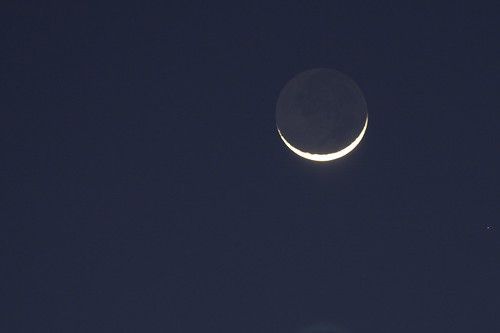
Earthshine at Earth hour

Yesterday night at 8.30 I switched my lights off and went to look out of the window from my great vantage point up on the seventh floor, overlooking some lovely scenery. Having had a pretty overcast day I wasn't expecting much, but the clouds had cleared and the moon was looking particularly stunning, with a lovely Earthshine lighting up the otherwise dark majority of its face.

Earthshine at Earth hour
Just down to the bottom right is Iota Arietis, a magnitude 5.09 binary star. On a dark night from my apartment I can pick up magnitude +11 objects, but in the twilight +5 seems to be the limit. Note that this is all without a telescope. Simply an amateur DSLR camera, a zoom lens (70-300mm), a tripod and a cable release. I continue to be amazed at what you can see with simple equipment.

The picture is untouched from the original apart from an unsharp mask, a crop and the brightening of the star in the bottom right.

Thursday, March 26, 2009

A minor diversion

A quick update from the weekend...

I had a friend over from England this weekend, and after seeing a Flamenco version of Carmen in London together on Thursday we flew back to Santiago on Friday to spend Saturday and Sunday exploring some of the Galician countryside.

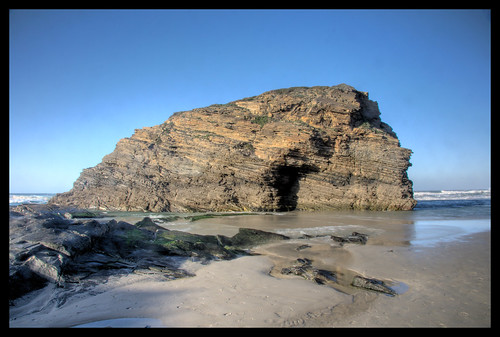
Saturday we headed to the Praia das Catedrais, one of Galicia's best known coastal landmarks to see the caves on the beach. The weather was fantastic and it's well worth a visit if you're on the North coast of this province.

rock on the water
On the way there we passed through Lugo and stopped off at the local farmer's market where they had a stunning selection of olives - indeed by far the best I've had in Spain. I thought I bought enough to last me the week, but I appear to be mistaken.

Sunday we headed to the West coast, between Pontevedra and Vigo to spend a few hours on the beach relaxing. In general I'm terrible at just sitting down and not doing anything at the sea, but I managed a good quarter of an hour of sunbathing before I had to get up and wonder around.

We were there with a few friends including a capoeira teacher who gave us an impressive display:
Capoeira on the beach
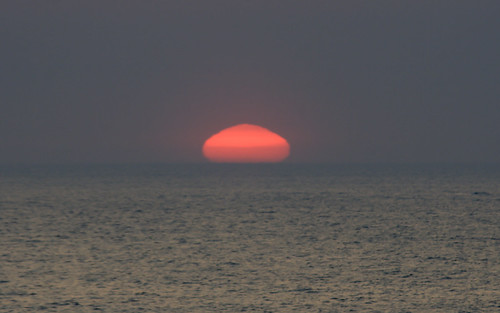
before we headed for the lighthouse nearby, overlooking the Isla de Cies to watch the sunset:
setting sun

We headed back on Sunday evening to try and catch the meteor shower though even the darkest spots in Santiago seem to have too much light pollution.

For now I'll leave this little bit of info for those around Galicia: Take a look out on Monday night at around 22.00 for the ISS which will be flying directly overhead and will have a visual magnitude of -2.3. Take a look here for the path and times.

Tuesday, March 17, 2009

Oxford revisited

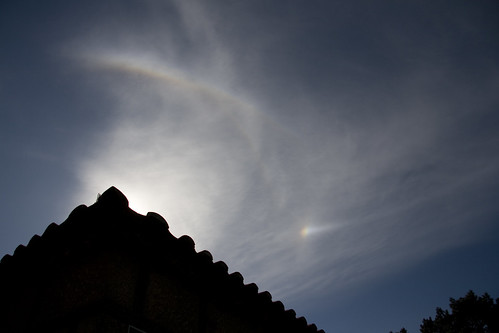
I'm back home in Oxford for a few days, here to have a routine medical procedure performed (it would have taken a long time to get this done in Spain, so it was easier simply to come back to the UK). I've spent the last couple of days in various cafes in the city centre, getting on with some work while waiting for my appointment tomorrow. It's really lovely to be back and I'm reminded what a stunning city this is. We've been lucky with the weather and in addition to seeing sundogs every day, the sun shining off the ancient stone walls has meant for lovely conditions for walking around the centre.

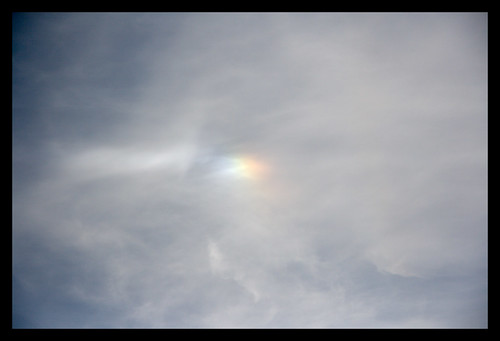
(sundog this morning from the back garden - again, as I walked around the streets afterwards, keeping an eye on it, nobody else had a clue. I'm always saddened that people just don't look around them at the incredible phenomena right before their eyes):

sundog

Today I took a break at lunch and walked into the Natural History Museum, one of my favourite places to get lost for an hour or so, and wondered the isles as fascinated as I was when I first discovered the museum at a very early age. Not only is the exhibition wonderfully timeless, but also the fantastic Victorian architecture makes for one of the my favourite buildings in England. The details in the construction would take a lifetime to discover and I only found out yesterday that every column in the upper level is made of a different stone found in the British isles, every capitol having a unique native plant carved into the detail.

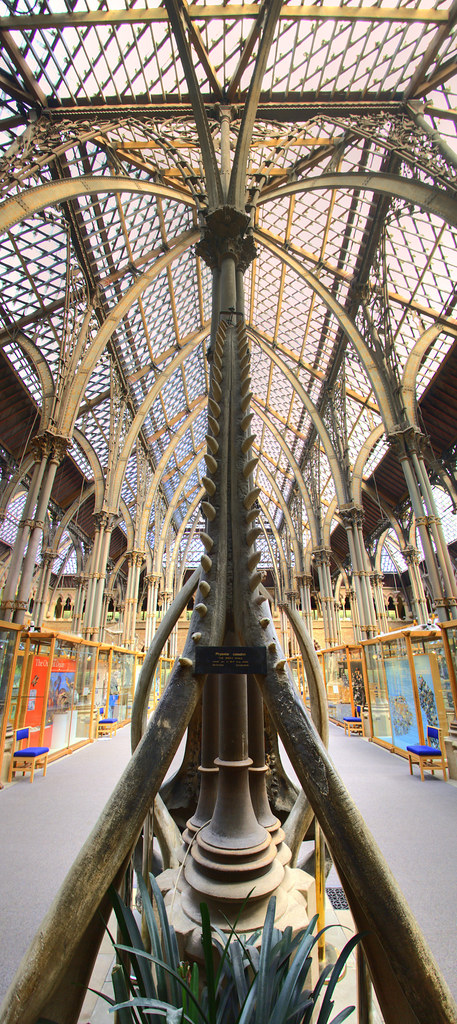
Before being greeted by the dinosaurs, the first thing you see as you walk in is the jaw of a sperm whale, rising up into the vaulted ceiling, calling for a vertical panorama:
jaws

Anyway, don't miss this museum if you're coming to Oxford - really a fascinating place.

I may be offline for a day or two from tomorrow morning, but will get back to things when I return to Santiago on Friday

Saturday, March 14, 2009

Continuum

Kimchi making + dinner for ten last night, reading papers + writing the introduction of a new one today, off to Oxford tomorrow, tedious medical things to be seen to for a couple of days (nothing serious), Thursday night in London to see Flamenco, back to Santiago on Friday, four papers being juggled, full steam ahead!

Friday, March 13, 2009

Couchsurfing reaches one million!

<10 minutes to read - an advert for and some of my experiences within Couchsurfing.
--------------------

Couchsurfing has just reached a huge milestone. There are now a million members of this website and the numbers are still growing fast. Here's where they are:


I thought I'd take the chance to write a few words about this site, which has brought an amazing wealth of knowledge, opportunities and friendship for me from, and in, fantastic places around the world.

The purpose of couchsurfing is simple:

It is a platform by which those traveling to new places may find people there who are willing to share their space and/or their time with strangers, in order to bring local knowledge to outsiders and make both traveling and living in that place a richer experience.

There are no overall constraints on this in terms of time, reasons for traveling, or how much you would like to put into the system. Each person may apply their own constraints as to how often or the sort of people they would like to host, if any.

The way it works is also simple: You sign up and create a profile page with as few or as many details about yourself as you would like to share. With this system, the more information you give, the better, as trust is an important part of the way it all runs smoothly.

When you would like to travel somewhere, you search for people in that location through the site. You may search for people who have a spare place for you to stay, or simply those willing to go for a drink or show you around their city. You can search by language, interest, location, and more.

In Santiago de Compostela there are just over 200 people registered to the site, 100 of these are offering their couches (or spare beds, or simply floor-space).

You then write to whoever you want, telling them about your plans and what you are looking for, whether it be a place to sleep or simply some information about what's going on in their part of the world. On receiving such an e-mail you can then look on the senders profile and find out a little about the person who would like to come into your life, if only for a short time. My profile can be found here (I should probably think about changing the photo, but it seems to intrigue people, so it's stayed up for now).

The crucial point is that you will not only read what they have written, but also the references from every other person who they have met through the site - these references are what makes Couchsurfing sustainable. It's a network of referral and trust. This is not going to work 100% of the time, but then you make an informed choice every time you step outside the house. The references on the site make the informed choice that much more reliable, (Note that the positive feedback is 99.8%).

You may then simply write back and say you're too busy, or give any excuse you want, or you may agree, and offer them what they are requesting. Typically you'll then exchange a couple more e-mails to arrange the timing and where to meet and then make sure everything is on course a couple of days before their arrival.

So far in Santiago I've hosted more than 65 people, from around the world and from all walks of life imaginable. I've met lawyers, chefs, scientists, photographers, film makers, linguists and psychologists, bikers, goths and life-long travelers, Japanese, Korean, Estonian, Guatamalan and Brazilian, and so many more. Each person comes into your life for a few days, but the link that you build up, be it only over a few brief evenings, is truly amazing. Sometimes I may only get to spend half an hour chatting with the people, as I'm careful not to let this take preference over my research, but if I have a spare weekend, we can regularly spend days walking around the city, cooking together, or simply hanging out in a cafe.

For a vague idea, this is the map of the nationalities of surfers I've hosted in the last couple of years:

However, it's not about the number of countries, nor the nationalities, but the diversity of people you meet through this site. Here in Santiago a large proportion of the people I know, I have met through couchsurfing during the meetups which happen regularly (organised through one of the thousands of groups on the site).

I should note also at this point that hardened couchsurfers tend to become a little religious about the whole thing, and it can become rather cultlike in the devotion which members pay to it. However, I know that letting strangers into your house is not for everybody and I've met a fair few people who've been horrified by the idea. Fair enough, it takes all sorts.

I haven't surfed as much as I've hosted, though I've stayed with people in Korea, Japan, China, Portugal, France and Spain with this system, and every time seen so much more than would have been possible had I booked into a local hostel and wondered around on my own for a few days.

In Korea at the weekends while I was there last summer I had an immediate group of friends that I could explore the city with, and I'm still in contact with several of them on a regular basis. Going to Paris I ended up in a flat in the centre of the city, in the house of a designer and in Tokyo I met more locals in the two days I was couchsurfing than I did in the three weeks before that, staying in a hotel.

Anyway, I simply wanted to spread the word. If you have questions about the system then feel free to ask me, or simply go to the FAQ or Wiki and see if the answers you are looking for are there. It's not for everyone, but it's a great way to meet people from around the world and make traveling a much richer experience.

Tuesday, March 10, 2009

Minority report style advances at TED - 10 minutes worth watching


Exciting possibilities!

Thursday, March 05, 2009

A little light coding

For coders only, I'm afraid.

Trawling through the Mathematica forum to try and fix a problem with a piece of code, I came across a fellow coder whose clever choice of variable names make my scripts look like true poetry. A lesson for us all!

---------

I'm knee deep in code of my own right now, attempting to finish off a couple of papers which are towards the bright end of the pipeline. I've had to be a rather unsociable host to my understanding couchsurfers this week. I've had some lovely meals with them, but otherwise had to leave them to their own devices. This week four Chinese guests, one from Guatamala, a Canadian, a German and a Japanese guy have been staying at my place. A real pity that such interesting characters are coming and going without me having a real chance to get to know them, but the current schedule simply isn't allowing for anything more than the occasionaly acknowledgement from behind my computer.

Anyway, back to it...

Wednesday, March 04, 2009

Carnival festivities in Galicia

(Written a couple of weeks back, yet only just received photographic evidence.)

Stepping a little out of my comfort zone is one of my new millennial resolutions that I'm attempting to stick to as much as possible. As a naturally rather shy person this tends to be generally daunting yet rewarding.

Anyway, when asked two weeks ago if I'd like to take part in a competition in a carnival I was hesitant, yet came to the conclusion that this was not the sort of chance that came along very often and I ought to go for it. I had few details about the competition apart from the fact that it was an annual event and we would be performing a short sketch in front of a large crowd as part of the local carnival celebrations.

My single chance for a practice came last weekend when I arrived at the sportshall of a nearby village to find a group of around 20 kids, along with miscellaneous parents and neighbours, all preparing frantically for the big event. The theme for our short sketch was the Olympics, in particular Chariots of Fire, the music thereof being our soundtrack. Somehow I was given a rather prominent role, for which little preparation was possible, but much could go wrong.

So, Sunday I arrived in Brion in the early afternoon, the smell of freshly prepared paella greeting me, and the current sunshine warming the patio on which we stood looking over the nearby hills. After a relaxed lunch we went to the back garden where a rabble of kids and adults were dressed up in an array of 1920s sport clothing, handlebar moustaches and greased-back hair being the order of the day for the men, the women wearing white dresses and bonnets.

Suitably made-up and dressed, we made our way to the top of the village to start the procession through the winding streets to the hall, a few hundred meters down the road. I was placed at the head of the procession, Olympic torch in hand, to lead our team to the sports hall at the end of the road. After half an hour of walking we arrived at the hall and had another half an hour of waiting nervously for our turn, the kids getting ever more excited and restless.


As our turn arrived we came in through the back of the hall to see a crowd of some five hundred onlookers crowded into the seats and flowing out onto the courts to watch us. As people took their places I stood back, and with the fire crew looking on with equal measures of concern and confusion I took out a bottle of lighter fluid, doused the Olympic torch and lit it.

As the music started, the atmosphere grew and our group came on. I ran in from the back, flame held aloft jogging around the hall, attempting not to light myself, or the paper banners hanging above me. Having successfully made it round the hall without undue fire damage I arrived at the pepetero (the Olympic flame) and on the first boom of the music I lit it, as in perfect synchrony the rest of the group started to make their balletic performances in slow motion around the hall. We had synchronised swimmers, half submerged in a sheet of blue cloth, held aloft by mustachioed gentlemen, javelin throwers and archers, rowers and tennis players, plus an entire gymnastics team, judges and runners.

Having already done my part at the beginning I was the one lucky enough to watch on as the team performed, and it was really quite a spectacle. Not that I didn't have faith, but somehow with the music playing at full volume and the onlookers silenced by the vision in front of them, the effect was far more than I had imagined.

I still haven't tracked down many photos of me in full regalia, so for now my photo of these chaps will have to do...taken after the event:


A video taken by cellphone from somebody in the crowd has been found though clearly it doesn't do the atmosphere justice (I can be seen running past in the first ten seconds - just watch for the fire). It may, however be enough to put pay to any chance of me being taken seriously ever again!

Saturday, February 28, 2009

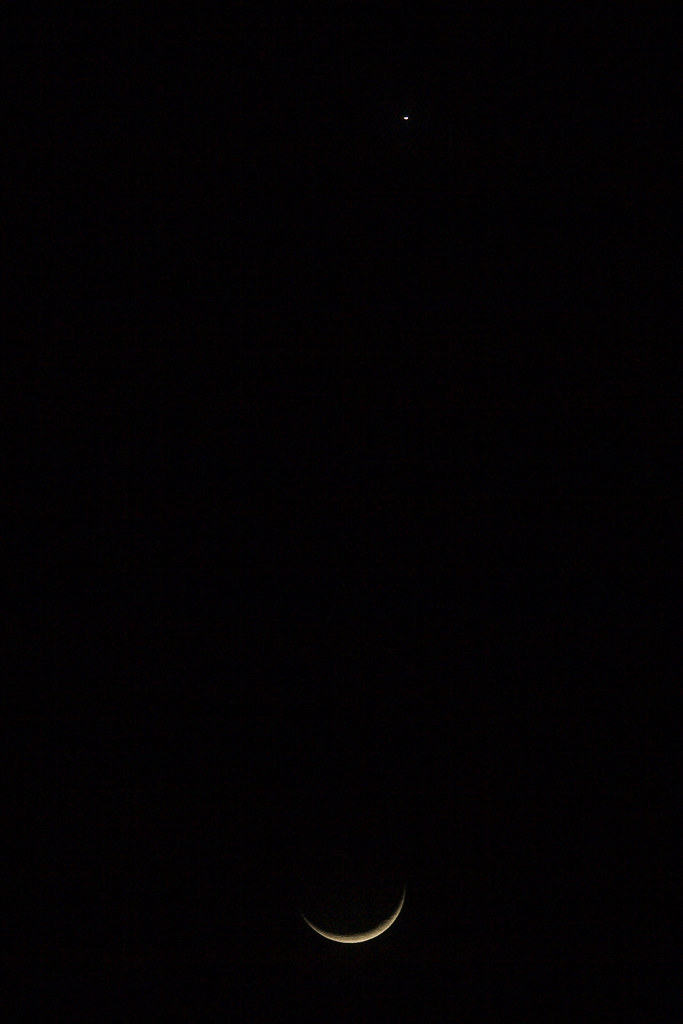
Venus and the crescent moon over Santiago

The moon and venus over Santiago de Compostela
Keep an eye out, the two will get even closer for the next couple of days.

See also the very nice shot from Twomanytribbles, complete with Earthshine and twighlight sky.

Wednesday, February 25, 2009

Excursive

I'm currently gathering together a few photos from the weekend which I'll put up soon. In the mean time I got a few shots from a day trip I took with a couple of friends yesterday.

Yesterday was carnival day in Santiago, and having seen it last year I fancied taking the opportunity to escape and see a little more of the Galician coastline.

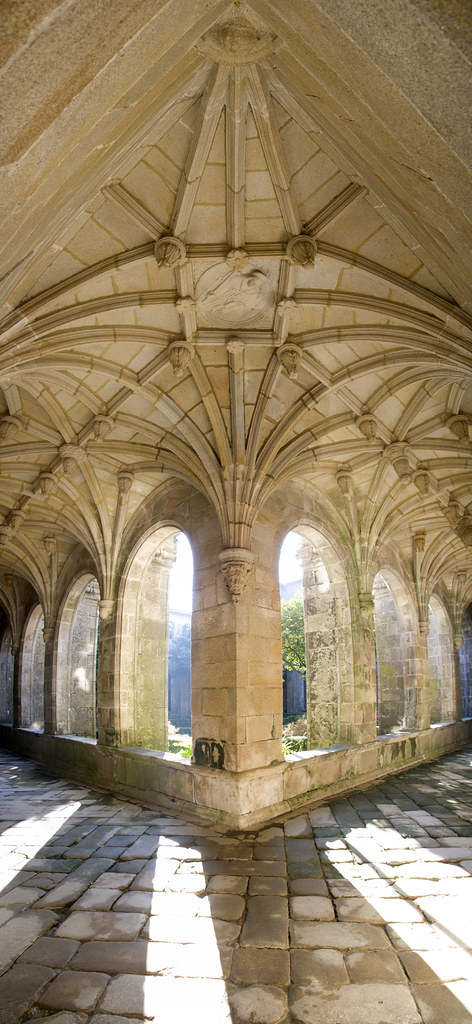
We drove down towards Pontevedra, stopping along the way at spots to explore, hike a little and get some local food, including some of the best bream I've tried around here. We started off at a local monastery, complete with a truly hideous alterpiece, gold dripping from the ceilings and plump cherubs rosy cheeked. Anyway, although I couldn't bring myself to take a full-on photo of the garishness in the chapel, the courtyard gave the chance to take an architectural panorama and so I pieced this together.

Monastery detail
The last shot is looking directly up and taking in the wall behind.

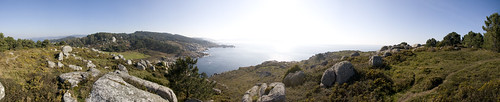
From there we headed to the hills and got a wonderful view over the ocean. Though I was on the lookout, there were no exciting atmospheric optics to be seen, but at least the light on the surrounding countryside was rather glorious:
Galician countryside
Click here for huge!

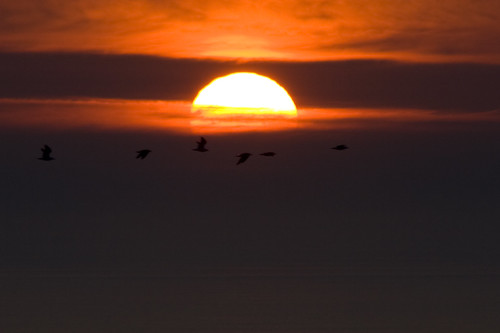
We drove on a little more and finally made our way to a little village having its own carnival celebrations. At the top of the village was a hill with a celtic settlement where we sat down to watch the sun set over the Atlantic. On the lookout for the Green flash I set up my camera on a flat piece of rock, attached the camera release and tried my best not to get blinded. Although I missed the Green flash, I did get a few setting sun photos before it disappeared.

It may be cliched, but as the sun was just setting a flock of birds flew in just the right plane to get the perfect 'birds beneath the setting sun' shot, a must for all wannabe photographers:
birds at sunset
Again, click for larger.

At the end of the day we headed to Cangas, where the local bars were so full that we had to try the completely empty Chinese restaurant. Chatting with the owners for a while they seemed so surprised that I could talk with them reasonably comfortably that they gave me a wonderful doggy bag full of huajiao, sichuan pepper, on the way out.

Anyway, There are plenty more shots to process, but time doesn't allow right now. Keep an eye on my flickr account and the odd one or two may appear in the next week.

Monday, February 23, 2009

Observing Comet Lulin

Tomorrow Comet Lulin makes its closest approach to Earth and I have my alarm set for 5 tomorrow morning to try and get a glimpse of it. If you want to find where to look to find the comet then I can highly recommend downloading Stellarium, the best desktop skymap program I've found, by far. From this page, you can find the instructions on how to add Comet Lulin to the encyclopedia of objects in Stellarium. It's then very easy to find exactly where to locate it after you've input a few bits of data about your location.

Comet Lulin from the Nasa website:


Anyway, I'll be looking to get some photos tomorrow early morning and will post anything that is worth looking at. I stretched my camera and lens to their maxima last week by getting a photo of Venus in its half lit crescent state. While it's certainly not the greatest venus shot ever, it is nice to see what can be done without a telescope.
venus

Sunday, February 22, 2009

Arrival of spring

After what seems like unending months of rain, including hurricanes which have brought much distruction to the area, the sun has finally begun to push itself through the murky gloom of Atlantic weather fronts. The last few days have been sunny with a brisk chill, but today brought the first true rays of warmth to Santiago. I was supposed to have a Couchsurfer come to stay for the weekend, but in the end her plans changed. She had a little time in the morning before she had to leave the city so she came round to chat for a couple of hours. The flat was still in disarray after a hotpot meal I'd cooked last night for seven friends though the bulk of the cleaning had been finished before bed.

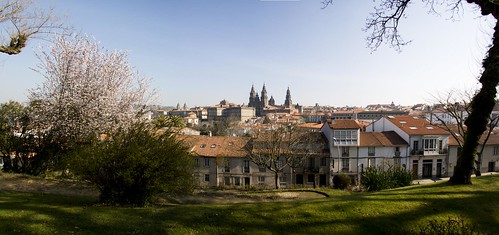
Anyway, with only a fleetingly short time to see the city we headed for the Alameda in the glorious morning sunshine and took a stroll roll to the point which I believe gives the most glorious view of the city. I took the opportunity to get a panorama of the basking buildings (click for much, much larger):

 Santiago from the Alameda
I've been working like crazy for the last few weeks, finishing most nights at around 2 am, and this was the first time in far too long where I could simply stop, for a few minutes, close my eyes and take in the warmth of Santiago. It was a wonderful, if brief, respite, and as we walked around the park and chatted I really did find myself winding down.

She then headed off for her future adventures and I returned to my routine once again - cafe, work and a few odds and ends of shopping to stop my flat falling apart.

Anyway, I've just about finished work for today and tomorrow holds some rather exciting adventures  which I'll write about in the evening, all being well. For now, I hope that the weather is as good where you are as it has been here.

Wednesday, February 18, 2009

AdS collective in Madrid

I've just returned from four fantastic days in Madrid. In fact it was only a last minute decision to attend the conference at all, but it has been well worth it. The topics and speakers were right on target for my current interests, and the discussions generated by the talks were constantly enlightening and provocative, without being aggressive (well, mostly).

I also had a chance to catch up with more friends, and meet more new people than I've been able to at any previous conference. As you travel more and more, and build up collaborations, such meetings simply turn into gatherings of friends. This, a far cry from the days, not so long ago, that I would go shyly into a room full of unknown faces and not have a chance to join in the discussions, whilst being bewildered by the talks. Anyway, three non-stop days, in the process of which a good number of new ideas have been generated and the fuses of older possibilities have been relit.

For now I have to get on with several projects in the next two weeks before another collaborator comes to visit at the beginning of March, so I'm going to try and fit in as much as possible in that time to see how far we can get with the current ideas which are taking shape.

Away from the conference, the time in the city itself was also excellent, as I couchsurfed with a great couple of local Madrilenios in Aleche, in the South West of the city. As well as myself and the two hosts there was a German erasmus student, plus a girl from the US and one from Finland staying on the various couches and mattresses around the house. One of my primary goals as a host is simply to make my guests feel at ease and at home, and the two guys putting us up were masters of this.

While I didn't have much time to socialise with everyone in the flat apart from cooking them a meal on Monday night I did have a bit of a tour of the centre of Madrid on Sunday afternoon. In the glorious Madrid sunshine we went to relax in Parque Retiro where hundreds of people soaked up the first few warm days of the year, while drummers bongoed and jugglers entertained everyone sitting out by the lake, getting ready for the week ahead!

Anyway, I come back tired but enthused and look forward to getting my teeth into these projects in the next couple of days.

Thursday, February 12, 2009

Always with the if onlys

I happened to stumble across an old post of mine, from back in the era of cold Beijing nights and surreal days which promised the unexpected around every corner. I've been away from there for over a year now, but it stays in your blood - everyone I know who has spent serious time there attests to this. The feelings of true love for that city are those of a stormy relationship, with highs and lows which even in retrospect bring back vivid feelings of elation and desolation.

In fact it wasn't the content of this particular post that I was reading, written around two years ago which caught my attention, but a little twang of nostalgia for the days that I took great pride in sculpting a post, paying attention to the flow and rhythm of every sentence and, on occasion if I was very lucky, causing others to comment that they had enjoyed the insights, the weirdness, the humour, or simply the string of words.

These days I'm busy, really really busy. I've had to slow down the social activities a little as I've turned my days inside out. Spending time in the office in the day and the library at night, reading the piles of papers that await my attention does not make for a very sociable timetable. I'm learning, I'm playing with new tools and ideas, and I'm enjoying it a lot, I would even go so far to say that I feel a current boost of creativity. But still the call of the open road was brought to my attention by the piece of writing that I put forth not so many moons ago.

Anyway, despite the momentum of work which I've promised myself will go on for the next couple of months at least - provided I don't burn out, I do feel the need to explore. Once again I'm feeling a little hemmed in by this beautiful, but undeniably small city. I want to get out at the weekends occasionally for an adventure, and though I enjoy my weekend trips to the local cafe where I continue with work, somehow I'm not feeling fulfilled by the current balance. It's a difficult balance to strike however, and the guilt and drive of wanting to get the work done must be carefully offset against my natural need for new stimuli.

Anyway, this Sunday I'll be heading to Madrid for the AdS collective at the beginning of next week, so I'm not going to be able to escape this time. However, I'll see what I can cook up for the coming weekends and hopefully look to post something more in line with what I have always envisioned this blog to be about.

Tuesday, February 10, 2009

CERN winter school 2009 lectures up online

Sadly I'm not able to attend this year, but it looks like there are a great group of lecturers giving talks on topics related to string theory. Unlike last year the lecture videos are being posted online immediately and there are already the first couple of days worth uploaded.

Take a look here to learn about fluid dynamics from AdS/CFT, the black hole information paradox, beyond the standard model physics, and more.

Monday, February 09, 2009

Atmospheric optics picture of the day

I posted about the wonderful solar halo display over Porto last autumn. Of course I sent my photos to atoptics and got an excited response that I may have captured a rather rare display. After much analysis of my large set of photos the good news is that indeed I was lucky enough to see a full display of Lowitz arcs. The pictures and description are up online at atoptics now as the picture of the day.

Portohalos-15

Saturday, February 07, 2009

Degenerate synchronicity via Dropbox

I've discovered a tool which, over the last week has considerably simplified the awful mess which was an unsynchronised set of work files, spread between my office computer and my laptop. With 20 versions of every file at different stages of completeness it was getting ridiculous.

I write a lot of files, mostly for mathematical programing. It's what I spend most of my time at work doing, and I enjoy it a great deal - the breaking down of a complex problem into workable, smaller steps which are understandable and efficient is as much a game as anything, it just happens to lead to papers and new results, which is always good.

Anyway, because I create lots of files at work which I often want to continue working on in the evenings I would normally e-mail myself the file, or take it home on a usb stick and add to it at home or in a cafe. At home I would regularly create two or three new versions of this program as I tried out new methods to solve a problem. The next day I would take one or all of these to work and continue working. The outcome was that I had dozens of different versions of every file and I was frequently confused as to which file was the newest/most correct version. My two computers got more and more out of synch as the degeneracy in files melted and the whole thing became a great mess.

Until now...Dropbox is a wonderfully simple application which in a matter of 24 hours seems to have solved all of these problems, and more. It's free to download and has an online storage capacity of a couple of gig (plenty for my current mathematica files).

When you download it and set up an account, the program creates a folder on your computer. You then put files into this folder and a copy of this folder which is online synchonises with that on your computer. The two versions only synchronise when you turn on the program on your computer, but what I've found best is to turn it on automatically when I log on in the morning, and then again when I log off at night, to get everything up to date. Provided I haven't created any huge new files it should take a matter of seconds.

So, the vital part is that I have a second version of the folder on my laptop. It again is synchronised to the version on the internet. When I update a file on my computer at work, as soon as I go home and connect my computer to the web, I have a synchronised version on my laptop with everything I've done during the day. I effectively now only have a single version of my files, it's just no longer local.

What is more I can connect to these files wherever I am by logging into my account online and using the web interface to get any file I want - be it a talk, a mathematica file, or a half written paper. There is no longer the problem of having multiple almost equivalent versions of the same file - life has been greatly simplified!

Of course I'm not relying on this system to hold up (though I have no reason to suspect it won't) so I back up my files religiously with Time Machine.

Anyway, I would highly advise this program to anyone else who has problems with the mess of using multiple computers, or who simply wants some free online backup. Definitely worth spending a few minutes to get your life back in order!

Thursday, February 05, 2009

Gijon summation

I'm back after around 6 hours in the car from the conference in Gijon. For me it was a good chance to meet up with friends from around the Spanish strings community and it's always good practice to give a talk to such an audience - I spoke too quickly again, my perennial problem in a half hour seminar. Most of the talks were simply too technically oriented in realms that I have no active experience in to be of much use to me, but I did leave feeling quite happy, in a strange way.

Going to the strings conference in Beijing three years ago I left feeling rather depressed that I wasn't able to follow all of the talks. I felt this a great failing on my part and that I had an insurmountable quantity of material to learn. Three years on and I have learned a lot, but I've also realised that I'm simply never going to be able to follow all specialised research talks, and that's just fine.

Not understanding them isn't a fault, but simply an indication that it's not an area that you've worked in, or spent weeks reading about. Though the work is clearly important I have little direct interest (at the moment) in knowing about tensor hierarchies in 4d supergravity. Such seemingly abstract subjects (from my stance) are clearly vital for the building of the subject that I work in, but if I spent my time learning all about this, I would never have a chance to get any of my research done - my priorities lie elsewhere.

It's taken quite a long time to get to the point where I'm happy to expand my area of expertise without feeling constantly embarrassed by the fact that there's so much more still to learn in other areas (this feeling hasn't vanished completely, mind). This fact may sound trivial, but I've met a lot of young researchers leaving conferences feeling considerably more stupid than when they arrived. Step by step you get there, but you don't have to understand every aspect of string theory and supergravity at once.

The most interesting talks from my perspective were those by Jose Barbon, on non-relativistic AdS/CFT and by Jan de Boer on Brownian motion in AdS/CFT, both of which I do intend learning as much as I can about in the near future.

Anyway, re. the city of Gijon itself, I'll post some photos when I've had some sleep, digested the cabrales and caught up with some pressing work. Next stop is Madrid for a three day meeting on AdS/CFT and it's applications to finite temperature and condensed matter systems - this should be a fantastic meeting with a lot of very good people going.

Tuesday, February 03, 2009

A quick update from Gijon

Just a quick update to mark the silence. I'm currently at a three day conference in Gijon, in Asturias where I'll be giving a talk tomorrow. The crowd of around 30 people here, mostly working in gravitational aspects of strings and branes, make up a pretty hardcore crowd of theorists from my perspective, but there are some interesting talks, in between the indix juggling and and miscellaneous mathematical acrobatics.

This is my first time in Asturias (around a five hour drive North East of Santiago), and we managed to sample the local delicacies of cabrales (a strong goat's cheese) and cider, oxygenated by pouring from a great height, or spraying out of some complex piece of cideroxygenating machinery (as seen on this page).


I have a bunch of other projects to be getting on with for now, and have had to retreat from the last lecture today to finish some things before dinner.

Anyway, had better get on, but in case you were wondering, this is where I'm at.

Saturday, January 31, 2009

Monte Pindo redux

This week has just been a little too busy for my liking, though with a visit from a researcher from Madrid who is working in a very similar area, it has been pretty productive too. I've only made it to the library at night a couple of times and next week I head off to a meeting in Gijon, so my schedule is going to have to be on hold until I return, at which point I hope that the pile of papers waiting to be read won't have multiplied too many times.

Anyway, I just got an e-mail from a Couchsurfing friend to say that the video he made on the day that a dozen of us went for a walk up Monte Pindo, on the stunning Galician coastline, has just been uploaded to youtube. The video captures beautifully the serenity of the scenes (though it misses our frantic scramble down in the dark!) - it also has a rather tranquil scene of me in photography mode creating this panorama (although I may simply be the greatest blot on the landscape in my movie history). Anyway, with many thanks to Voyta for these great memories of a day when we managed to get away from it all!

Monday, January 26, 2009

Happy New Year!

New Year in China is a surreal experience. I look forward to the next time I can be there for this amazing event. In the mean time, thanks to Meiadeleite, I found this video which is the only one I've seen which comes close to showing what a large Chinese city is like at New Year. It really is the closest thing that most people will see to a war zone. The first year I was in Beijing was the first time people had been allowed fireworks in some 13 years, the display lastest almost non-stop for two weeks and the pollution levels went through the roof. You had to be careful walking anywhere you went because people stand in the middle of the street and let them off left, right and centre. Anyway, Happy New Year!

Sunday, January 25, 2009

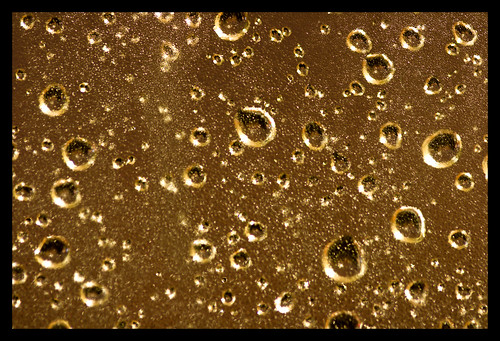
Through my window...

...looking at a rainy Sunday afternoon.

bubbles drops and bokeh

Saturday, January 24, 2009

Saturday loose ends

Santiago is still standing after the storm yesterday which caused a couple of blackouts through the night (link from here).

I fear that this means that my code which was running overnight will not have been saved, so I'll have to go back and restart that some time this weekend.

In the meantime I've been trying out a new piece of software: Mnemosyne, which is similar to the interval learning software, Genius, which I wrote about some time back. The benefit of Mnemosyne is mostly that there are plenty of ready made word lists in Spanish and Chinese (amongst many other languages). The interface takes a little more time to get comfortable with, mostly due to its simplicity, but it seems like another good system for interval learning. (NB. See also Kevin's page with some great links to more Chinese files for Genius)

This morning I also found a series of lectures at the Perimeter Institute (as I followed a link from Bee's blog) which look excellent. In particular, this course from Alex Buchel which is an ongoing course on String theory promises to be a valuable resource for those starting off in this subject without any other directed learning. Also check out the extensive course on Quantum field theory.

(Random, no context link to a multigigapixel panorama from the Online Photographer. I shan't be processing anything like this any time soon!)

Anyway, another busy weekend beckons including the promise of plenty of good Chinese and Korean food tonight with a Korean birthday to go to. Kimchi supplied by yours truly.

Friday, January 23, 2009

Incoming

Record low pressure is predicted, the rain is building and the wind is whistling. Schools are closed and classes canceled in the university today (though we're all still here, listening to any word from the Galician weather services working down the corridor). It could turn out to be nothing but the promised storm may be a biggie. I'll keep you up to date.

Wednesday, January 21, 2009

On the shoulders of...

I have a little while before I head off through the currently lashing rain to do my now routine few hours in the library, which I'm currently thoroughly enjoying, and certainly getting a decent amount done in the wee hours of the morning.

I wanted to post a quotation, which made me chuckle, which I came across last weekend while reading Steven Pinker's book 'The stuff of thought' (authors@Google talk on this book),  a study on how we can learn a great deal about the way we think through the way we speak and pick up language. I've never been disappointed by a Pinker book yet, and generally close the last page with a thoroughly altered perception of the world from that which I started with.

In a chapter focusing on the inateness of language, Pinker choses to discuss the extreme possibilites, starting with the ideas of Jerry Fodor, who believes that we are born with around 50,000 concepts which are pinned with their corresponding vocabulary when we come across the words which fit the concept. Though Pinker clearly has some fondness for Jerry, he does dress him up as the joker and discusses the straw man concept specifically to build him up and knock him down. Pinker clearly isn't alone in his dismissal of Jerry's ideas. The quotation below, more humorous than insightful into the world of neurolinguistics, comes from Dan Dennet (see here for a great TED talk on dangerous memes), whose writing I enjoy very much:

Most philosophers are like old beds: you jump on them and sink deep into qualifications, revisions, addenda. But Fodor is like a trampoline: you jump on him and he springs back, presenting claims twice as trenchant and outrageous. If some of us can see further, it's from jumping on Jerry.

Incidentally, the argument and mockery is not unidirectional, with Fodor arguing against Dennet's very machinery of philosophy - see Fodor's wikipedia article for details.

On a similar note, after being rather disappointed with Maryanne Wolfe's first couple of chapters of Proust and the Squid: The story and science of the reading brain I was extremely pleased that it picked up considerably and though there were occasionally too many unnecessary details on the neurophysiology behind her ideas, the sections on dyslexia, especially with respect to the condition in different languages, was fascinating.

Anyway, about time for me to brave the weather, plenty of papers to read through tonight...

Tuesday, January 20, 2009

It's been a strange old day...

Nothing of any particular note, just one of those strangely shaped days which you don't quite know where to place.

I woke this morning with a sore throat, feeling generally shivery after entertaining for 12 last night (seven from Korean, one from China, whose birthday we were celebrating in my flat, one Austrian, a German/Macedonian a Gallego and myself). The wind and rain this morning where rattling my windows and the thought of going to work in such conditions rather filled me with dread...I pulled the covers up and hoped that either the Galician weather or my throbbing throat would disappear quickly...neither of which happened before 6. I spent the day watching some video lectures and catching up with admin, certainly nothing terribly noteworthy, on this, the most depressing day of the year.

Anyway, by 7 I was feeling sufficiently fed up of being unproductive that I headed into the department and printed off some papers before heading into the library around 10. I'd never been to the main campus library and it was a rather nice surprise. I met with a friend who is revising for some Spanish exams and finds, as I do, that her concentration is honed at night when there are few distractions. We headed down to the basement level, packed with students cramming for their exams and sat at one of the banks of well lit tables next to the Japanese-styled indoor garden with a small stream running through it and paving surrounded by lush vegetation. Reminiscing of my productive days in Kyoto I can think of nothing better than this setting, away from the distraction of the world above yet in an idyllic setting with the bonus of being surrounded by books!

Anyway, it was a very useful few hours and coming home at 2 this morning I've certainly got a lot more done tonight that in the same amount of time for quite a while. I fear that my hours may just have to shift to take advantage of this tranquility, but I'll definitely give it a go. A few hours in the office in the day, a break in the afternoon and a few hours at night with nothing but pencil and paper and the sounds of a gently flowing stream to accompany me sounds like something I could make a habit of.

Thursday, January 15, 2009

Running away from us

I thought this was a particularly startling look at how fast we are accelerating technologically. A big lesson we can learn from the past is that we have virtually no idea what the future will look like!

From NEQNET.

I need another week between now and the weekend to get half the things done that I was hoping. Still, it's been reasonably productive so far. Tomorrow we'll hopefully finish off a review and then I have to get back to the four hottest projects on the fire.

Sunday, January 11, 2009

Full moon over Santiago (largest full moon of 2009)

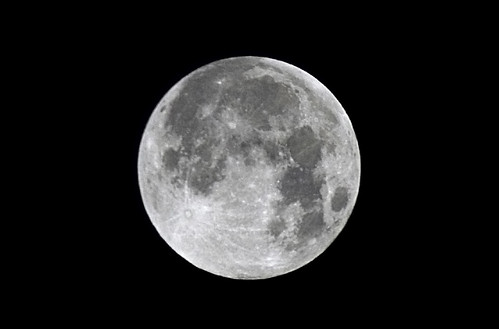
I set my alarm this morning for 5.30am, because only at this time can I view the moon at perigee from the comfort of my living room, with the tripod set up, and without freezing to death while setting up the shot (the window stays open for only a little longer than the 1/800th of a second it took to get this shot). Of course you get less contrast in a full moon than a crescent moon, but it's still a lot of fun to play around with the new zoom. I still yearn for liveview!

full moon
Click for larger.

Saturday, January 10, 2009

Linky goodness catch up

It's really good to settle back down to a normal routine here in Santiago, however busy that may be. I was greeted with friendly smiles in the cafe that I hang out at every weekend and it's always a good chance to get on with some random bits and pieces of research/Spanish/Chinese and other miscellania. Work picked up straight away and it's going to be a hectic few months. My first trip will hopefully be to a workshop in Gijon where I'll be presenting a talk on transport coefficients in holography, as in Madrid last month.

As a random Saturday sample I thought I'd catch up with a few of the links that I've clicked on over the last few weeks in my feedreader. I'm simply going to post them in rough date order, so have a browse through and see what you find interesting.


Sir Ken Robinson's new book, The Element. If his TED talk (School kills creativity) is anything to go by, this should be a fascinating and very well written look into finding one's passion in life, including case studies of artists, physicists and movie stars.

Scott Aaranson points to Freeman Dyson's article discussing P versus NP. This article doesn't go into the complications and details of this famous theorem, but it's a good starting place to start rummaging through Scott's many excellent posts on computer science and mathematics. In particular, I thought that the following sentence stood out as an important point to take from one of the most slippery concepts in mathematics:

P versus NP is the example par excellence of a mathematical mystery that human beings lacked the language even to express until very recently in our history.
Martin at Khymos discusses a recent culinary trip and a miscellany of interesting points from molecular gastronomy. I link to this in part because it includes a note on Peter Barham, who taught me thermodynamics at Bristol University and happens to hold the world record for the shortest time to make ice cream (demonstrated in a memorable class with his world-famous liquid nitrogen technique).

On the gastronomy front I'm planning on making a trip down to Extremadura one weekend to go and sample the morally acceptable fois gras, as discussed in this TED talk by Dan Barber.

Following the discussion by Phil Plait's (who is in the popular running for the next NASA administrator) some time ago that we may be in the sights of a potential gamma ray burster in our back yard, it seems that we should be in the all-clear given some new results on the orientation of the binary system, from Universe Today.

Blake Stacey has a sci-fi novel out which looks like a lot of fun, and includes String Theory in it's keywords! If his fictional writing is as good a read as his blogging then this should be a lot of fun. I'll be sure to pick up on any AdS/CFT anomalies however ;-)  (Until Earthset)

Dimitry at NEQNET points to a set of lectures by Leonard Susskind on quantum entanglement which I've started watching and are rather good. With 15 hours of online lectures, that's going to need another day in the week for now though. NEQNET has a lot of thought provoking posts, including a recent couple on AdS/QCD from guest-blogger Josh Erlich.

If you haven't already read The man who loved only numbers, I would highly recommend it as a look into the mind of one of mathematics' most prodigous and intriguing characters, Paul Erdos. All of his papers are now available online (from God Plays Dice).

Again from Universe Today, not content with simply finding extrasolar planets, astronomers are now looking for moons around extrasolar planets (exomoons). One of the reasons for looking at this is that we may be able to find Earth-like moons circling larger planets in the habitable zones of sun-like stars. It seems that the techniques works by looking for the wobble in the wobble of the star.

A meeting of skeptical minds par excellence, Dawkins interviews Derren Brown on the art of stage psychics.

Going back some considerable time now, Boingboing links to Malcolm Gladwell's article detailing the importance and difficulties in finding good teachers. Seems obvious, but as always Gladwell makes you realise how much more there is to such a situation. Gladwell added some of his additional thoughts on his blog.


Toomanytribbles continues a fine stream of interesting links on atheism, skepticism, photography, fun and wonder, interposed with wonderful photos. One of my recent favourites from her photostream.

Atoptics continues to provide excellent information on atmospheric phenomena and was the main source for my colloquium on the subject back in December. The recent Wendelstein halo was a stunner.

That'll do for now as a gentle brush at the surface of webby goodness.

On a side note and to make up for the time spent catching up on the above links, I've found a solution for my inability to stay away from e-mail for more than a few minutes. It may seem a bit much, but I know this is a problem that I'm not alone in having and this technique works for me. If you're suffering from the same modern addiction, try setting an alarm clock on your computer to go off at designated times (mine goes off five times a day), and only then check your e-mail. It's sad, but I personally need this self-imposed constraint and the time I save is worth the humiliation of admitting to such a foible. Personally I use this one, but whatever works for you

Anyway, now to catch up on some papers from last week.

Tuesday, January 06, 2009

Back to Spain

Update: Safely back in Santiago after a very long night with an hour sleep split between the coach, the airport departure lounge and the airplane seat. Not in a fit state for clear thought right now but will have a good night's sleep tonight and hopefully get back into the swing of things tomorrow.

---------------

Tonight I'll be making my way back home to Santiago. The journey is a long and tedious one as I have to get to a rather awkwardly placed airport for an 8am flight. I'll be leaving home at 12.30 tonight for a 1am bus which will get me to the airport at 4, where I'll hang around until the two hour flight back home at 8. The journey door to door is roughly the same as door to door Oxford to Beijing, but I am looking forward to settling back into 'normality'.

Getting back to Santiago I have a couple of big projects to get on with, including arranging a long program for 2010 and three papers which are, as normal, in the pipeline.

For now I'll get on with packing up for the journey tonight and will get back to you when I'm settled back into Santiago.

Sunday, January 04, 2009

The Moon over Oxford

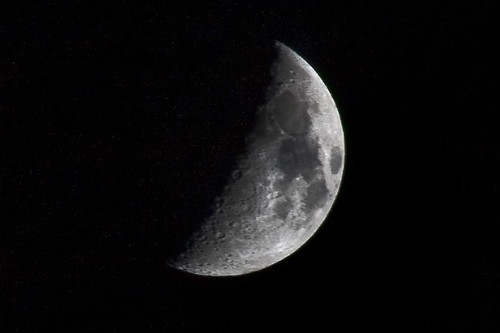
I still have a long way to go with getting a feel for the new lens, but the moon was looking too good to miss last night. A slight mist meant that the focus isn't perfect, but it's come out quite well (thanks to Toomanytribbles for the idea to turn off image stabilisation when using a tripod). I applied a little tone mapping to bring out the areas which were very bright so that there was a little more texture and I'll be keeping an eye out for the full moon in a few days. I'll keep you posted.

The moon from Oxford
I had a look last night but was rather too early to see the quadrantid meteor shower. Did anyone else see them early this morning?

Notice by the way that Neptune is close to Venus at the moment and at magnitude 7.9 it's spottable with a pair of binoculars or a camera. I'll see if I can get a shot of it in the next few days. Mercury should also be visible with the naked eye just after sunset.

Saturday, January 03, 2009

My guide to (mostly) SLR photography

Part 1/n (where n may be 1): Exposure

I've been wanting to write something like this for a long time. I've had the opportunity to share what I've learnt about the technicalities of SLR photography with a fair few interested people over the last six months or so, and while they seem to leave fairly happy, I know from experience that it takes a while to become confident about whether the bigger numbers mean more light, or less light, or deeper or shallower depth of focus etc, and what's really most effective for each situation. So I thought I'd try and write up a little guide that I can point people to when they're unsure. The answer is that it's very easy, but it does take a while to become somewhat natural.

Note that I still have a long way to improve, but on the technical side I think that I at least understand what's going on, even if I can't always put it into effect as I might like every time. This is also not solely for people with SLRs although some things may sway more towards digital than film, simply because that's what I'm used to. Many point and shoots these days allow good control over the variables that I will be describing here.

This guide is also to be used in addition to the manual of your camera. The controls used in order to change the variables I will talk about here will vary from camera to camera and you'll need to look this up yourself if you don't know already. This should be pretty easy! 


The Variables

Essentially in what I'm going to talk about there are three variables to play with. These are: Shutter speed, aperture and ISO, or film sensitivity. Changing these variables will alter in turn, how much motion is stopped or blurred, how deep your depth of field is, and how grainy your photography is (note that all of these can be good or bad, depending on what you're aiming for). In addition they will also affect the amount of light hitting your sensor. The game is to get the correct depth of focus and motion stop or blur, while tuning the variables to get the right exposure. It's a science which is relatively simple, but when you're out there with only a moment to get the shot, it turns into an art.

I won't talk too much about the controls on the camera, which will vary from make to make but there are some things which are relatively general. Many cameras have not only a manual setting, which allows you to change all of these three variables independently, but also an AV and a TV setting which allow you to vary the aperture and the timing respectively, letting the camera work out the optimum conjugate variable. I would advise starting with the AV and TV settings simply because it gives you less to think about and allows you good control in many situations. I'll talk about this more at the end. However, first I'll explain ISO, because this is relatively simple and is needed for all non-automatic settings. You can generally control the ISO whether you're in manual, AV or TV.


ISO in a nutshell

The ISO dictates how much light needs to fall on a given patch of the sensor for it to record a signal. The lower the ISO the less sensitive. However, in order to increase the sensitivity of the sensor (by using higher ISO), it means that the area for each 'grain' of the photo is larger, so that less light needs to be falling on the whole sensor for a given grain to trigger. What this means is that if you want a clearer image, with less grains, then ideally you want a low ISO, and if you want a grainy image you want a high ISO. However, sometimes you have to go to high ISO even if you would really prefer a less grainy image. The reason is that because of the other settings you have chosen, not much light is getting onto the sensor.

Summary:

  • Low ISO = lower light sensitivity (often good for bright conditions), and less grainy pictures.
  • High ISO = higher light sensitivity (often needed in dark settings), and more grainy pictures.
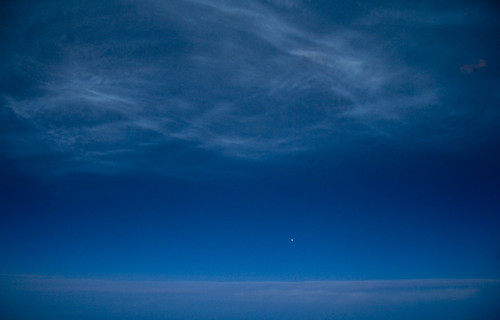
I took the following photo at ISO 1600, which will always give you graininess (though I've reduced that a little with noise reduction software). I would never usually use such a large ISO unless the lighting was very low and I couldn't put the camera on a tripod. From the plane that I was sitting in, this was not an option. Noctilucent clouds over Mongolia:
Noctilucent clouds
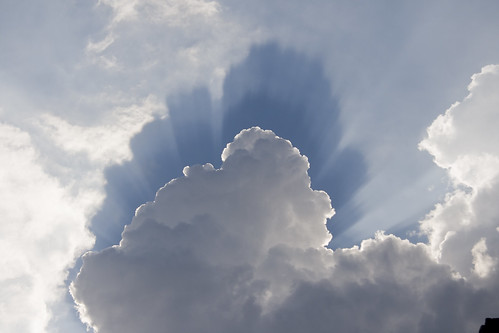
This was taken with a low ISO, as the subject was bright - I didn't need a sensitive sensor algorithm to get a correct exposure as there was already lots of light falling on it. There is less grain in this photo. Cloud shadows over Seoul:
cloud shadow

So, having understand that we have control over the sensitivity through the ISO control we move on to aperture and shutter speed. Each of these alters the amount of light hitting the sensor but also alters the picture in other ways. We'll deal with aperture first:


Aperture

The aperture dictates how wide the diaphragm of the lens is. The smaller the aperture, the less light is getting to the sensor and the larger the aperture, the more light gets in. The other, important effect of aperture is that it changes the depth of field of your photo. A larger aperture will give you a shallow depth of field, whereas a smaller aperture will give you a deep depth of field. Depth of field really means how much of your picture is in focus. In fact it's only possible to get a single distance in perfect focus (without very fancy optics) but how quickly the other distances become more blurred (the falloff in focus) is known as the depth of field. It might initially seem like it would be best to get everything in focus, but in fact for many opportunities this is not the case. Portraits are the perfect example of occasions where you really want only a certain area of the picture in focus.

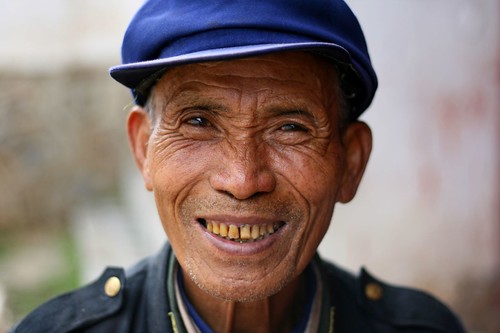
Here is an example of a photo I took in Lijiang. This was taken with a lens with a large maximum aperture (I'll come onto the numbers soon):
IMG_3934
You can see that the blurring of the background gives a good contrast and makes the face stand out much more than if you had been distracted by the areas of the picture which are not important for this subject. Of course with this large aperture you are also letting in more light and so can afford to use a low ISO (you don't need a large sensitivity if you're letting in a lot of light already).

In contrast, this photo is taken with a very very small aperture, meaning that there is a huge distance in relatively good focus:
art museum black and white

However, because there was so little light getting through the very small aperture and because I didn't want a grainy image, I had to take a longer exposure to let enough light onto the sensor to give a well exposed image. I rested it on the floor to stabilise the camera. I'll come onto the shutter speed in the next section.

The measure of aperture is f-stop, and there is a great deal to understand about how much you will change the light entering the camera when you change the f-stop by a certain amount, and how you need to change the ISO or the timing to counter this, but I would recommend not worrying about this too much at first, but simply playing around. What is important to know is that a large aperture is given by a small f-stop. The man in Lijiang above was taken at f/1.4, whereas the reflection in the museum was taken at f/29. For a normal landscape I would usually use something like an f/9 or thereabouts, all things being equal, but it depends on the lighting conditions and how much I want in the good focus. In fact the crispness of an image will also be affected by the f-stop because each lens really has an ideal aperture for the sharpest image possible.


Summary:
  • Large aperture = small f-stop (f/n where n is small) gives you a shallow depth of field but lets in more light
  • Small aperture = large f-stop (f/n where n is large) gives you a deeper depth of field and lets in less light
And the third variable you have control over is.

Shutter Speed

This is pretty clear. The slower the shutter speed the more light you will have hitting your sensor, and the more motion you can capture. Depending on whether you want to freeze a moment or capture the blur of motion you will want to alter the shutter speed to a slower or faster setting.

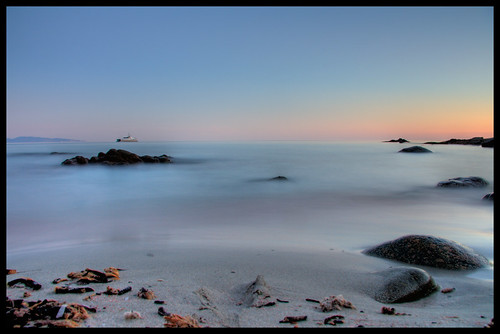
The following is a ten second exposure of the sea in Corsica. The long exposure gives a silky look to the water:
beach at dusk
However, in order not to let in too much light it was important that I had a low sensitivity (low ISO) and a narrow aperture.

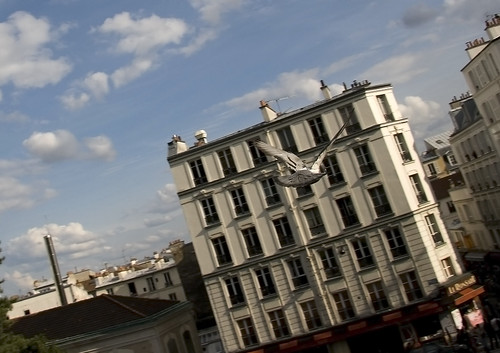
This lucky shot was taken at 1/400th of a second (actually I took it over my shoulder as the pigeon flew past):
pigeon capture


Stable images:


One thing to watch out for is that even with image stabilisation (and depending on the magnification of your zoom) you are unlikely to be able to hand hold a shot for more than about 0.2-0.3 seconds without it being shakey. Any more than this and you will need a tripod or something to balance the camera on. At large zoom, the time you can hand-hold will drop significantly. For 300mm even a 1/100th second shot will come out blurred if I'm not very very careful.

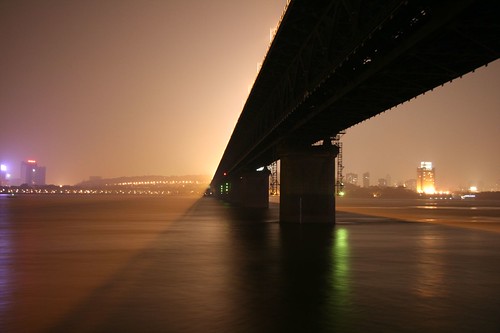
In many situations a tripod is essential for getting the shot. This ten second shot of the first bridge over the Yangtze river in Wuhan for instance. This was taken at ISO 400 which means that there's a bit of graininess. If I had lowered the ISO however I would have needed to increase the time of the shot and because my tripod isn't great, you would probably have been able to see the wobble. It's a compromise.
The first bridge over the Yangtzi, Wuhan


The balancing act

The art then is to be able to get the three variables right so that you have:
  • The depth of focus that you want (do you want all the picture or just a little in focus)
  • The timing you want (do you want to stop the motion, or capture the blur)
  • With the correct exposure (you usually want to be able to get the lighting which picks out the detail that you want without saturating anything).
The correct exposure itself is subjective and it's often the case that when one thing is correctly lit, something else in the frame will be too dark or too light - this is where HDR comes into its own but I'm not going to go there now.

At the beginning of this post I mentioned the settings Manual, AV and TV. Manual means that you control both the aperture and the timing. You have full control over the exposure. Generally in your viewfinder you will have a marker which tells you whether your image will be correctly exposed. The light meter is looking at the image and telling you whether, in a certain area of the frame, there is too much or too little light.

In AV and TV you set the aperture and timing respectively. Use these when all that is important to you is to get either the correct depth of focus or the correct speed of shot respectively and you are not worried about the other variable. You can generally tell the camera how you would like the photo exposed and it will calculate for you the correct value for the conjugate variable to get the desired exposure.

Anyway, anyone who has played around with their settings for a while will probably know all the above and more, but I've met many people who have lovely DSLR cameras and haven't had a chance to work out how to control the settings for the best shots in each situation. I hope that this will be a useful guide and will show you that there's nothing scary with the controls which you have at your fingertips.

If you've read this I would appreciate the following:
  1. If there was something which was particularly unclear then please tell me and I'll do my best to elucidate.
  2. If it wasn't useful at all, then don't be afraid to tell me (unless it just wasn't useful because you already knew it).
  3. If I've made any mistakes then do pipe up.
  4. If you've read through it and it has been useful then please give a link to any photos that you've been particularly pleased with.
  5. If you have any extra bits that you'd like me to explain then tell me and I'll do my best.
  6. Have fun with your cameras!

Christmas, New Year and a look back

I'm back in Oxford, sitting in the Summertown Wine Bar with glorious sunshine pouring in through the windows in the roof. It's freezing out but a lovely, crisp day nonetheless.

I have just a couple of days left in England before heading back to Spain. It's been great seeing friends and family, but I'm also looking forward to getting back home and getting back into work which I've been itching to do ever since I realised that a vital file which I thought I'd bought with me was safely and uniquely stored on my computer in the office. Still, I've been able to scribble a few calculations down in the meantime and have plenty to get on with as soon as I touch down.

So, I thought I'd update the last couple of weeks with some photos.

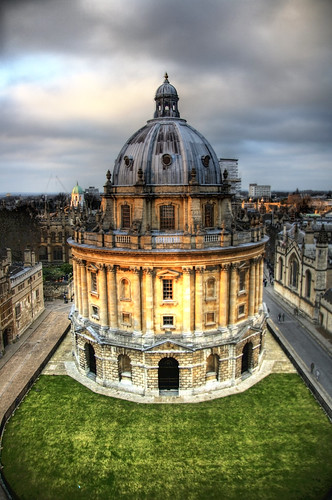
Just after Christmas three of my Korean friends from Santiago turned up in Oxford and so I took them round the city, to see some of the views and the colleges. They were rather disappointed not to bump into Harry Potter in Christchurch but I think that in all they were rather impressed with my hometown. I took them to the top of St Marys on the High Street which offers one of the best views over the city. The sun was low and cast a rather beautiful light over the stone buildings surrounding us, including the Radcliffe Camera:

Radcliffe Camera
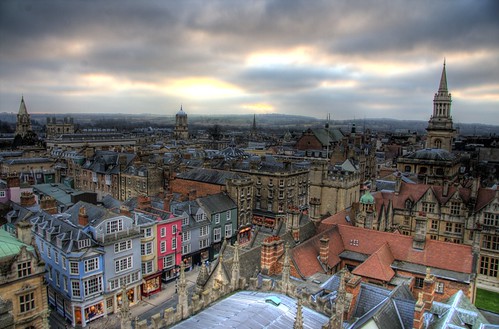
and the High Street and hills in the distance:
View over Oxford2.jpg
After a home-cooked Indian meal I saw them back on the bus to London and I had some time to spend with my uncle and aunt and cousins, catching up after many months without seeing them. I have to bite my tongue not to comment how much my cousins have grown (I didn't appreciate it much when I was in their shoes).

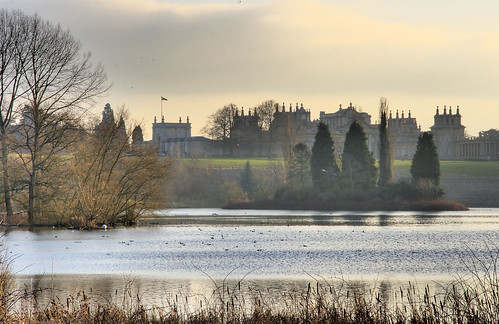
Anyway, with skateboards, juggling equipment and puppets in tow we made our way around various parks around Oxford, including a trip to Blenheim Palace which was great to walk around, having not been there for perhaps 15 years:
Blenheim2.jpg
After saying goodbye I headed off to London to meet up with friends, staying in Mortlake, and Dulwich.

Sitting in a traditional London pub with an open fire and warming up over good conversation and good drink was truly a lovely way to wind down after the normal Christmas chaos. It's great to see friends all doing extremely well in their various endeavors.

On the 30th I made my way into central London to walk along the South Bank to the Tate Modern to see what was showing and get a view over the city (great view of St Pauls from the top floor). The city was bustling with shoppers looking for a bargain and the museums were similarly heaving with tourists. The crowds offered a great chance to try out the new lens which I'd picked up for a ridiculously cheap price on ebay just before leaving.

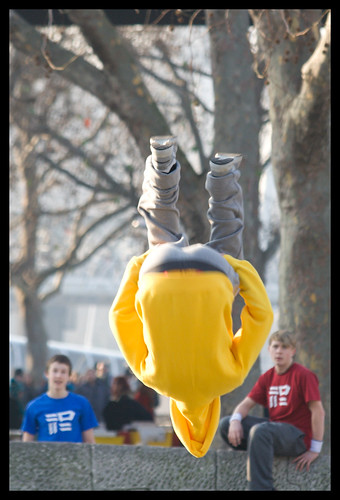
It seems that Parcour is the new Skateboarding, as this time there were more people jumping from bollard to bollard than there were falling off planks of wood:
Parcour
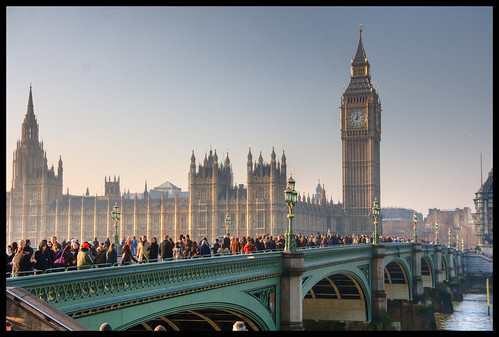
With a 70-300mm lens I could get shots like this from a distance without feeling intrusive. Similarly from afar I could catch the tourists pouring over Westminster bridge:
Westminster Bridge and the Houses of Parliament
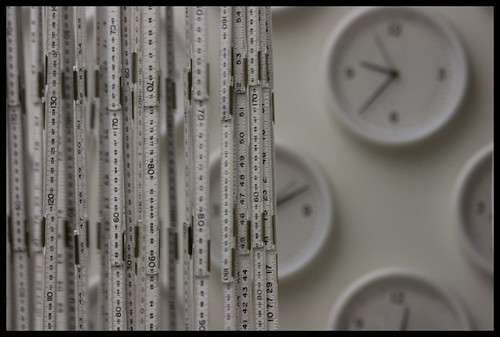
Getting to the Tate Modern I wasn't in a Rothko mood and although I like his work, the idea of seeing it with a room packed from wall to wall with other people somehow detracts from the calmness, so I forwent that for the Cildo Meireles exhibit which I enjoyed a great deal. Rather fun was the room filled with hanging tape measures, with clocks covering the walls. Interestingly the room as a reference frame was never mentioned:
Reference Frame
New Year's Eve was spent with friends in and around Farringdon, at a bar which had been hired out for the evening. Nothing huge, but a great chance to talk with people I haven't spent enough time with over the last few years. We headed back at three, feeling that that was pretty respectable though remembering the days we would have kept going through to the next day with no problem at all.

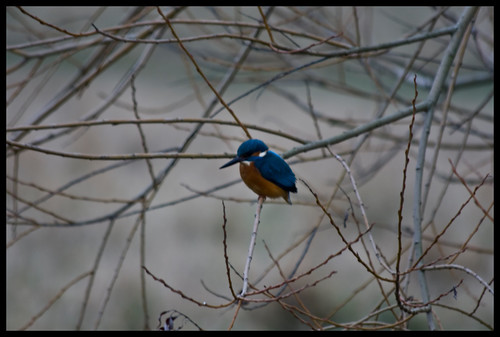
With a chill in the air on New Year's day we went to Richmond park, London's largest park with its local population of deer and parakeets. The park was full of families enjoying the crisp winter's day, people running off their hangovers and amateur photographers seeing what the first day of the New Year had to offer. I was lucky enough to spot my first Kingfisher, sitting by the stream and diving into the water to catch fish. Sadly I never managed a shot as it dove in, but did get a few perching shots.
Kingfisher
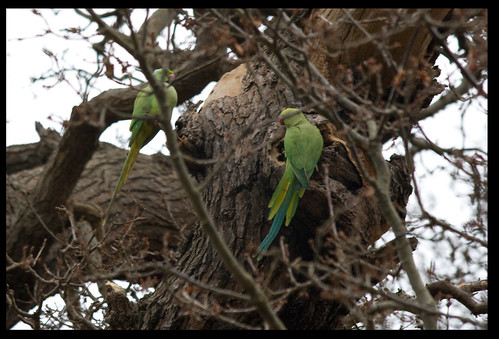
I still have to get used to this lens, as it's clear that on an overcast day I do need a tripod for a steady shot at 300mm. The parakeets were also out, flashing their colours and squawking away incesantly:
Parakeets in Richmond
After the walk I made my way back to Oxford where I've continued to gorge on Christmas food and spent lot of the rest of my time in cafes finishing as many Christmas books as possible. Proust and the Squid on the go now, which I'll talk about later, I hope.

Dreaming in Code was a fun, if somewhat quixotic look at the world of software design. The author spent several years following a company in Silicon Valley which was trying to design and build a large piece of software. It's simply the tale of how difficult it is to coordinate a large team of people to write good code and the frustrations which go along with it are clearly immense. In fact I was attracted to the book by the title, a state that I've got myself into on many enjoyable occasions where a problem won't leave you, even when you're asleep. These tend to be the occasions where I have the most breakthroughs in a problem and it can make you feel hugely focused, if exhausted!

Anyway, I'm going to leave it at that for the moment, but I wish you all a very happy New Year!

Friday, December 26, 2008

Christmas Break

All is well here in Oxford, where I'm back for a couple of weeks over Christmas and New Year. I'm just taking a bit of a break from sitting in front of the computer all hours and leaving the blog to take whatever direction seems most natural after the New Year.

Anyway, being at home with family is enjoyable, but I find myself getting lazy (despite cooking many of the family meals, which brings me great pleasure), something which I find myself easily slipping into but a facet of my personality that I don't like at all. Hence I'm going to take off from here in a couple of days and spend some time in London, seeing friends, going to galleries and sitting in cafes reading some of my Christmas gifts. I've almost finished off Cry, The Beloved Country, a very powerful book about South Africa in the 1940s. After this I'll be diving into some Pinker (who without exception manages to change my view of the world in a few hundred pages), Kundera, Steinbeck and Susan Sontag's On Photography. There are another six or seven in the Christmas pile which I'll write about if I get the chance.

On art and museums, I did finally make it to see Guernica while I was in Madrid. My final afternoon in the city I dashed to the centre and made straight for the Reina Sofia. There is a lot of wonderful 20th century art on display, mostly Spanish, though the centrepiece is without doubt Guernica, a painting which I've read plenty about in a book devoted to this historical piece. It was every bit as powerful as I'd expected and the trip was well-worth it as I stood transfixed with no other museum-goers to disturb me.

Anyway, I hope that everyone else has had a peaceful and enjoyable Christmas! Enjoy the holidays if they're being celebrated in your neck of the woods.
Saturday, December 20, 2008

Madrid in a flash

I returned last night from Madrid, where I've spent the last three days at the Christmas meeting where I was giving a talk and talking with some of the local researchers with whom we hope to start something in the New Year. The workshop was good, but intense and included a variety of topics, from the latest from the Pierre Auger cosmic ray observatory in Argentina, to the latest excitement on the M2-brane mini revolution. We also had a very interesting talk on the accident at the LHC whch gave an idea of the scale of the damage and what was now being done. Indeed the weak-links between the magnets are now being fixed in a number of other possibly vulnerable sectors. The good news was that there were spare magnets for every one which was damaged and it looks like this hasn't pushed the project into the red in any way.

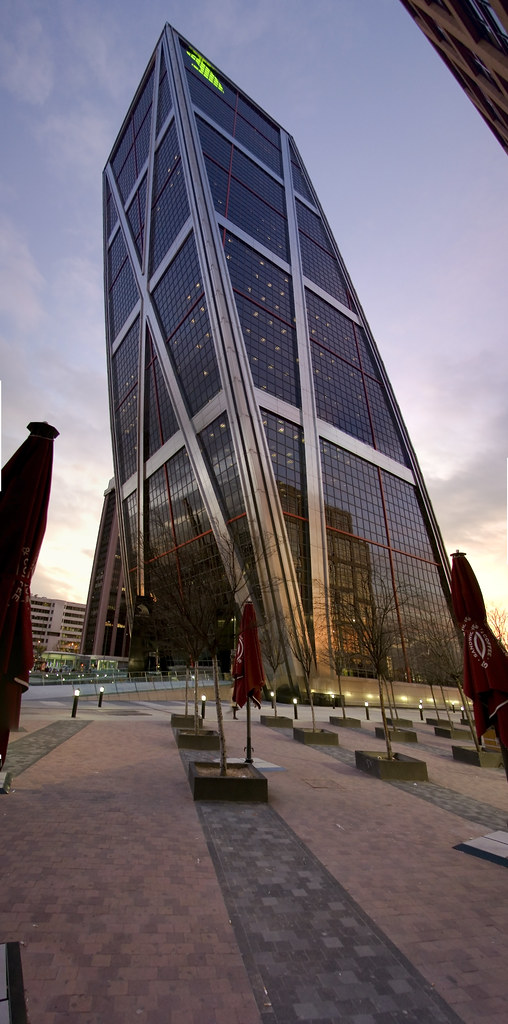
Anyway, a quick picture I took on the way back from the workshop on Friday of this amazing leaning tower close to the Plaza de Castilla.
Panorama2

Anyway, last night my flight back to Santiago made a total of 26 trips this year which could go some way to explaining my current state of exhaustion. I still have a few things to finish off before Christmas including two conference proceedings which just have to be checked a final time, and a couple of calculations I'd really like to get done before I relax completely.

Tomorrow I head back to England where I'll spend a few days at home before running around the country to catch up with friends I haven't seen since doing the same thing last year.

The New Year holds a feast of possibilities which certainly can't be fit into a 12 months so I'll have to see how my time-stretching abilities are working and perhaps give up something to make a little more...sleeping should be first out of the window.

A couple more updates due before Christmas, but for now there's lots to be organised before heading home.

Monday, December 15, 2008

Wasted

Despite the notice on my letterbox asking that no free papers be delivered (helpfully written in Gallego by a friend) today I received a record 19 magazines and other pieces of miscellaneous wastage. Not impressed!
Friday, December 12, 2008

Clay Shirky on wasted hours and the media revolution

If the weather isn't letting you get a good look at the moon tonight, and you're not otherwise being more creative, you could do a lot worse than watch this talk by Clay Shirky, one of the most eloquent and knowledgable spokespeople on the new wave of interactive internet media. This talk, on the cognitive surplus. My favourite quote, from part 1:


Desperate Housewives functioned as a kind of cognitive heat sink, dissipating thinking that might otherwise have built up and caused society to overheat.