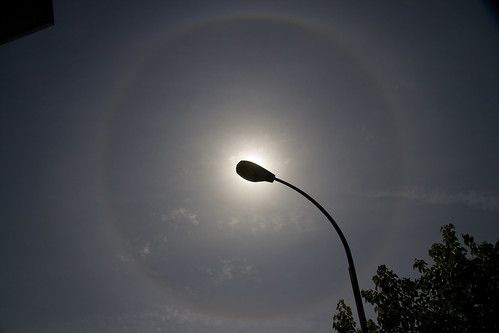
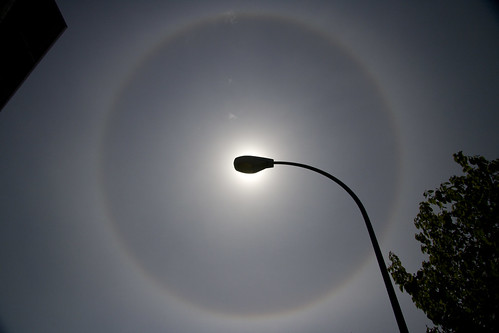
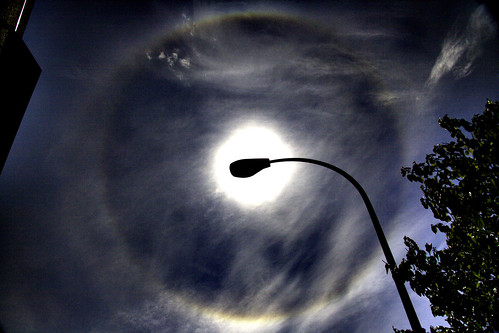
I gave my talk on atmospheric optics today to an audience of perhaps 40. It was smaller than expected, but enjoyable nonetheless and I had more questions than I normally get for a string theory talk! I had been a little rattled by the fact that not only was the talk being advertised heavily around the university, but also on the regional weather station meteogalicia. Still, every Galician and her dog did not turn up and the fears of the previous night were not lived out. In fact combined with a fairly unpleasant day ahead of me tomorrow (triple chalazion excision) I worked myself up into a bit of a sweat and only managed an hour's sleep last night. Still, it's been a good experience and I'd be happy to give this talk again.
My talked introduced the physics of: ice halos, glories, heiligenschein, opposition effects, all sky crepuscular rays, mirage sunsets, green flashes and rainbows, including a few animations to discuss the detals of the optics for several effects. I spent most of this week digging into atoptics to get more information, and Les Cowley who runs the sight has been extremely helpful.
In looking for a little more information last night I came across an article by Sir Michael Berry (of Berry Phase fame and winner of an Ignobel prize for frog levitation). I remembered he gave a talk when I was an undergraduate in Bristol on his favourite things in the world of physics and this had included a section on rainbows. I tracked down an article he wrote for Physics World on a review of a book on rainbows, which included a quote from Descartes. This was exactly what I needed to complete the rainbow section.
Before Newton understood about the splitting of colours by a prism, Descartes had introduced his law of refraction (though this had been discoverd many centuries previously) and had used this to understand the basics physics of rainbows. I'll leave you with this quote of Descarte's, written in 1637, which, as with much of Descartes' writing, sums up the ideas eloquently and gets right to the heart of the matter.
"A single ray of light has a pathetic repertoire, limited to bending and bouncing (into water, glass or air, and from mirrors). But when rays are put together into a family - sunlight, for example - the possibilities get dramatically richer. This is because a family of rays has the holistic property, not inherent in any individual ray, that it can be focused so as to concentrate on caustic lines and surfaces. Caustics are the brightest places in an optical field. They are the singularities of geometrical optics. The most familiar caustic is the rainbow, a grossly distorted image of the Sun in the form of a giant arc in the skyspace of directions, formed by the angular focusing of sunlight that has been twice refracted and once reflected in raindrops."