Monday, March 31, 2008

Skype Chinese lessons - an advert

Although I've always maintained that this site is for me to jot down my odd thoughts as I stumble from place to place, taking in what's around me, I'm also happy to write up the odd review and advert when there are things which I think are particularly worthwhile.

I was contacted through the blog a couple of weeks back when I said that I was getting on well with the Chinesepod lessons, from a company called EChineselearning who offered me some Skype Chinese lessons. Because life is just a little too busy at the moment and I'm currently not happy to take time out of the middle of my day to continue what is in essence an added extra to life, I've ended up scheduling these lessons at midnight once a week - this is 7 am Beijing time which is the earliest they can manage.

Anyway, I had a quick test over the phone to find out what my level was, and soon after received the materials for the first lesson: a chapter from some way through a text book.

My first lesson was a pleasant surprise. I wasn't sure if it was going to be awkward having a lesson over the phone, but as they are set up with web-cams, being able to see the teacher is a big help. We spoke predominantly in Chinese, though on the odd occasion where the teacher did have to explain something in English, she was clearly very good - As far as I know most of the teachers have degrees in teaching Chinese to foreign students. They use both Skype text as well as a blackboard behind them to write down anything supplementary and the Skype text is particularly useful as you can simply keep this is a file on the computer for later.

I've just had a couple of lessons so far, and though I don't have much time during the week to practice (though I have an hour extra conversation once a week with a Chinese student) it still feels like this is going to be a very useful resource to help improve my skills before I head back to visit the KITPC in Beijing.

This is also much cheaper than most one-on-one Chinese lessons would be. The lowest prices they offer are under ten dollars a lesson, and compared to most one-on-one language lessons, this seems very reasonable.

Anyway, if you're looking for a resource of very professional Chinese teachers but can't spare the time or money to find a private tutor in your neck of the woods I'd definitely advise giving this new language learning method a go.

Wednesday, March 26, 2008

Olympic Gold

Toomanytribbles has been shooting some amazing architecture photos in Beijing recently. I took this shot last year in Beijing of the Bird's nest Olympic Stadium:
Bird's nest details
Somehow it's taken on a rather more finished look which TMT captured in this stunning photo:
the golden nest
Check out more of her photos at her Flickr site here and on her blog here.

Tuesday, March 25, 2008

Videos from the RTN winter school are now up

Lots of great introductory lectures here including those on gauged supergravity which I wrote a little about earlier.

BBC news unblocked in China

This is pretty big news, though as I've said before, unsurprising in the run up to the Olympics which will see tens of thousands of International journalists in Beijing. They don't want a lot of angry writers on their hands and not allowing them to see their own news sites would certainly be one way to be sure of firey words!

My only hope is that when they discover that China doesn't fall apart when a free flow of press is allowed that perhaps they won't shut everything back down after the games.

(On the other hand, there's this)

Sunday, March 23, 2008

Miscellaneous links for last week

I've had a chance to watch the first two parts of Sidney Coleman's legendary lecture course on QFT this weekend. Each is about an hour and a half long and although you won't learn much more of the fundamental physics than in any basic QFT book, the insights and thought patterns which come through from Sidney's wonderful lecture style are a superb addition to the current resources on the subject. The blackboard is not easy to read but the audio for the most part is very clear, even when Sidney is walking around, puffing on his cigarette. I would advise following along to the lecture notes which have been partly TeXed up here. (Thanks to theoreticalminimum for the reminder).

There have been a few other interesting posts this week in addition to the good news about the above lectures:

One of the most substantial posts came from Flip Tomato with a vast list of resources for anybody wanting to learn supersymmetry, from just about any level. I would probably add to this the book by Buchbinder and Kuzenco: Ideas and Methods of Supersymmetry and Supergravity: Or a Walk Through Superspace, though this is notation-heavy it's also very very thorough. I've never had to deal with this subject in anger but would probably turn to this book if I did.

Mark at Good Math, Bad Math is starting a series of posts on Game theory, which I'm looking forward to following. We were lucky to have John Nash come to Santiago back in November and a few members of the physics and maths department had a question and answer session with him the day before his public speech. It was fascinating to watch a man who usually shies away from the spotlight but has been so instrumental in developing whole new areas of mathematics with many many applications to the real world. He spoke a little about string theory (his sentences would move continuously from one subject to another, with carefully chosen words, but a seemingly chaotic sense of direction) and in fact one of his first published results (the Nash Embedding theorem) details the embedding of Riemannian surfaces into higher dimensional Euclidean space which seems to have some cute coincidences with the dimensions of string theory - he did point out that he didn't see anything deep in this apparent numerology.

The blogosphere has been going wild over the case of PZ Myers being expelled from a free showing of a film in which he was interviewed, under false pretenses. The pro-creationist film Expelled - No Intelligence Allowed (which has been given bad reviews on just about every facet), lived up to its title. The list of ironies is endless including the fact that Richard Dawkins, Myers' guest was not recognised and was allowed into the cinema. After the showing Dawkins asked why PZ had been ejected and was given a series of ridiculous answers. The story can be read from the first hand account here.
Note that Myers' first post on his expulsion has so far racked up around 1500 comments! See here a discussion between Myers and Dawkins after the event.

News that MIT and google are teeming up to search for Earth-like extrasolar planets is extremely exciting!

News from Slashdot of a new X-prize being offered for the design of ultra-energy efficient cars.

From science to food and Food for design had a short article a mysterious billionaire who has quickly become a world expert on the art of sous-vide - cooking meat in highly controlled conditions for extremely long periods of time. Khymos is a good place to start to learn about this culinary art form.

My friend and author of The Adventures of the Pisco Kid, Michael Standaert, has been writing about the situation in Tibet over at the Huffington post. Danwei has also linked to an interesting video of how easy it is to pull the wool over everybody's eyes. See also here for Michael's discussion of talk of boycotting the Olympics - I agree in large part with his sentiments on this one.

The online photographer discusses the rights of photographers in public spaces and includes a rather disturbing video from London.

And in some of the strangest news of the week (and I still don't know whether to believe this or not) it seems that the Eiffel tower is going to be added to for its 120th anniversary - Looking around on the web it seems to be for real!

Anyway, during a relatively productive week in a generally quiet office I've managed to squeeze in listening to a good deal of the Michel Thomas Spanish course in my walks around the town and to and from work. Perhaps not for everyone but I'm finding his teaching method perfect for me. On top of this, having an Israeli, a Spaniard, a Brazilian, an Italian and a Texan all couchsurfing this week has made for enjoyable after hours company in the flat and in the town.

Saturday, March 22, 2008

Sidney Coleman's QFT lecture course now online!

I'd heard talk that Sidney Coleman's legendary lecture course had been recorded, back in the 70s, and there was rumour that it had even been transfered to DVD, but the idea that it would ever come to light seemed somewhat distant.

Well, as pointed out by Clifford Johnson, the films are now available for everyone. There's a childish excitement in me wanting to watch these legendary films froim a man whose expository writing was second to none. So, I'll leave you with the link, and go and start watching!

P.S If you want to watch them offline, you need Firefox and the unplug plugin.

Semana Santa procession in Santiago de Compostela

In a winding medieval street in the old quarter of Santiago de compostela, the rain is falling in a misty drizzle and the dark is cut only from the haze of the lights shining from the top of the cathedral. There's a strange silence and few people are on the streets. We walk for a few minutes and gradually feel a rumble through the ground. The rumble grows to an audible, rhythmic, deep bass. As we approach the source of the sound we arrive in a small square, surrounded by the tall shadowy columns of the ancient architecture. A crowd has gathered but is entirely silent. From around the twisted corner the sound is getting louder, and the bass is echoing off the walls. Slowly they appear, walking in procession. A group of twenty or so robed figures, with bare feet and white peaked hoods with holes in the eyes, these hoods bring only one thing to mind and it sends a shiver down my spine. The source of the sound is now also clear. Each hooded processor is armed with a thick metal fork, 6 foot high and, with two prongs at the end. As they slowly walk, in solemn unison, they bang the pitch-forks on the ground, a little slower than the pace of a heart beat, this sound is as terrifying as the image of their disguised faces. On their shoulders is a stage, on top of which is a model of the Virgin Mary. Somehow I feel both terrified and angry at the mix of images I see in front of me. The procession moves on, and with it, the chilling, ritual echoes of the staves on the medieval paving slabs. We're all left in stunned silence, in need of a sit-down and a quiet drink. It feels like we've somehow crossed paths with the same place, a millenium ago. Belief is strong here, and it's left me shaken.

I didn't have my camera and I don't think that a photo would be able to capture the dark atmosphere. This video, doesn't show the full picture, but gives an idea of some of the imagery. I should also note that what has left me shaken is somehow what the imagery has now been linked to. My knowledge of the history of such costumes is sparse and the current stereotype of the white hooded figure leads to prejudice which presumably has nothing to do with what I witnessed yesterday. This is similar to how the Swastika, when seen all around India, feels hardwired in my mind to bring up other, unrelated feelings. I think that it's this misfiring of crossed wires which makes the spectacle somehow more confusing for me.

Friday, March 21, 2008

Liquid oceans under Titan's surface

My second link to incredible astronomy news via the Bad Astronomy Blog today, but Phil's article on the possible oceans below the surface of Titan makes for fascinating reading. Sadly, as he points out, it is likely to be a long time before we know whether the combination of organic compounds in the atmosphere and liquid water below the surface have produced a second body in the solar system teeming with life.

Thursday, March 20, 2008

Naked eye visible gamma ray burster

Usually the timescale of events in the universe is measured in billions of years. However, sometimes that isn't the case. When astronomic events happen over shorter timescales, they tend to involve fireworks. In fact, sometimes they're so impressive that we can not only detect them with the most advanced telescopes as the light reaches us from the other side of the observable universe, but we can see it with the naked eye. This is what happened last night, or would have happened if you'd been looking at just the right area of the sky.

(From pi of the sky, who have the best steam-punk set up for a telescopic system I've ever seen.)
A gamma ray burster, some 7.5 billion light years away exploded in spectacular fashion, and in a few seconds, released more energy than our sun will release in its entire lifetime of several billion years. Considering the energy that the sun gives off every second (billions of times the energy of the largest nuclear bomb ever created) this is enough energy to power a whole lot of lightbulbs. This sort of power outshines entire galaxies, consisting of hundreds of billions of stars and if one ever goes off in our neighbourhood, we're in some pretty serious trouble!

In the words of the Bad Astronomer:

It’s difficult to put this into the proper context. GRBs are monumental explosions, the exploding of a massive star where most of the energy of the catastrophe is channeled into twin beams of energy. These beams scream out from the explosion like cosmic blowtorches, and for thousands of light years anything they touch is destroyed. Happily for us, GRBs always appear hundreds of millions or billions of light years away.

Neil Turok at TED

Neil Turok, a high energy physicist originally from South Africa, is a researcher in Cambridge, and is probably most famous for his models of the Ekpyrotic and cyclic universes. He was also instrumental in setting up AIMS - the African Institute for Mathematical Sciences which aims to nurture the brightest minds in Africa as a way forward in finding solutions for the many problems on the continent, from within - all the hopes of the developed world putting Africa back on its feet seem to be having little effect.

On top of the above achievements he this year won one of the three TED prizes and in his speech, talks here about the current situation at AIMS and his hopes for the future, hopes for 15 more AIMS across the continent and hopes to find the next Einstein in Africa. It's a powerful idea and it's clearly this sort of motivation which is needed to give people the chance to make a difference.

Wednesday, March 19, 2008

Juicy

Having just spent two years in a country where we worked right through Christmas, it's now rather strange to be in a land where everything shuts down for Easter too. There were a few of us in the office nonetheless and current programs spent today nicely spiraling into chaos.

A few years back I went on an object oriented programming course where we were informed that no one sub-program should be more than 7 lines long. A program should be made up of many of such sub-routines, but the likelihood of losing track of what you're doing drastically increases when you have to keep 7 lines worth in mind at any one time. Anyway, I'm flagrantly breaking such rules and paying the price right now.

Anyway, mid-day today I was invited for lunch to the house of one of the professors, who lives up on a hill overlooking the city. Following an extremely fine meal cooked by his Swedish wife and some excellent Spanish brandy, I was given a large bag of home-grown lemons to take back with me. So, this evening half of them have been sliced, salted and juiced and are sitting, glistening on their way to being preserved. The first week is the salting week, after which they are steeped in oil and left for up to six months to be used in tagines, risottos and any number of other Middle Eastern recipes.

preserved lemons
Tomorrow I still have plenty to get done in the office but four couchsurfers should be descending on my place at some point. They'll be doing their own thing over the weekend so I'm hoping to continue the current pace of productivity.

Sunday, March 16, 2008

Organic molecules detected on extra solar planet

This is another step forward in the detection of life on other planets (something which I wrote in detail about here). However, the news is that a planet which is too hot to support life has methane in its atmosphere. I presume that this has been found by looking at the absorption lines as the light from the star travels through the atmosphere of the planet. NASA will be holding a press conference on Wednesday to talk about these results. Note that the exciting point is that we now have the technology to do this, not particularly that this finding is in itself that surprising.

(TMT who shared this item)

Saturday, March 15, 2008

Miscellaneous links from last week

A few items that I've starred in my Google Reader this week:

There have been a number of interesting posts on the mission to Enceladus, one of the many fascinating moons of Saturn which the Cassini orbiter (NASA link) has been studying for the last couple of years (including the Huygens mission to Titan) and will be for the next few. This week the probe skirted across the surface of Enceladus (well almost) including going through a giant gas plume. I've yet to see more than pretty pictures (any data), but the pictures can be found here:

From Toomanytribbles

Before the event, TMT also posted some data on the plans for the flyby.

More astronomy links:

From Physics world, the news that Alpha-Centauri, our nearest star may itself have an Earth-like planet. All simulations of planetary formation about the star seem to suggest an Earth-like planet is likely.

A Boing-Boing article on the giant cargo which took off this week on its way to the International Space station. A large part of this cargo is a huge robot, slightly reminiscent of those in Alien.

Astronomers are not terribly good with coming up with names for their new bits of equipment. For instance one overwhelming large telescope being built is going to be called the OWL (I'll let you work that one out!). At Slashdot is an article on the similarly aptly named Large Binocular Telescope which took its first image (sadly not of a terribly inspiring object, in the grand scheme of things - from the Bad Astronomy Blog)

Lubos Motl discusses the news that the sonic equivalent of a black-hole has been simulated. A Bose Einstein condensate in certain conditions should exhibit an event horizon and even Hawking radiation.

On the ArXiv:

A tour de force of calculational complexity is the result that the six-gluon MHV amplitude at two loops does indeed equal the hexagonal Wilson loop (An AdS/CFT prediction amongst other things), though not equal to the BDS conjecture - again as expected from AdS/CFT because the dual conformal symmetry is not strong enough alone to tie down the form of the amplitude. This was seen in two papers, by J.M.Drummond, J.Henn, G.P.Korchemsky and E.Sokatchev and by Z. Bern, L. J. Dixon, D. A. Kosower, R. Roiban, M. Spradlin, C. Vergu and A. Volovich.

We also saw another step on the path to understanding unquenched flavour in gravity duals of gauge theories in the paper by Felipe Canoura, Paolo Merlatti, Alfonso V. Ramallo where they studied the holographic dual of a 2+1 dimensional field theory with backreacted flavour branes in various regions of the parameter space of the N=1 field theory.

Frederick Denef
has his notes on constructing string vacua, from the Les Houches school, online which I'm yet to read through but would like to.

Off the ArXiv but still in physics writing, Blake Stacey continues his discussion of supersymmetric quantum mechanics>

A link from a long time ago about hydrophobic sand (from Food for design). A fascinating substance which, if the cost could be reduced, would be an ingenious solution to quickly clearing up oil spills.

Videos from TED continue to be almost unendingly fascinating and the good news is that the whole archive of recordings from the very first TED conference will gradually be released. It says a lot that back in 1984 TED was forward thinking enough to record all the talks.

From Slash-dot, comes an article discussing whether huge cash prizes could be a good way to quickly progress in making breakthroughs in major scientific and technological problems. Definitely worth debating.

From Cosmic Variance comes a link to the Bloggingheads video with Sean Carol and John Horgan. I watched this this evening and thought that Sean did a great job at setting the current status of much of modern cosmology.

And finally on a couple of non-scientific notes:

I don't have the time to read as much as I'd like these days. The last book I finished was Godel, Escher, Bach, a rather monumental study of logic, art, consciousness, beauty, the foundations of mathematics, music and much more besides. A fascinating book and great for an introduction to the logic by which our universe seems to work, though I felt he tried to pack in a too many subjects which, while they do have connections and these connections go deep, it felt as though each topic was trying to burst out of the seams of the book and become a book in its own right.

Anyway, from Boing-Boing came a link to a beautiful looking book on Mumbai, somewhere I'd love to go and I'm sure that if I read this, my desire to go there would increase even more (Maximum City, Mumbai lost and found by Suketa Mehta)

And finally, an essay from The Online Photographer on the tendency for the populist photographers of today to overdo colour contrast and saturation to create a candy-filled world, with none of the subtlety which great photography captures. I know this is something I have to be careful of and the comments made for an interesting set of reactions.

Anyway, a full day tomorrow of Mathematica decoding - I plan a blog post on this subject alone some time :-) but for now I've Spanish practice to be getting on with.

Tuesday, March 11, 2008

Exhaustion and Inspiration

Having gone on last time about efficiency and packing in as much as possible I'm now out for the count with a lurgy which has knocked me out for the last couple of days. Thankfully with Mathematica on the laptop and collaborators with instant message programs I've been able to continue contributing somewhat to the progress of the current project - a project which is going in all sorts of directions we'd never expected (the best kind of project in my mind).

With the lurgy currently winning I wanted to look for some inspiration (this was not going to come from Spanish daytime television!) and found a couple of great TED talks to share. One of the most incredible ones came from Craig Venter, who is currently running a lab which is pushing the boundaries of creating synthetic life. The hope is that we may be able to make lifeforms which can be tuned to perform processes that life wouldn't naturally evolve to do (at least not so efficiently) in an Earth-like environment. Things like converting high concentration carbon-dioxide back into combustible fuels. Anyway, the process of this is fascinating and well worth a watch:


Plus a talk from Nicholas Negroponte, the man behind One laptop per child, from a talk in 1984 on the future of huge computer interaction. Some remarkably insightful thoughts.

And lastly some rather wonderful theramin playing from Pamelia Kurstin.

Anyway, I'm going to wrap myself back up, make a hot drink and retire once more...

Saturday, March 08, 2008

Packing it all in

I'm currently trying to balance a few too many things in my life. It seems to be settling however and I'm not feeling too rushed any more. While putting most of my effort into my research I still want time to learn two languages, get to the gym and keep a reasonably active social life (frequently focused on Couch-hosting these days). I've found a few things recently which are helping me to manage this all of the above in a reasonably sane manner.

The first tip is that I'm taking full advantage of new technologies for my language learning. Having listened to the 90 half hour Pimsleur lessons for Chinese while I was in Beijing I now need something a little more advanced and Chinesepod is proving extremely useful. They have around 800 lessons, with around a hundred lessons each of six different grades, from Newbie to really very advanced. I'm still only on the second grade and listen to these while I walk to and from work. This gives me around 40 minutes of Chinese language practice every day and while it's not truly interactive, it is helping me to improve. One face to face lesson of Chinese per week on top of this means that I can actually practice what I learn.

(For a great blog on Mandarin, especially the Beijing dialect, check out Beijing sounds. Have a read of this post for the best explanation for the importance of the Beijing-R I've ever heard - from a 6 year old. The recordings on this site are very good and there's plenty of decent feedback after each of his posts - found on Laowai Chinese.)

For Spanish I went through the first 30 lessons of Pimsleur Spanish and found that they weren't quite as good, for me, as the Mandarin lessons had been. So, I've switched to the Michel Thomas method. In this method you and two other students (on the recordings) are taken by Michel Thomas himself from the very basics, quickly building up sentences and discussing some of the rules of the language. The male and female students on the recordings start from zero knowledge and spend about as much time messing up as you do (well, the guy is purposefully, I believe not a great student). With half an hour of this in the evenings I can become a little more familiar with Spanish every day. In particular Michel Thomas is all about relaxation and not about stressful rote learning.

I've also started a regular language exchange after lunch with a physics masters student who is looking to improve his English. It's probably pretty painful for him to hear me murder the language but I'm convinced that there's a barrier in terms of confidence, and not knowledge, which needs to be overcome to really see improvements in speaking. On top of all this is half an hour of more tedious rote learning and three hours of lessons per week.

In terms of not turning into a bag of potatoes as I sit at my desk most of the day I've been following Tim Ferris's advice and getting to the gym twice a week for half an hour each time. That half an hour is murder but I'm finding it just as effective as trying to pack in more time and more sessions. I don't agree with everything on his site by any means but he has a lot of great tips for cutting down wasted time.

Anyway, on this slightly drizzly Saturday evening on which I'm not attempting to expand my social life I thought I'd note down my current pointers for not having a nervous breakdown - Any other tips would be gratefully received!

Wednesday, March 05, 2008

I am legend alternative ending + our alternative ending

Update 19th March: The video can still be found here. It's been taken down most other places.

Phil at The Bad Astronomy blog has posted a link to the alternative ending for I Am Legend, which has to be a good thing, as the ending spoilt what was actually a pretty reasonable Hollywood movie (something which is pretty rare these days). There were religious elements to the ending which were simply unnecessary and you were left wondering why they'd bothered. The new ending replaces religion with love, which makes it cheesy but substantially better than the original. Note that the movie is a zombie movie, so watch it if you're into this kind of thing.


Something which is far, far more terrifying than any zombie movie is the idea of the galactic police having itchy trigger fingers and their taser pointed directly at us. Well this may be the case and if the gamma ray burster were to let loose on us, we'd be in a whole lot of trouble. Could be quite a fireworks display! Again, a link from BAblog

Tuesday, March 04, 2008

Feeds and fields

I spoke about Yahoo Pipes a long time ago, but here's a fun one from Googlesystem blog. This pipes the comments feed and sees who has been commenting most on your blogger blog.

A quick pic from Sunday when I drove with a couple of friends up to Pico Sacro, about 10 km from Santiago de Compostela and a great peak for looking over a whole swathe of Galicia.
View over Santiago de Compostela from Pico Sacro

Sunday, March 02, 2008

The end of the world

It's been a long and exhausting but ultimately very satisfying day today. Two of my friends are here from England to visit for a couple of days so I was at the airport at 7.30 this morning to pick them up after their flight from Madrid. Having been kept awake until early morning by partying neighbours this was not an easy task but good strong Spanish coffee made the job that much easier.

We picked up a hire car and after dropping things off at my flat we headed out for the coast, my first real excursion in Galicia (I'm a little ashamed to say it's taken me so long to do this!). We took the car to Muros to the West of Santiago where we stopped off for another caffeine hit and walked along the extremely pleasent harbour front, while the not so pleasant political vans went past, urging us to vote for the various candidates in this month's general elections.

The journey from Santiago to Muros is very pleasant with lush green hillsides - unlike most of Spain which is in general very arid. However, this area is known mostly for its spectacular Atlantic coastline, and indeed it is stunning.

From Muros, North, up the Coast of Death to Fisterra (the end of the world, though a different end of the world from Finistere) takes you on winding roads past beautiful, isolated beaches and small towns with fishing and agriculture still the main source of income.

We stopped along the way in a local bar for lunch and rather confused the very accommodating boss with a request for a vegetarian option. After he waved a piece of beef in our direction and we suggested that probably wouldn't fit the bill he nodded, smiled, walked around the corner and came back with a bucket full of octopus which he cooked up specially. Not wishing to seem rude the two non-vegetarians ended up gorging on beef, pork and octopus while the veggie had nothing but a few nibbles.

On, up the coast and there were picture opportunities aplenty, from the crashing waves to the moss covered houses and seawater eaten bits of machinery. The 60 km up to Fisterra is dotted with thousands of wind turbines, which many don't like though I actually find them rather inspiring, sitting up on the crests of the hills, facing the Atlantic gales. (If you haven't seen it already, this video of 'When wind turbines go bad' is short and well worth a watch)

Getting to Fisterra I was a little worried that we would be met with the same sort of theme park which resides in Land's End, the most Westerly point of the Southern mainland of Great Britain. In England it is a candy floss drenched amusement park of the most sickly, exploitative proportions. Somewhere which should somehow feel isolated simply feels like a gaudy playground full of cheap shops and coin machines.

Anyway, Fisterra is much more underplayed and consequently more pleasant. The density of people is not much lower but, apart from the cafe, the lighthouse itself and the panoramic view of the Atlantic ocean are the only attractions.

Anyway, it's been a spectacular day, after an atmospheric start with low clouds we were left with bright blue skies and all returned wind-swept and exhausted but definitely pleased to have made the effort.

More photos to follow and more on Flickr, but these were a few from today:

Lighthouse near Muros

lighthouse
A derelict boat in a small inlet:
old boat
and the lighthouse at Fisterra:
Lighthouse at Fisterra
Believe it or not the above photo had virtually no editing done to it (just sharpened up a notch). I'm not sure why it has come out looking slightly unreal but anyway, the lighthouse at the end of the world is well worth a trip.

Thursday, February 28, 2008

TED talks in Monterey

Follow this year's conference in Monterey, California on the TED website and from their blog. It looks like there's a whole host of interesting talks to watch. Tell me if you find anything particularly inspiring...

Also check out the slightly less high profile, but no less interesting Bil.

One of the latest talks was from Roy Gould, on the WorldWide telescope:
http://www.blogger.com/img/gl.link.gif
'a technology that combines feeds from satellites and telescopes all over the world and the heavens, and builds a comprehensive view of our universe.'


This is one of the top on my list to watch soon.

See a few of my reviews here of previous TED talks.

Saturday, February 23, 2008

Sucker!

The lamprey it seems is not only a curious looking creature but an interesting organism to help biologists understand the evolution of the jaw. I am told that it also makes a fine dinner, something which Henry I would at one time have attested to, before it was too late! I caught the following guy mournfully looking at the passers by in the old town of Santiago de Compostela last week.
lamprey
lollamprey suggestions will be accepted.

Friday, February 22, 2008

Science and religion

We have Fernando Alday here in Santiago for the next few days. He's talking about gluon scattering amplitudes in the planar limit (large number of colours) from AdS/CFT. Today he was taking us through the recurrence relations which one gets in the small ('t Hooft) coupling limit, but which, after resummation seems to give a general equation for all values of the coupling. (See Bern, Dixon and Smirnov)

In the next two lectures we will find out how Alday and Maldacena were able to use the AdS/CFT correspondence to show similar relations in the large ('t Hooft) coupling limit.

You can see one of Fernando's talks from when he was visiting last year's string programme in Cambridge here. He's a great speaker and I'm all for the use of blackboard talks whenever possible.

(See Jacques Distler's explanation from last year's Strings conference.)


A quick snap from last weekend.

The Cathedral in Santiago de Compostela is not only the end of the p.t. but also home to one of the largest incense burners in the world (Google Santiago de Compostela - I find the fact that it's so hard to find out anything about this place without it involving the p.t. rather frustrating so I'm aiming to steer searchers to something more about this place - even if on this case it is of a liturgical nature.)

The Botafumeiro was originally put in place to hide the smell of the pilgrims who had spent months on the road on the way to be relieved of their sins. It's still used today, though now it's more of a tourist attraction than a form of air conditioning. It takes several people to lift it onto the huge pulley system and six monks to swing it, and boy does it swing!

Have a look here for a simulation of the movement and a brief explanation of the mathematics behind it - I'm afraid my French is a little rusty to give a full translation.

Anyway, I took the following photo while they were loading the Botafumeiro.
Bota Fumero II
and a couple more here.

Wednesday, February 20, 2008

A bit of HDR fun

After the conference in Sitges I went through some photos and played around a bit with some HDR trickery (High Dynamic Range). The idea is to take a photo where normally the extremes of contrast would mean that some bits were overexposed while others are underexposed. By taking several photos at different exposures and a good tripod or flat piece of ground you can take the pieces from each photo which are correctly exposed and put them together into a single shot. Actually you trick and get a program to perform such an algorithm for you. Anyway, sometimes the result is completely over the top and sometimes it's very powerful. Take a look at some of the photos from Trey Ratcliff at Stuckincustoms. Anyway, the following was taken out of my lounge window at sunset. In fact this is taken from a single RAW file which contains enough information to perform an HDRification from a single shot. Perhaps a bit too easy to call art, but fun effects nonetheless.
Santiago sunset Take IIClick for larger versions and a couple of other attempts at HDR. (Many thanks to Trey for the tip on the above photo - it may not be quite there but it's given me some more ideas to play around with)

Tuesday, February 19, 2008

Brains and brawn, and brains (and branes)

I've bookmarked a few videos over the last couple of months of people doing things which people simply shouldn't be able to do, both mentally and physically and thought I'd share them.

The first is the story of Daniel Tammat, a British boy with an unusual form of Autism. He is an autistic savant, but very high functioning in that his social interaction, one of the key impairments of many people with autism, is largely unaffected. His ability shows up through a form of synaesthesia which links colours and shapes with numbers. It appears that he can perform incredible mathematical calculations simply by manipulating the images in his head. Don't be fooled by the first few calculations he pulls of, which are the sorts of mental trickery which I've seen other people perform, and impressive though it is, it's not the result, but how he gets there which is most interesting. He even has a feeling for the properties of numbers, such as whether one is prime or not. Such 'feelings' must surely be limited, but they are stunning nonetheless. At the end of the video Daniel shows off his other talent which is for languages, when he goes to Iceland to see if he can get familiar with some local phrases.

(Part one of five:)

See the whole video here.

The other videos are shorter but impressive nonetheless.

From the mental to the physical and a couple of videos from Tim Ferris which appealed to me. I'm sure that when I was at primary school, people would try break dancing which invariably involved some pseudo-Cossack dance with an attempted head spin. Things it seems move on and this video is frankly unbelievable. Some of the things he does suggest that his centre of mass is rather further up his body than that of most 'normal' human beings, but then normal isn't an adjective that describes this guy very effectively! Frankly I find watching this just incredible and it makes me chuckle to realise that most of us push ourselves to extremes so rarely.
.
Also check out another French guy named Lilou who I believe is the world number one break dancer currently, and while he is insanely impressive, I find his dancing more like contortion than an art.

Also, for another video of people doing amazing things, this time with footballs on the streets of Mexico, have a look here. Somewhere between Parkour, Capoeira and keepy-uppys, even if on occasion the ball is CGI, it's impressive to watch.

And back to the mind...

If you ever thought that Rubik's cube was too devious for you, or indeed too easy, then you will be appauled or pleased respectively to know that there are order-7 Rubik's cubes out there. Once you know that there are algorithms for solving such things the amazement lessens, as it's not a matter of knowing every step in advance to go from the beginning to the end.

From The Unapologetic Mathematician - John, of course, has more on the mathematics of this.


Anyway, I have T-dualities to get back to, hope you find something inspiring in the above

Spanish update - three months in

I've just come back from my first Spanish language exchange so I thought I'd give a bit of an update on how things are coming on with the language.

After what felt like a blistering start, working very hard and late into the evenings on learning Spanish vocab, things felt like they've hit a bit of a brick wall. I learnt around 1000 words in my first month but I'm not sure that that has increased much in the following two. With such a gradual process it's rather hard to monitor my own progress, but certainly with recent conferences and winter schools, there have been some big breaks in getting into the language.

Things look relatively clear ahead and I'm managing around 4 hours a week of lessons in the evenings, one-on-one. My teacher speaks no English during the lessons and I use almost none. With my work currently moving along reasonably well I'm working solidly in the day and then usually for a while after dinner. The idea of then going through flash cards of vocab and drilling myself on the grammar seems to become less and less appealing.

So, as an incentive to get another mode of language input I went along tonight to a bar in the old town which hosts a weekly language exchange. I turned up late but was still able to find a Spaniard to torture for a while and language was indeed exchanged. I'll certainly be going back as I'm finding the biggest hurdle at the moment is actually using what I know.

As with Chinese I'm going through the Pimsleur course which is a great addition. In the case of Chinese it was the best method I found for picking up the correct sounds, whereas for Spanish, the sounds are less of a problem and the grammar (which is in some senses non-existent in Chinese) is much trickier.

In fact I find it much more relaxing to listen to Chinese podcasts (Chinesepod) these days and am probably picking up more Chinese than I reasonably should be - they have hundreds of lessons at all different levels, highly recommended. As I've said before, having put a modicum of effort into the Mandarin before, I really don't want to lose it.

I thought that watching Spanish television would help but the programs seem to be so mindless that I simply turn my brain off and let it wash over me - not a terribly good solution. Radio is slightly better but harder to understand due to lack of context

Anyway, three months into Spain and I can converse on a pretty basic level. Not quite where I wanted to be by now, but definitely heading in the right direction.

Saturday, February 16, 2008

Kevin Rudd's apology and a few tales of Aboriginal society

It's unlikely that I'd be writing this post if it wasn't for Couchsurfing and in particular the Couchsurfer who is currently staying with me. My Couchsurfer, Jada, is an Australian girl of Aboriginal descent who was brought up an Aboriginal community in Northern Australia. For her this week has been extremely important, historically, and I feel privileged to have spent so much time talking with her and finding out about the significance of this week's events in the grand scheme of the last century and more.

For those who didn't know, this week Kevin Rudd, Australia's Prime Minister made an official apology on behalf of the Australian government to the Aboriginal and Torres Strait Islanders for the stolen generations. The taking of children, mostly from mixed white and indigenous backgrounds, took place from the 1870s all the way up to the 1970s. The reasoning was that those with some white blood needed saving from the barbarous non-Christian influences (of the oldest continuous civilization on earth!). They were taken by law from their families and placed in the care of good Christians. The communities were ripped apart by this policy over a period of about a century. This was on top of the culture being already invaded by Western influences and the lack of rights to the indigenous peoples (they were not fully represented in the census until 1967, despite being sent to fight in the second world war - and not being counted back).

Jada, my Couchsurfer, has been directly affected by the policies of the last century. Jada's aunt and great grandmother were taken from their families, in the 1920s and 70s respectively and so this has had a direct influence on her life.

The apology has been met with mixed feeling, though I understand that in general it is seen very positively. Some people don't believe that such an apology was necessary and some believe that because it wasn't this government which implemented the policies, that it shouldn't be them that says sorry. The sincerity with which the apology was delivered was moving and frankly if it helps to mend the ruptures which have been caused, then claiming responsibility for being part of the system which has caused the last centuries tragedies seems valid. The similarities with the Truth and Reconciliation commission in South Africa are not great but the idea of admissions of guilt and in particular the stories being told in the Australian media now appear to be engendering similar feelings of amity.

Having chatted with Jada over the last few days I've learnt many interesting things but clearly in such a short time I've heard just a fragment of what there is to know about this millenniums old culture. I'd love to be able to write down all the details which I've learnt but sadly I feel it's rather rude to have a guest around and then record them in an interview :-)

Since the British settlers arrived in Australia towards the end of the 18th century, more and more of the indigenous populations have been forced out of their natural way of living. I wondered how many people still live in the completely original way.

The answer is that of the 400 thousand or so Aborginal people, none lives as they would have done a couple of hundred years ago. Not a single one still lives off the land in the original nomadic lifestyle. The last nine literally walked out of the outback onto the streets of Alice Springs in 1984!...and that was it. No more! In fact Jada looked after one of the nine who walked out, a guy whose Western name is Thomas, . He didn't speak English then and he still doesn't today, though apparently he likes to take a Country and Western book around with him which he likes to look at from time to time. He's now an extremely well-renowned painter of Aboriginal art.

There's simply no incentive for the current generations to get back to the original way of life, which is not surprising. Not to say that life is easy for the communities.

One of the reasons that there has been mixed reaction in Australia to the apology is because there is some considerable resentment towards the Aboriginal people. In some occasions the social benefits they get are greater than non-Aboriginals and a large percentage of the Aboriginals that others see live in squalor and spend their days drinking.

(In some places there are laws about how much alcohol can be bought by Aboriginal people in a single day. On one occasion Jada went with a cousin into a shop to buy a bottle of wine. They left to get a bag and when they tried to come back in, her cousin was unable to reenter. Her cousin's skin was much darker than hers and so the rules dictated that she wasn't allowed back into the store until the next day. This isn't a story from 50 years ago - this is happening today, by law!)

Anyway, the resentment on one level is understandable. People say that the Aboriginal people should be helping themselves more and that if they sit around all day drinking, why should anyone else care? Well, a large factor is that if your culture has been disrupted after some 5000 years of continuity, your children are taken away, you're treated as a second class citizens, or worse, that it's not really surprising that things fall apart. For instance, for people who were born into a nomadic lifestyle the concept of money is simply not ingrained and when such communities have money, the idea of saving, rather than spending it on readily available alcohol just doesn't register.

The positive note seems to be that in the grand scheme of things the last 200 years is a blink and the last 50, though very serious, may not be irreparable. The deep pride which the Aboriginal people have for their culture should, in time be enough to get over the mess which has been caused by the muddled intrusion of one society on another.

We spoke a little about the religion. Jada is an actor by training as well as a musician and artist and paints the Aboriginal art (This has been coined the Dreamtime stories by European settlers) - the spoken and painted forms which allow the folklore to pass down through the generations - the culture has no written language. The lore dictates that Jada is not allowed to draw anything other than her Dreaming. Her particular Dreaming is called Caterpillar Dreaming and is related to a mountain range not far from Alice Springs, called the Macdonnal Ranges. She paints and repaints this Dreaming through her own interpretations and it's a vital part of the culture that these tales do not get lost.

The Dreamtime stories are a vital way in which the culture continues from generation to generation and if these are lost it would truly be a tragedy. The languages are already disappearing and even in cities with large Aboriginal communities, the options to learn the native languages are few and far between.

I've learned much more from Jada, about the superstitions, the funerals, the current and past situations and I certainly feel like I would like to find out more. It's a fascinating culture which has gone through serious upheavals in our lifetime. The future is looking brighter, but by no means easy and I hope that the extra attention which is being drawn to the current situation of the culture helps things to improve.

I don't wish to gush, but I am extremely grateful that Couchsurfing has helped me to meet so many fascinating people since I joined two years ago, and on this particular occasion to meet and talk with Jada over the last few days. If you are open minded and don't mind letting a stranger come into your house to share your city then I would highly advise joining up and meeting a lot of wonderful people!

Tuesday, February 12, 2008

Barcelona take 2

...and a couple of photos taken on Sunday afternoon walking around Barcelona before catching the flight back to Santiago

This was taken with a 5 second exposure and some post processing (It seems to be clipped in some browsers so click for the full version):
Park in Barcelona
and of course the Sagrada Familia. This building makes the construction of the LHC look relatively painless. It is hoped that it will be finished by 2025, 100 years after Gaudi's death.
Sagrada Familia

Contrasts and reflections on Barcelona

From the Catalan art gallery, which is on a hill overlooking much of Barcelona. It's a wonderful building with a lot of light and shadows:

Catalan art gallery dome
and from just behind the gallery one can walk to the area where the Olympic games were hosted. The Telefonica tower makes for a striking white contrast against the blue sky, but I'll just give you this reflection for now:
Barcelona Olympic area reflection

Click for larger and here for more.

A busy week ahead with a few more ideas to play with since going to the conference. It's really tough to ignore other possible projects even when you have lots on and I'm just happy to be learning lots from those around me at the moment.

Sunday, February 10, 2008

Sitges and more

I've just returned from Barcelona where I was couchsurfing last night. The workshop in Sitges was very good and has given me a few things to think about. In particular I was interested in the discussion of calculating entanglement entropy using AdS/CFT plus a rather good talk on Kac-Moody algebras in supergravity which ties in with some reading I'm currently doing. My talk seemed to go down fine too, though I know that I spoke too quickly, something I have to pay more attention to in general.

The Couchsurfing was a lot of fun, though when I turned up in Barcelona at 6 in the evening, my host (who I'd never met) was out with friends in a bar and we didn't have a chance to go back to her flat to put down my bags. The night was enjoyable and I got to meet a lot of locals, from all walks of life (artists, directors, ex-physicists, Ibizan party animals and more besides). Today, I took some time to walk around Barcelona and have a lot of photos to process when I can.

I'll just post one photo for now. This was from the first night in Sitges, where the conference was being held. Sitges is known for the huge carnival which lasts several days. On the final night is a special ceremony on the beach, known as the burying of the sardine. After this there is a huge fireworks display over the church. This was the photo I took from the balcony of my hotel room:

Fireworks over Sitges

Thursday, February 07, 2008

Photo in National Geographic daily dozen

I just received an e-mail telling me that one of my photos appeared in the National Geographic Daily Dozen (January, week 4). Well, that's nice surprise. This was the photo:
IMG_3622

Net censorship to be removed - briefly

Yep, kind of inevitable. As I've said before, China and in particular Beijing is going to be a spotless paradise for the time around the Olympics after which the pollution will roll back and the net nanny will resume her duty. From the Peking Duck

----------

After the previous slightly low post I took myself off to a local Chinese restaurant where I was doted upon and made to feel much better. In the mood to tackle these problems now...

Ups and Downs

My mood is currently in a bit of a strange state of manic flux - something which I don't often experience, but I want to write things down to try and stabilise everything in my own mind.

I'm currently at a conference in Sitges, just outside of Barcelona.

Yesterday I was up at 5.30 to take the flight to Barcelona and spent a few hours walking around this absolutely beautiful city. I had expected the architecture to be impressive but I have to say I was absolutely taken aback by how stunning it was. Lots of photos to follow when I get back to Santiago and process them.

I met up with three of my colleagues later at Barcelona airport and we took the train to Sitges, a small, seaside town on the Med. So, the good points:

I'm at a conference, listening to some interesting talks, by some very good physicists. There are a lot of impressive people here and I should be able to talk to a fair number and make some good links.

The hotel is incredible, or rather the view is. The view from my window looks out over the perfect blue skies and the Mediterranean sea. The beach is perhaps 20 meters or so from my balcony and the palm trees gently rustling in the wind make for a relaxing accompaniment while I work at my laptop.

So, everything should be perfect...but

I try not to talk or blog about negative things, but sometimes they just build up and you gotta...sorry!

The cold which I caught back in Santiago is turning into a bruiser. My normal symptoms for a cold are sweating from the face like a pig and this is never pleasant for me, or anyone else - this doesn't make me feel terribly sociable. Consequently I slept badly last night and so am feeling grouchy today.

I'm reminded here of the fact that my Spanish hasn't come on as fast as I'd have liked. Trying to juggle physics and learning another language is proving tough once more and though I've learned a lot of vocab, the active use of it is coming along frustratingly slowly. Hopefully when I stop running around the country I'll have more time to concentrate on it. People are very very good about speaking English when I'm around and so it's a lot easier than it ever was in China, but I do occasionally think it would be nice to interact normally in shops and restaurants in the country I live.

A couple of my projects have just hit problems which is the way with research, but an accumulation of very different things has suddenly dealt me a bit of a blow and has knocked my confidence a little. Sometimes you just have to take a deep breath and get on with it...

OK, so I feel like I should just pull myself together, pump myself up with some pills and enjoy this amazing place and get on with the the work at hand. Sometimes it's just good to get these things down on paper...may not sound like much but sometimes, especially when you're tired from travelling it can get to you. Right, better, off and out for dinner!

Tuesday, February 05, 2008

Santiago de Compostela Carnival

There is a patron saint for every day of the year and it seems that there's one holiday for every patron saint. It seems we have nominal holidays here at least every couple of weeks, where many things close, including the department. That said, most of us are still in the office working but today things really came to a halt.

Today, being Shrove Tuesday is big business in this predominantly catholic country and I got my first taste of a real Spanish carnival. Things kicked off at about six in the evening as the streets, lined with people readied themselves for the party. People had been mulling about in costume for at least the previous hour, dancing, and singing to keep themselves warm.

I had expected a couple of rickety old floats with people waving and was stunned by the costumes and energy which went into the whole thing. Despite the rain which towards the end fell hard. Everyone seemed to have a great time as the carnival wound its way up from the station to the cathedral square.

You could spot me a mile away (not just because I was the tallest around by almost a head) but because I was the only person completely unprepared, with no umbrella, and I was also one of the few people with a camera. In China I became used to the idea that the smallest of events was enough to start snapping pictures, and people in all parts of China that I visited liked to invest in very expensive equipment.

In Spain it appears to be the polar opposite and I guess there must have been one camera for every few hundred people - anyway, just a slightly strange cultural anomaly I hadn't expected. There are plenty more photos from the day on my Flickr site but here are a few for the blog:

white woman
green dancer
colourful man
boy in gold

saxophonist
Tomorrow I'm flying to Barcelona early in the morning and then taking a car to Sitges where I'm attending a three day conference. I will be giving a talk on Friday to a pretty distinguished audience and though I'm feeling a little intimidated, I am looking forward to it. I'll report from the conference if there's both wifi and time.

Monday, February 04, 2008

Bubbly goodness

A friend of mine in Beijing is employed in the great army of international experts working to make the 2008 Olympics run smoothly. It so happens that she also makes the occasional video of her travels around Beijing. This week she has been lucky enough to go to the stunning National Aquatic Centre - The Watercube, which is the largest ETFE (read plastic bubble) clad building in the world and stands next to the Bird's Nest. Here is her video composition:


(Via Toomanytribbles)

Ancient and modern

I hope to talk in more detail about this weekend soon, having had a fascinating Couchsurfer staying at my place for a couple of days.

Today we went for lunch with another of Santiago's 20 or so active Couchsurfers for a delicious, traditional Galician meal. I was thoroughly impressed when our host bought out his Gallego water cooler, a device which is traditionally taken into the fields while working a hard day in the hot sun. The jug is made of a slightly porous material which lets the water slowly through where it evaporates and cools the contents.

What is more, Fara has written the equation for the rate of cooling of the water onto the outside of his vessel. This formula takes into account the humidity in the air, the surface area of water in contact with the container, the outside temperature, and the specific heat capacity of water.


At some point I'll also post up a photo of the crutch converted into a flute but that will have to wait until a more reasonable hour...

Tuesday, January 29, 2008

Is there intelligent life out there?

I was asked three questions by a friend, in the comments section a couple of posts back. These were:
1)Do you think that extra-terrestrial life is likely?
2)What is the smallest galaxy there is?
3)Can you explain what happened before time?

The second question I have to look up in the appropriate source, the third question I will have to clarify my own thoughts before imposing them on the world. The first question however I have relatively clear views on and so give the following answer:

The probability of there being extra-terrestrial life is made up of many factors, but I think that it's most useful to break it down into two main parts. Both of these are still somewhat unknown but we are learning more and more about them all the time.

The two factors are:
1) How many planets in the near vicinity/observable universe are there which are suitable for supporting life.

2) What are the chances, given the right conditions, for life to form on one of these planets?

The chance of there being extraterrestrial life out there comes from appropriately combining these two numbers.

I'll deal with each of the above factors separately.

Up until about 10 years ago we didn't have a good idea about whether we were special in terms of having a planet of our size, with water, going around a star at the right distance for water to be in liquid form. (Although the first published discovery of an extrasolar planet was in 1988, later confirmed, it is only more recently that we have had a good handle on these observations.)

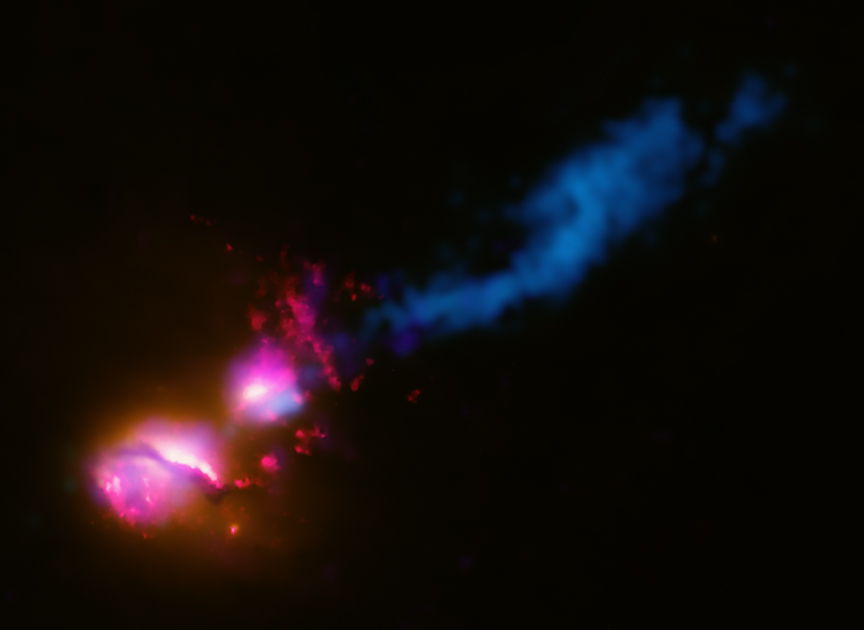
The power and accuracy of our telescopes is constantly improving. Not just for the case of telescopes which view in the visible range of the electromagnetic spectrum. There are giant telescopes on earth which view radio signals and, at the other end of the spectrum, there are telescopes which we've put into orbit which look at very high energy rays in the x-ray and gamma-ray range of the spectrum. These see some of the most energetic events in the universe and we're learning a huge amount about some incredible phenomena which happen out there.

Credit: X-ray: NASA/CXC/CfA/D.Evans et al.; Optical/UV: NASA/STScI; Radio: NSF/VLA/CfA/D.Evans et al., STFC/JBO/MERLIN

What the improvements in technology have allowed is for us to study stars in much finer detail. We can look at the amount of light coming from a distant star to a very high accuracy, as well as knowing where it is to large precision. If one of these stars has a planet circling around it there can be several effects. The easiest cases are when the planet is rotating such that it comes between us and the star. The star will block out some of the light as it passes in front of the star and it will also make the star wobble as the gravitational pull of the planet will mean that the star is also circling, though round a much smaller circle than the orbit of the planet. Of course the larger the planet, the easier these effects are to see but we're getting better and better at seeing even small planets. In the last ten years we've gone from thinking that we might be unique to finding that in fact there are planets circling many many stars just in our neighbourhood of the Milky Way. Our observations are now so good that we can even look at the chemical composition of the atmosphere of the planet. As the light from the star passes through the atmosphere, certain wavelengths are absorbed by the molecules in the gases and we see this effect in the light that reaches us. We're learning more and more about these extra-solar planet and are finding planets which are more and more Earth-like all the time.

So, it seems that there are plenty of planets in the stars nearby us. There are a few hundred billion stars in the Milky Way and around the same number of galaxies in the observable universe. So the number of Earth-like planets (or even not that much like earth, but at least with an atmosphere and a solid ground) is probably huge, almost certainly it's millions of billions in the universe. That's the good news!

Digital Sky.LLC

(NB. There are actually somewhat more strict criteria for a habitable planet)


So, it seems that the first number is a really big one!

How about the chances for life forming? Well, before I come onto that, how about the chances of forming intelligent life from the first very simple life-forms through billions of years of evolution? You might say that if it happened here, it should be quite likely to happen anywhere else. One could raise a warped version of the anthropic argument to say that even even if it was only us in the whole universe who had been lucky enough to become conscious beings, it would also be us who asks the question: "what's so special about us?" (this is a slightly twisted form of the anthropic argument, but it's the same basis).

We are a long way from understanding consciousness and there are a variety of schools, from the extremes who believe in a soul and think that consciousness doesn't come from something physical in our brains, to those who believe that consciousness is simply a matter of the firing of neurons in the brain which could be modelled equally well on a sufficiently complex computer program. I'm of the latter school.

Some systems which evolve genetically (many such systems can be modelled on computer) will end up in a similar state, relatively insensitive to the environment or the starting conditions. Other systems are very sensitive to what is around them and how they start. It's my belief that given a somewhat different environment and a system which can evolve (reproduce, mutate and compete within its environment) will evolve into something which may not look like us, but will probably have a branch which develops consciousness - I don't see consciousness as anything magical, just very hard to understand! This is simply my gut feeling as a non-expert.

So, I think that once evolution is in place, as long as there are not events which halt that evolution (meteor impact, lack of resources, violent changes in environment) given enough time, conscious beings will evolve which will end up with something comparable with our society and technology.

For me the hardest question is how likely it is for all of this to start. If you look at the structure of DNA, RNA, amino acids and proteins, it seems incredible that this has come into being, but we have to remember that these things themselves have evolved from something simpler. This original structure only had to have the properties which I mentioned above: reproduction, mutation and competition for environment. It is likely that given enough complexity in an environment (perhaps a large selection of molecules to play with), once you have a simple molecule which can reproduce with some variation, the creation of a DNA-like structure isn't that unlikely. From what I understand, there are many people trying to make this (abiogenisis) work in the lab. I don't know much about the levels of success so far, starting from a very simple molecule. It seems likely that the beginnings of life probably started in the chemical-rich, hot environment in a volcanic system - deep sea vents being the usual suspect, though there are possibilities of more exotic beginnings.

Volcanic environments shouldn't be that rare on earth-like planets so it seems that the likelihood of planets with the right conditions for life to start is still a large number, even when you specialise to those with water and volcanic activity. The question of whether life will form there seems to be a tough one, but I believe (with no qualification) that the chances are pretty good.

So, my view is that the small number that you have to multiply by the very large number (the number of earth-like planets) probably isn't that small and so I believe firmly that there is life out there and what's more, intelligent life.

How about spotting them? Well, we've been sending out radio waves for around 100 years. These will now be 100 lightyears away and the very first ones which were sent will, at that distance, be very very weak. Somebody with more knowledge of astronomy than me could probably tell you the ratio of background radio noise to our most distant signals and whether A) It would be theoretically possible to detect it and B) whether we could detect it with the technology we have if we were on the receiving end. Note that there are of the order 10,000 stars within 100 light years of us (extrapolated from densities in closer regions where we can detect the fainter stars).

The signals that we are sending out now are stronger and in 100 years, there will be a large number of stars and possibly planetary systems which will be receiving these signals. The same question could be asked about these signals that one could ask about the signals which are just getting to those distances now. If we were on the other end, could we see the signal? If the answer is yes and there is intelligent life somewhere in the near vicinity then as our detection techniques improve, the likelihood of finding a signal goes up - this is really exciting!

There is already a search on (SETI - the search for extraterrestrial intelligence). Radio signals are picked up and the data is sent around the world where it is analysed on the personal computers of individuals and organisations who have agreed to put in a percentage of their processing time to looking for the mark of intelligent life out there - the sort of signal which would be unlikely to come from one of the many events which give out radio waves all the time.

There have in the past been hints that signals have been seen, but up until now we've been disappointed. My view is that it's only a matter of time, the signals are out there and I think that we are likely to see something in the not-too distant future. However, if the chances of the original formation of life, even given the right conditions, are very small, then we may remain alone for some time to come. As we find out more about what's out there and where we came from we are getting closer and closer to an answer.

That's my tuppence anyway :-) I'll try and answer your other questions when I have a bit more time!

(Edit - Strangely enough there has been a post from Isabel on a part of the above topic, talking about diversity from evolution - read it at God Plays Dice).

Sunday, January 27, 2008

Photos from CERN

As I mentioned a couple of posts back, we were lucky enough to go the 100m down into the chamber for the CMS detector. I got a few pictures while we were there.

First of all, on the surface before going into the cavern and indeed all around the CERN sites you see huge gas tanks. These tanks are for storing helium. The detectors and accelerator have to be cooled to just above absolute zero (there are superconducting magnets for the accelerator which only work at very low temperatures). If there is a problem with any of the components they may have to be taken apart, or at least looked at in detail. In order to do this, the helium will be released and the parts will warm back up. CERN has the largest supply of helium in the world and this is both expensive stuff and not easy to produce. It is still being produced now in order that they have a large enough supply. So, when you release the helium you want to store it somewhere, not just let it off into the atmosphere, and that is what these enormous tanks are for. The circumference of the tanks is, I guess, around 2 or 3 meters.
LHC helium tanks
100m down into the cavern and we were lucky enough to see the last two pieces of the CMS detector being readied to slot into place. The following panorama is from 6 shots, which don't go together perfectly, but give a pretty good impression of the complexity of the detector:
CMS detector panorama
The largest component of the CMS detector weighs in at 2000 tonnes. Your average crane cannot carry this sort of weight and so in order to lower it into the cavern they had to construct a specially designed pulley system. The two towers on top of the CMS building housed the wheels for this pulley. In the background of this picture is Mont Blanc:
CMS and Mont Blanc
Mont Blanc can be seen more clearly in this picture which I took as we were taking the bus to the site. The new polarising filter for my camera works very well at removing the reflections from the glass in the bus. the extreme blue in the sky in the picture of the helium tanks also comes from using a polarising filter which helps to remove any haze:
Mont Blanc
See here for a couple more from the detector.

RTN recap part 1 and gauged supergravities

I'm back in Santiago after a week at the RTN winter school in CERN. I have a full list of topics that I want to go over from the school, and this time I REALLY will do it (I may have said that before, but this time I really mean it). In particular Henning Samtleben gave an excellent course on gauged supergravity and flux compactifications which was extremely clearly presented for what is not an easy topic to get your head around. There's a reading list which was supposed to be read before the lectures but I feel that I will get more out of them now. I'll put up a link as soon as the videos are up online.

I'll see if I can give a basic overview of gauged supergravities, if only to get it clear in my own head.

Gauged supergravities can be understood from two points of view.

The first route is to take an ungauged supergravity which comes from a compactification of 10 dimensional supergravity on a torus of some number of dimensions. This will give you an effective theory in D=10-d dimensions where d is the dimension of the torus. The second route is to compactify on a less trivial space and to turn on n-form fluxes in your theory.

For the first route, the D-dimensional theory which you obtain from compactifying on a torus will have both gauged and global symmetries. The gauged symmetries will be abelian and there will be a gauge field for each of these U(1) symmetries. Then there will be a global symmetry, which typically will take the form of an exceptional group (one subset of the semi-simple Lie groups).

The theory you now have is an ungauged supergravity (although it does have gauge fields, the name comes from the fact that there are no non-abelian gauge symmetries). A gauged supergravity is formed by gauging some subset of the global symmetries.

There may be many ways to do this (to choose the subset of global symmetries to gauge) which will put the abelian gauge fields that you already have into the adjoint representation of the now non-abelian gauge group. The way in which you do the gauging (choose the subgroup of the global symmetries to gauge) is all defined in terms of a single tensor. This tensor has a series of constraints which must be imposed in order to form a closed algebra when you perform the gauging and also to keep supersymmetry (though you may wish to break some number of the supersymmetries in the gauging - giving you a maximally or non-maximally supersymmetric gauged supergravity).

As I said, there are two routes to gauged supergravity. The second route is to go back to the 10 dimensional supergravity that you started with, and rather than simply compactifying on a torus, you compactify on a more complex manifold - a d-sphere, a torus with torsion, or you may turn on some fluxes which wrap closed cycles in the compactified directions. This process results in the same gauged supergravity theories that you would have obtained by gauging a subgroup of the global symmetries in your 'trivially' compactified theory.

The point about these theories is that you have gone from a 10 dimensional theory to a lower dimensional theory with a non-abelian gauge group. This is clearly an interesting area to explore and has many applications, from the AdS/CFT correspondence to model building and more...

Anyway, that's the very basics (the flow chart as I have picked it up over the last week) of gauged supergravities.

As far as I can tell, the main subtleties come from 1) applying the constraints on the tensor which encodes the gauging of your global symmetries and 2) finding a realisation where the gauge transformations act in a manifestly covariant manner on your fields.

I may try and do the same thing for the other lectures if I get some time. For now I'll upload some photos from the trip.