Showing posts with label astronomy. Show all posts

Wednesday, May 20, 2009

Atmospheric optics and astrophotography links of the day

I'm under mountains of coding these days and the highs and lows that this brings my life seem to change from day to day. Luckily today was an overall positive one, meaning that the number of bugs removed appears to be greater than the number of bugs 'implemented'. The current problem is getting a little tiresome though and it's getting to the point that I've spent much more of the last few weeks doing programing than feeling like I was doing physics. Still, it comes with the territory and I enjoy it overall.

While I'm mulling over why my the 1s and 0s are not sitting comfortably in my current code I thought I'd put up a couple of quick links here from eye-catching sources of the last couple of days.

First and foremost is Toomanytribbles who caught a great solar halo display over Athens. This can be seen on the atmospheric optics photo of the day site today. Toomanytribbles sent the pictures to me to identify first, and I'm pleased that my answers agreed with those of Les, the real expert, over at Atoptics. You can find the full explanation over on the OPOD link above.

The pictures here show the circumscribed arc with a parhelic circle, the fainter white circle at the top of the second picture.

unweaving the ice crystal halo:  137/365

parhelic halo

While I'm about it I should advertise a couple of her other photos. Toomanytribbles has been posting a photo a day in a project, simply named 365 - a photo a day for a year. These can be seen in her photostream and on her blog. I've seen her photos change incredibly over the last couple of years and the work she is producing now is simply outstanding. A lot of her work involves very short degree of freedom and creative bokeh and she has been taking advantage of these techniques over the last few days in photos with her new toy. Sometimes the simplest objects make for the most stunning photos. Click on the photos to see more.

athens circle, athens square

calatrava fire and ice:  134/365

In addition to these great photos I thought I'd post up a video which I first saw at the Bad Astronomer's blog. A simply spellbinding still-photo animation of the emergence of the milky way onto the desert sky. This is not to be missed.

Galactic Center of Milky Way Rises over Texas Star Party from William Castleman on Vimeo.

Thursday, May 14, 2009

Herschel and Planck on the up and up

I'm absolutely snowed under with coding at the moment, but I'll be keeping an eye on the launch of Planck and Herschel this afternoon. Take a look at the brief overview from Asymptotia and Backreaction as to why this is one of the most important launches of all time.

It seems the launch can be watched from here.

Monday, February 23, 2009

Observing Comet Lulin

Tomorrow Comet Lulin makes its closest approach to Earth and I have my alarm set for 5 tomorrow morning to try and get a glimpse of it. If you want to find where to look to find the comet then I can highly recommend downloading Stellarium, the best desktop skymap program I've found, by far. From this page, you can find the instructions on how to add Comet Lulin to the encyclopedia of objects in Stellarium. It's then very easy to find exactly where to locate it after you've input a few bits of data about your location.

Comet Lulin from the Nasa website:


Anyway, I'll be looking to get some photos tomorrow early morning and will post anything that is worth looking at. I stretched my camera and lens to their maxima last week by getting a photo of Venus in its half lit crescent state. While it's certainly not the greatest venus shot ever, it is nice to see what can be done without a telescope.
venus

Sunday, January 04, 2009

The Moon over Oxford

I still have a long way to go with getting a feel for the new lens, but the moon was looking too good to miss last night. A slight mist meant that the focus isn't perfect, but it's come out quite well (thanks to Toomanytribbles for the idea to turn off image stabilisation when using a tripod). I applied a little tone mapping to bring out the areas which were very bright so that there was a little more texture and I'll be keeping an eye out for the full moon in a few days. I'll keep you posted.

The moon from Oxford
I had a look last night but was rather too early to see the quadrantid meteor shower. Did anyone else see them early this morning?

Notice by the way that Neptune is close to Venus at the moment and at magnitude 7.9 it's spottable with a pair of binoculars or a camera. I'll see if I can get a shot of it in the next few days. Mercury should also be visible with the naked eye just after sunset.

Friday, December 12, 2008

Lunacy and more

For those of you foolhardy enough not to have Universe Today bookmarked in your feedreader, then you may not know that today the moon is at its closest approach to the Earth this year. It will be 14% larger and some 30% brighter (for those who are not, like I am, in overcast venues) than the moon at its further point this year. This is good for moon watching, but not so great for the Geminid meteor shower which will be somewhat obscured by the extraterrestrial light pollution.

As for me, I'm feeling pretty tired after a busy but successful few days, other than spending 20 minutes trapped in a lift on Wednesday morning. Trust me to be in the lift when there's a powercut. The emergency light was sadly neither bright enough to let me read, nor to take a photo of myself in my encarceration.

I'm currently writing up a review for a conference proceedings which I'd like to get out of the way before 't Hooft turns up next week to give a couple of talks (both departamental and public) and before I go off to Madrid to the Christmas meeting where I will be giving a talk. I'll simply link to my paper from this week with no more commentary for now than the fact that this was an extremely enjoyable paper and one of the best collaborations I've been in, given that all of us bought very different skills to the table. We already have several more ideas on the go and hope to get more done soon.

Tuesday, November 25, 2008

Update, overflow and conjunction

Things are just a little too busy at the moment (hence taking five minutes out to write this!). The atmospheric optics talk is taking a little longer to get right than I'd hoped, having not given a pop-science/photography/flashy images talk for many years. On top of this I'm writing up a conference proceedings, tidying up two papers and working on two other projects simultaneously. I also have to think seriously about a talk I'll be giving before Christmas at a meeting in Madrid. Spanish lessons are on hold this week and I'm not even managing to get to my Spanish exchange. I do however have a temporary housemate who is in between flats with whom I can practice Chinese and Spanish and is currently cooking up a feast while I plug away at mathematica.

And before I forget, at the beginning of December, look out in the early night sky for a fantastic conjunction between Jupiter, Venus and the crescent moon

Thursday, November 13, 2008

Extrasolar planets pictured around sun-like stars for the first time

Some fantastic astronomy news which I'd been waiting for since hints were given a couple of days ago on Dynamics of Cats. Two pictures have just been released with images of extrasolar planets. One star with one planet and another with two planets orbiting it. These bring the total of extrasolar planets found to date to around 300, but this is the first time the planets have actually been pictured (around a normal sized star).


(Image taken from the Hubble press release).  For all the details and an explanation of the above image, head over to Bad Astronomy Blog. See also Dynamics of Cats writeup on this news.

On a side note, if you're around Galicia at the moment, keep an eye out in the sky, conditions seem to be pretty favourable for solar halo viewing at least over the next few days. 

Sunday, May 04, 2008

Mercury on the horizon

Keep an eye out for Mercury on the horizon this evening, just after sunset, close to the crescent moon in the West, following the sun. It's looking clear here at the moment and with sunset in around 5 minutes, my camera is at the ready.

Thanks to BABlog

Update: Clouds rolled in Santiago-style - not a sausage.

Friday, March 21, 2008

Liquid oceans under Titan's surface

My second link to incredible astronomy news via the Bad Astronomy Blog today, but Phil's article on the possible oceans below the surface of Titan makes for fascinating reading. Sadly, as he points out, it is likely to be a long time before we know whether the combination of organic compounds in the atmosphere and liquid water below the surface have produced a second body in the solar system teeming with life.

Thursday, March 20, 2008

Naked eye visible gamma ray burster

Usually the timescale of events in the universe is measured in billions of years. However, sometimes that isn't the case. When astronomic events happen over shorter timescales, they tend to involve fireworks. In fact, sometimes they're so impressive that we can not only detect them with the most advanced telescopes as the light reaches us from the other side of the observable universe, but we can see it with the naked eye. This is what happened last night, or would have happened if you'd been looking at just the right area of the sky.

(From pi of the sky, who have the best steam-punk set up for a telescopic system I've ever seen.)
A gamma ray burster, some 7.5 billion light years away exploded in spectacular fashion, and in a few seconds, released more energy than our sun will release in its entire lifetime of several billion years. Considering the energy that the sun gives off every second (billions of times the energy of the largest nuclear bomb ever created) this is enough energy to power a whole lot of lightbulbs. This sort of power outshines entire galaxies, consisting of hundreds of billions of stars and if one ever goes off in our neighbourhood, we're in some pretty serious trouble!

In the words of the Bad Astronomer:

It’s difficult to put this into the proper context. GRBs are monumental explosions, the exploding of a massive star where most of the energy of the catastrophe is channeled into twin beams of energy. These beams scream out from the explosion like cosmic blowtorches, and for thousands of light years anything they touch is destroyed. Happily for us, GRBs always appear hundreds of millions or billions of light years away.

Sunday, March 16, 2008

Organic molecules detected on extra solar planet

This is another step forward in the detection of life on other planets (something which I wrote in detail about here). However, the news is that a planet which is too hot to support life has methane in its atmosphere. I presume that this has been found by looking at the absorption lines as the light from the star travels through the atmosphere of the planet. NASA will be holding a press conference on Wednesday to talk about these results. Note that the exciting point is that we now have the technology to do this, not particularly that this finding is in itself that surprising.

(TMT who shared this item)

Saturday, March 15, 2008

Miscellaneous links from last week

A few items that I've starred in my Google Reader this week:

There have been a number of interesting posts on the mission to Enceladus, one of the many fascinating moons of Saturn which the Cassini orbiter (NASA link) has been studying for the last couple of years (including the Huygens mission to Titan) and will be for the next few. This week the probe skirted across the surface of Enceladus (well almost) including going through a giant gas plume. I've yet to see more than pretty pictures (any data), but the pictures can be found here:

From Toomanytribbles

Before the event, TMT also posted some data on the plans for the flyby.

More astronomy links:

From Physics world, the news that Alpha-Centauri, our nearest star may itself have an Earth-like planet. All simulations of planetary formation about the star seem to suggest an Earth-like planet is likely.

A Boing-Boing article on the giant cargo which took off this week on its way to the International Space station. A large part of this cargo is a huge robot, slightly reminiscent of those in Alien.

Astronomers are not terribly good with coming up with names for their new bits of equipment. For instance one overwhelming large telescope being built is going to be called the OWL (I'll let you work that one out!). At Slashdot is an article on the similarly aptly named Large Binocular Telescope which took its first image (sadly not of a terribly inspiring object, in the grand scheme of things - from the Bad Astronomy Blog)

Lubos Motl discusses the news that the sonic equivalent of a black-hole has been simulated. A Bose Einstein condensate in certain conditions should exhibit an event horizon and even Hawking radiation.

On the ArXiv:

A tour de force of calculational complexity is the result that the six-gluon MHV amplitude at two loops does indeed equal the hexagonal Wilson loop (An AdS/CFT prediction amongst other things), though not equal to the BDS conjecture - again as expected from AdS/CFT because the dual conformal symmetry is not strong enough alone to tie down the form of the amplitude. This was seen in two papers, by J.M.Drummond, J.Henn, G.P.Korchemsky and E.Sokatchev and by Z. Bern, L. J. Dixon, D. A. Kosower, R. Roiban, M. Spradlin, C. Vergu and A. Volovich.

We also saw another step on the path to understanding unquenched flavour in gravity duals of gauge theories in the paper by Felipe Canoura, Paolo Merlatti, Alfonso V. Ramallo where they studied the holographic dual of a 2+1 dimensional field theory with backreacted flavour branes in various regions of the parameter space of the N=1 field theory.

Frederick Denef
has his notes on constructing string vacua, from the Les Houches school, online which I'm yet to read through but would like to.

Off the ArXiv but still in physics writing, Blake Stacey continues his discussion of supersymmetric quantum mechanics>

A link from a long time ago about hydrophobic sand (from Food for design). A fascinating substance which, if the cost could be reduced, would be an ingenious solution to quickly clearing up oil spills.

Videos from TED continue to be almost unendingly fascinating and the good news is that the whole archive of recordings from the very first TED conference will gradually be released. It says a lot that back in 1984 TED was forward thinking enough to record all the talks.

From Slash-dot, comes an article discussing whether huge cash prizes could be a good way to quickly progress in making breakthroughs in major scientific and technological problems. Definitely worth debating.

From Cosmic Variance comes a link to the Bloggingheads video with Sean Carol and John Horgan. I watched this this evening and thought that Sean did a great job at setting the current status of much of modern cosmology.

And finally on a couple of non-scientific notes:

I don't have the time to read as much as I'd like these days. The last book I finished was Godel, Escher, Bach, a rather monumental study of logic, art, consciousness, beauty, the foundations of mathematics, music and much more besides. A fascinating book and great for an introduction to the logic by which our universe seems to work, though I felt he tried to pack in a too many subjects which, while they do have connections and these connections go deep, it felt as though each topic was trying to burst out of the seams of the book and become a book in its own right.

Anyway, from Boing-Boing came a link to a beautiful looking book on Mumbai, somewhere I'd love to go and I'm sure that if I read this, my desire to go there would increase even more (Maximum City, Mumbai lost and found by Suketa Mehta)

And finally, an essay from The Online Photographer on the tendency for the populist photographers of today to overdo colour contrast and saturation to create a candy-filled world, with none of the subtlety which great photography captures. I know this is something I have to be careful of and the comments made for an interesting set of reactions.

Anyway, a full day tomorrow of Mathematica decoding - I plan a blog post on this subject alone some time :-) but for now I've Spanish practice to be getting on with.

Wednesday, March 05, 2008

I am legend alternative ending + our alternative ending

Update 19th March: The video can still be found here. It's been taken down most other places.

Phil at The Bad Astronomy blog has posted a link to the alternative ending for I Am Legend, which has to be a good thing, as the ending spoilt what was actually a pretty reasonable Hollywood movie (something which is pretty rare these days). There were religious elements to the ending which were simply unnecessary and you were left wondering why they'd bothered. The new ending replaces religion with love, which makes it cheesy but substantially better than the original. Note that the movie is a zombie movie, so watch it if you're into this kind of thing.


Something which is far, far more terrifying than any zombie movie is the idea of the galactic police having itchy trigger fingers and their taser pointed directly at us. Well this may be the case and if the gamma ray burster were to let loose on us, we'd be in a whole lot of trouble. Could be quite a fireworks display! Again, a link from BAblog

Tuesday, January 29, 2008

Is there intelligent life out there?

I was asked three questions by a friend, in the comments section a couple of posts back. These were:
1)Do you think that extra-terrestrial life is likely?
2)What is the smallest galaxy there is?
3)Can you explain what happened before time?

The second question I have to look up in the appropriate source, the third question I will have to clarify my own thoughts before imposing them on the world. The first question however I have relatively clear views on and so give the following answer:

The probability of there being extra-terrestrial life is made up of many factors, but I think that it's most useful to break it down into two main parts. Both of these are still somewhat unknown but we are learning more and more about them all the time.

The two factors are:
1) How many planets in the near vicinity/observable universe are there which are suitable for supporting life.

2) What are the chances, given the right conditions, for life to form on one of these planets?

The chance of there being extraterrestrial life out there comes from appropriately combining these two numbers.

I'll deal with each of the above factors separately.

Up until about 10 years ago we didn't have a good idea about whether we were special in terms of having a planet of our size, with water, going around a star at the right distance for water to be in liquid form. (Although the first published discovery of an extrasolar planet was in 1988, later confirmed, it is only more recently that we have had a good handle on these observations.)

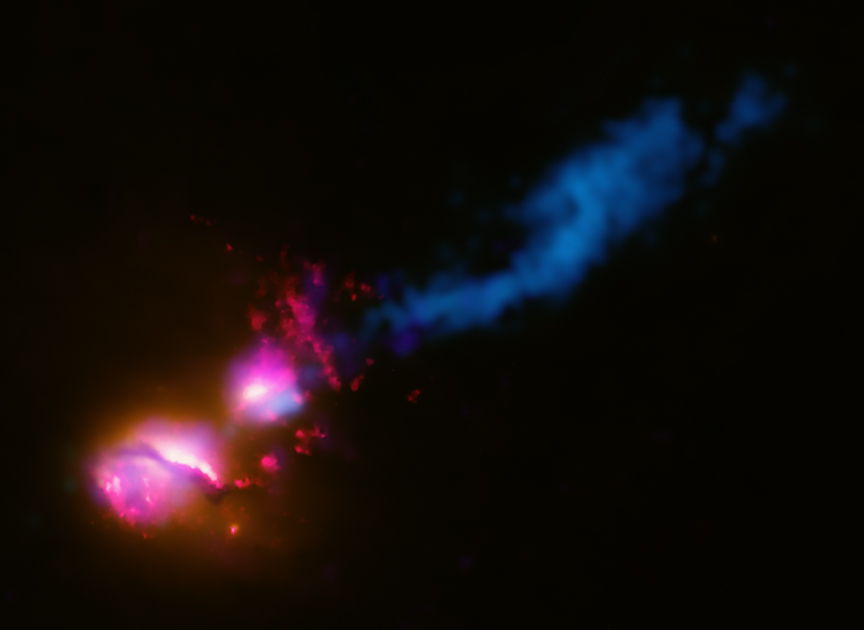
The power and accuracy of our telescopes is constantly improving. Not just for the case of telescopes which view in the visible range of the electromagnetic spectrum. There are giant telescopes on earth which view radio signals and, at the other end of the spectrum, there are telescopes which we've put into orbit which look at very high energy rays in the x-ray and gamma-ray range of the spectrum. These see some of the most energetic events in the universe and we're learning a huge amount about some incredible phenomena which happen out there.

Credit: X-ray: NASA/CXC/CfA/D.Evans et al.; Optical/UV: NASA/STScI; Radio: NSF/VLA/CfA/D.Evans et al., STFC/JBO/MERLIN

What the improvements in technology have allowed is for us to study stars in much finer detail. We can look at the amount of light coming from a distant star to a very high accuracy, as well as knowing where it is to large precision. If one of these stars has a planet circling around it there can be several effects. The easiest cases are when the planet is rotating such that it comes between us and the star. The star will block out some of the light as it passes in front of the star and it will also make the star wobble as the gravitational pull of the planet will mean that the star is also circling, though round a much smaller circle than the orbit of the planet. Of course the larger the planet, the easier these effects are to see but we're getting better and better at seeing even small planets. In the last ten years we've gone from thinking that we might be unique to finding that in fact there are planets circling many many stars just in our neighbourhood of the Milky Way. Our observations are now so good that we can even look at the chemical composition of the atmosphere of the planet. As the light from the star passes through the atmosphere, certain wavelengths are absorbed by the molecules in the gases and we see this effect in the light that reaches us. We're learning more and more about these extra-solar planet and are finding planets which are more and more Earth-like all the time.

So, it seems that there are plenty of planets in the stars nearby us. There are a few hundred billion stars in the Milky Way and around the same number of galaxies in the observable universe. So the number of Earth-like planets (or even not that much like earth, but at least with an atmosphere and a solid ground) is probably huge, almost certainly it's millions of billions in the universe. That's the good news!

Digital Sky.LLC

(NB. There are actually somewhat more strict criteria for a habitable planet)


So, it seems that the first number is a really big one!

How about the chances for life forming? Well, before I come onto that, how about the chances of forming intelligent life from the first very simple life-forms through billions of years of evolution? You might say that if it happened here, it should be quite likely to happen anywhere else. One could raise a warped version of the anthropic argument to say that even even if it was only us in the whole universe who had been lucky enough to become conscious beings, it would also be us who asks the question: "what's so special about us?" (this is a slightly twisted form of the anthropic argument, but it's the same basis).

We are a long way from understanding consciousness and there are a variety of schools, from the extremes who believe in a soul and think that consciousness doesn't come from something physical in our brains, to those who believe that consciousness is simply a matter of the firing of neurons in the brain which could be modelled equally well on a sufficiently complex computer program. I'm of the latter school.

Some systems which evolve genetically (many such systems can be modelled on computer) will end up in a similar state, relatively insensitive to the environment or the starting conditions. Other systems are very sensitive to what is around them and how they start. It's my belief that given a somewhat different environment and a system which can evolve (reproduce, mutate and compete within its environment) will evolve into something which may not look like us, but will probably have a branch which develops consciousness - I don't see consciousness as anything magical, just very hard to understand! This is simply my gut feeling as a non-expert.

So, I think that once evolution is in place, as long as there are not events which halt that evolution (meteor impact, lack of resources, violent changes in environment) given enough time, conscious beings will evolve which will end up with something comparable with our society and technology.

For me the hardest question is how likely it is for all of this to start. If you look at the structure of DNA, RNA, amino acids and proteins, it seems incredible that this has come into being, but we have to remember that these things themselves have evolved from something simpler. This original structure only had to have the properties which I mentioned above: reproduction, mutation and competition for environment. It is likely that given enough complexity in an environment (perhaps a large selection of molecules to play with), once you have a simple molecule which can reproduce with some variation, the creation of a DNA-like structure isn't that unlikely. From what I understand, there are many people trying to make this (abiogenisis) work in the lab. I don't know much about the levels of success so far, starting from a very simple molecule. It seems likely that the beginnings of life probably started in the chemical-rich, hot environment in a volcanic system - deep sea vents being the usual suspect, though there are possibilities of more exotic beginnings.

Volcanic environments shouldn't be that rare on earth-like planets so it seems that the likelihood of planets with the right conditions for life to start is still a large number, even when you specialise to those with water and volcanic activity. The question of whether life will form there seems to be a tough one, but I believe (with no qualification) that the chances are pretty good.

So, my view is that the small number that you have to multiply by the very large number (the number of earth-like planets) probably isn't that small and so I believe firmly that there is life out there and what's more, intelligent life.

How about spotting them? Well, we've been sending out radio waves for around 100 years. These will now be 100 lightyears away and the very first ones which were sent will, at that distance, be very very weak. Somebody with more knowledge of astronomy than me could probably tell you the ratio of background radio noise to our most distant signals and whether A) It would be theoretically possible to detect it and B) whether we could detect it with the technology we have if we were on the receiving end. Note that there are of the order 10,000 stars within 100 light years of us (extrapolated from densities in closer regions where we can detect the fainter stars).

The signals that we are sending out now are stronger and in 100 years, there will be a large number of stars and possibly planetary systems which will be receiving these signals. The same question could be asked about these signals that one could ask about the signals which are just getting to those distances now. If we were on the other end, could we see the signal? If the answer is yes and there is intelligent life somewhere in the near vicinity then as our detection techniques improve, the likelihood of finding a signal goes up - this is really exciting!

There is already a search on (SETI - the search for extraterrestrial intelligence). Radio signals are picked up and the data is sent around the world where it is analysed on the personal computers of individuals and organisations who have agreed to put in a percentage of their processing time to looking for the mark of intelligent life out there - the sort of signal which would be unlikely to come from one of the many events which give out radio waves all the time.

There have in the past been hints that signals have been seen, but up until now we've been disappointed. My view is that it's only a matter of time, the signals are out there and I think that we are likely to see something in the not-too distant future. However, if the chances of the original formation of life, even given the right conditions, are very small, then we may remain alone for some time to come. As we find out more about what's out there and where we came from we are getting closer and closer to an answer.

That's my tuppence anyway :-) I'll try and answer your other questions when I have a bit more time!

(Edit - Strangely enough there has been a post from Isabel on a part of the above topic, talking about diversity from evolution - read it at God Plays Dice).

Friday, January 11, 2008

Astrophotography first steps

My first attempt at non-lunar astrophotography. Taken in a village in Leicestershire, UK, with a 30 second exposure at f/4.5 and a focal length of 17mm (fully zoomed out on the Canon 17/85). I've never been able to see Orion's nebula with the telescope I bought when I was 13 as well as I can with this long exposure on the camera. If the rain ever leaves Santiago again I'll head out to the countryside to try some more shots.
orion
(The highlights in the tree are simply where I attempted to brighten the highlights and caught a few spots I didn't want to) Another shot here which includes an airoplane trail streaking past the Pleides, sadly not a comet.

Monday, December 17, 2007

The year's best astronomy images

No rest for the wicked, but I didn't want to miss pointing you to this year's top 10 astronomy photos, from Bad Astronomy Blog - another awe-inspiring set of images!

I think that anything more detailed from me is likely to have to wait until the Christmas break. Setting up home, settling in and trying to get a project finished before the break has been filling all hours.

Thursday, November 01, 2007

Comet 17/P Holmes

The science blog community has been awash with news about this comet which suddenly increased its magnitude by a factor of some 400,000 making it easily visible with the naked eye. I'm aware that some readers of this blog are not regular science blog readers, so I urge you to go and take a look before it's no longer visible with the naked eye. I took a look this evening in a relatively brightly lit neighbourhood but could clearly make out the extended nature of the comet and although its span is only a tenth or so of the diameter of the moon (my guess) you can still make out that there is a central core and a diffuse region around the outside. So, go and take a look. See here for directions - very easy to make it out close to Cassiopeia.

Lots of information at these sites (more here, and more photos here)

Monday, September 17, 2007

Pale blue dot

Tales of a spectacular meal yesterday must wait until I can get the photos onto my computer. In the mean time and totally unrelated. Toomanytribbles linked to this video which is worth a watch. Makes you feel pretty insignificant!

Friday, August 24, 2007

Large hole in the Universe

There seems to be a big hole in the universe. A gap where there isn't matter, where there should be. There isn't much that I've found with any explanation simply because I don't think anyone knows. I'd be interested in speculative answers from experts though.

The hole was found by the very large array telescope which sees virtually no stars between 6 and 10 billion light years in one particular direction.

sparse details can be found at:
Lubos Motl's reference frame.
Slashdot
Toomanytribbles
Livescience

Monday, July 02, 2007

Moon snaps

As promised to a Beijing friend, even though I see you got your own, rather better version :-)

IMG_1879
Taken just outside Wudaokou station. My 17-85 mm lens isn't really up to the job of astrophotography, but for now this will have to do.