I was asked three questions by a friend, in the comments section a couple of posts back. These were:
1)Do you think that extra-terrestrial life is likely?
2)What is the smallest galaxy there is?
3)Can you explain what happened before time?
The second question I have to look up in the appropriate source, the third question I will have to clarify my own thoughts before imposing them on the world. The first question however I have relatively clear views on and so give the following answer:
The probability of there being extra-terrestrial life is made up of many factors, but I think that it's most useful to break it down into two main parts. Both of these are still somewhat unknown but we are learning more and more about them all the time.
The two factors are:
1) How many planets in the near vicinity/observable universe are there which are suitable for supporting life.
2) What are the chances, given the right conditions, for life to form on one of these planets?
The chance of there being extraterrestrial life out there comes from appropriately combining these two numbers.
I'll deal with each of the above factors separately.
Up until about 10 years ago we didn't have a good idea about whether we were special in terms of having a planet of our size, with water, going around a star at the right distance for water to be in liquid form. (Although the first published discovery of an extrasolar planet was in 1988, later confirmed, it is only more recently that we have had a good handle on these observations.)
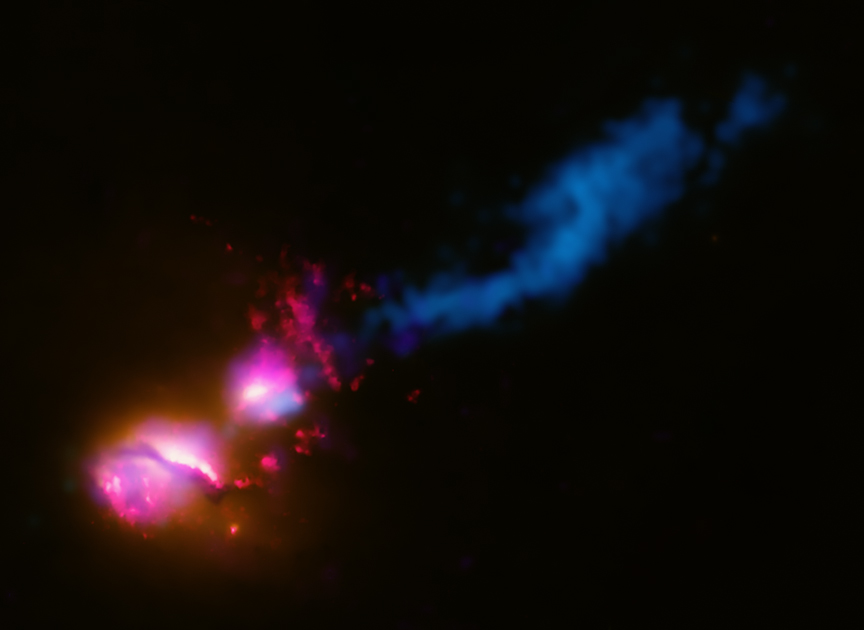
The power and accuracy of our telescopes is constantly improving. Not just for the case of telescopes which view in the visible range of the electromagnetic spectrum. There are giant telescopes on earth which view radio signals and, at the other end of the spectrum, there are telescopes which we've put into orbit which look at very high energy rays in the x-ray and gamma-ray range of the spectrum. These see some of the most energetic events in the universe and we're learning a huge amount about some incredible phenomena which happen out there.

Credit: X-ray: NASA/CXC/CfA/D.Evans et al.; Optical/UV: NASA/STScI; Radio: NSF/VLA/CfA/D.Evans et al., STFC/JBO/MERLIN
What the improvements in technology have allowed is for us to study stars in much finer detail. We can look at the amount of light coming from a distant star to a very high accuracy, as well as knowing where it is to large precision. If one of these stars has a planet circling around it there can be several effects. The easiest cases are when the planet is rotating such that it comes between us and the star. The star will block out some of the light as it passes in front of the star and it will also make the star wobble as the gravitational pull of the planet will mean that the star is also circling, though round a much smaller circle than the orbit of the planet. Of course the larger the planet, the easier these effects are to see but we're getting better and better at seeing even small planets. In the last ten years we've gone from thinking that we might be unique to finding that in fact there are planets circling many many stars just in our neighbourhood of the Milky Way. Our observations are now so good that we can even look at the chemical composition of the atmosphere of the planet. As the light from the star passes through the atmosphere, certain wavelengths are absorbed by the molecules in the gases and we see this effect in the light that reaches us. We're learning more and more about these extra-solar planet and are finding planets which are more and more Earth-like all the time.
So, it seems that there are plenty of planets in the stars nearby us. There are a few hundred billion stars in the Milky Way and around the same number of galaxies in the observable universe. So the number of Earth-like planets (or even not that much like earth, but at least with an atmosphere and a solid ground) is probably huge, almost certainly it's millions of billions in the universe. That's the good news!

Digital Sky.LLC
(NB. There are actually somewhat more strict criteria for a habitable planet)
So, it seems that the first number is a really big one!
How about the chances for life forming? Well, before I come onto that, how about the chances of forming intelligent life from the first very simple life-forms through billions of years of evolution? You might say that if it happened here, it should be quite likely to happen anywhere else. One could raise a warped version of the anthropic argument to say that even even if it was only us in the whole universe who had been lucky enough to become conscious beings, it would also be us who asks the question: "what's so special about us?" (this is a slightly twisted form of the anthropic argument, but it's the same basis).
We are a long way from understanding consciousness and there are a variety of schools, from the extremes who believe in a soul and think that consciousness doesn't come from something physical in our brains, to those who believe that consciousness is simply a matter of the firing of neurons in the brain which could be modelled equally well on a sufficiently complex computer program. I'm of the latter school.
Some systems which evolve genetically (many such systems can be modelled on computer) will end up in a similar state, relatively insensitive to the environment or the starting conditions. Other systems are very sensitive to what is around them and how they start. It's my belief that given a somewhat different environment and a system which can evolve (reproduce, mutate and compete within its environment) will evolve into something which may not look like us, but will probably have a branch which develops consciousness - I don't see consciousness as anything magical, just very hard to understand! This is simply my gut feeling as a non-expert.
So, I think that once evolution is in place, as long as there are not events which halt that evolution (meteor impact, lack of resources, violent changes in environment) given enough time, conscious beings will evolve which will end up with something comparable with our society and technology.
For me the hardest question is how likely it is for all of this to start. If you look at the structure of DNA, RNA, amino acids and proteins, it seems incredible that this has come into being, but we have to remember that these things themselves have evolved from something simpler. This original structure only had to have the properties which I mentioned above: reproduction, mutation and competition for environment. It is likely that given enough complexity in an environment (perhaps a large selection of molecules to play with), once you have a simple molecule which can reproduce with some variation, the creation of a DNA-like structure isn't that unlikely. From what I understand, there are many people trying to make this (abiogenisis) work in the lab. I don't know much about the levels of success so far, starting from a very simple molecule. It seems likely that the beginnings of life probably started in the chemical-rich, hot environment in a volcanic system - deep sea vents being the usual suspect, though there are possibilities of more exotic beginnings.
Volcanic environments shouldn't be that rare on earth-like planets so it seems that the likelihood of planets with the right conditions for life to start is still a large number, even when you specialise to those with water and volcanic activity. The question of whether life will form there seems to be a tough one, but I believe (with no qualification) that the chances are pretty good.
So, my view is that the small number that you have to multiply by the very large number (the number of earth-like planets) probably isn't that small and so I believe firmly that there is life out there and what's more, intelligent life.
How about spotting them? Well, we've been sending out radio waves for around 100 years. These will now be 100 lightyears away and the very first ones which were sent will, at that distance, be very very weak. Somebody with more knowledge of astronomy than me could probably tell you the ratio of background radio noise to our most distant signals and whether A) It would be theoretically possible to detect it and B) whether we could detect it with the technology we have if we were on the receiving end. Note that there are of the order 10,000 stars within 100 light years of us (extrapolated from densities in closer regions where we can detect the fainter stars).
The signals that we are sending out now are stronger and in 100 years, there will be a large number of stars and possibly planetary systems which will be receiving these signals. The same question could be asked about these signals that one could ask about the signals which are just getting to those distances now. If we were on the other end, could we see the signal? If the answer is yes and there is intelligent life somewhere in the near vicinity then as our detection techniques improve, the likelihood of finding a signal goes up - this is really exciting!
There is already a search on (SETI - the search for extraterrestrial intelligence). Radio signals are picked up and the data is sent around the world where it is analysed on the personal computers of individuals and organisations who have agreed to put in a percentage of their processing time to looking for the mark of intelligent life out there - the sort of signal which would be unlikely to come from one of the many events which give out radio waves all the time.
There have in the past been hints that signals have been seen, but up until now we've been disappointed. My view is that it's only a matter of time, the signals are out there and I think that we are likely to see something in the not-too distant future. However, if the chances of the original formation of life, even given the right conditions, are very small, then we may remain alone for some time to come. As we find out more about what's out there and where we came from we are getting closer and closer to an answer.
That's my tuppence anyway :-) I'll try and answer your other questions when I have a bit more time!
(Edit - Strangely enough there has been a post from Isabel on a part of the above topic, talking about diversity from evolution - read it at God Plays Dice).