Showing posts with label particle physics. Show all posts
Showing posts with label particle physics. Show all posts
Wednesday, September 10, 2008


Tuesday, September 09, 2008
LHC startup - links only
I'm afraid that things are simply too busy for me to justify a full writeup, the length of which the LHC deserves, so I shall just jot down some thoughts for now and link to the best places to get information on tomorrow's start-up.
Tomorrow is not that day of first collisions, that will come presumably in a few weeks time. Tomorrow is the first day of full circulation of protons within the beam pipe. This is a technological milestone, and a hugely important day for the progress of the machine, but not a special day for scientific discoveries.
The LHC is the largest, most complex machine ever built to discover what happens on the smallest, most basic level of nature - somehow this seems rather perverse, but that's the way the world works, and this is how we've learnt to probe the forces that govern the universe, and the matter which lies within it. The LHC is a feat of engineering, technological and political marvels, and the fact that it is already many, many years behind its original startup date does not detract from the fact that it is an incredible human achievement...and tomorrow we discover whether or not they correctly connected the starter motor. In fact tomorrow they will be discovering many new things about this machine which cannot be known until protons are running through it.
Having spent some time myself at Babar, a particle accelerator at SLAC, in Stanford, and spent many many hours in the control room, watching over the histograms, and seeing the engineers lose the beam over and over again (this isn't a criticism, it's a comment on how difficult the job is, even for a well-established machine), I won't be too surprised/dissapointed if tomorrow things do not go off to a perfectly smooth start straight away. If it takes hours/days or even weeks to correctly get the proton beams circulating, it wouldn't be that incredible, but I look forward to seeing what happens tomorrow nonetheless.
Anyway, tomorrow I will be keeping up with the progress in the morning through various sources. You can find many good links from:
A quantum diaries survivor
Cosmic Variance, who will be live-blogging the events
The US LHC blog
Of course, the CERN/LHC webpage
Including the live webcast
Twitter on CERN, or indeed CERN on Twitter - I've never looked at Twitter, being already deluged with too much information, but it seems that for up to the minute events, this is probably useful.
Also check out the TED website for some more information.
OK, that'll do for now. Enjoy!
Sunday, January 27, 2008
Photos from CERN
As I mentioned a couple of posts back, we were lucky enough to go the 100m down into the chamber for the CMS detector. I got a few pictures while we were there.
First of all, on the surface before going into the cavern and indeed all around the CERN sites you see huge gas tanks. These tanks are for storing helium. The detectors and accelerator have to be cooled to just above absolute zero (there are superconducting magnets for the accelerator which only work at very low temperatures). If there is a problem with any of the components they may have to be taken apart, or at least looked at in detail. In order to do this, the helium will be released and the parts will warm back up. CERN has the largest supply of helium in the world and this is both expensive stuff and not easy to produce. It is still being produced now in order that they have a large enough supply. So, when you release the helium you want to store it somewhere, not just let it off into the atmosphere, and that is what these enormous tanks are for. The circumference of the tanks is, I guess, around 2 or 3 meters.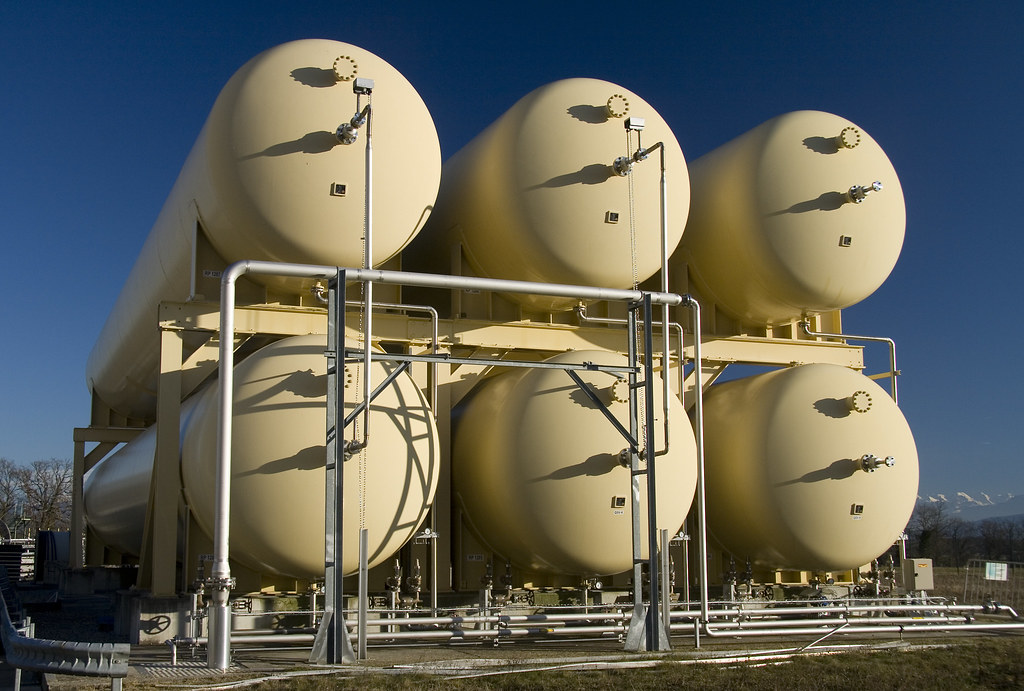
100m down into the cavern and we were lucky enough to see the last two pieces of the CMS detector being readied to slot into place. The following panorama is from 6 shots, which don't go together perfectly, but give a pretty good impression of the complexity of the detector: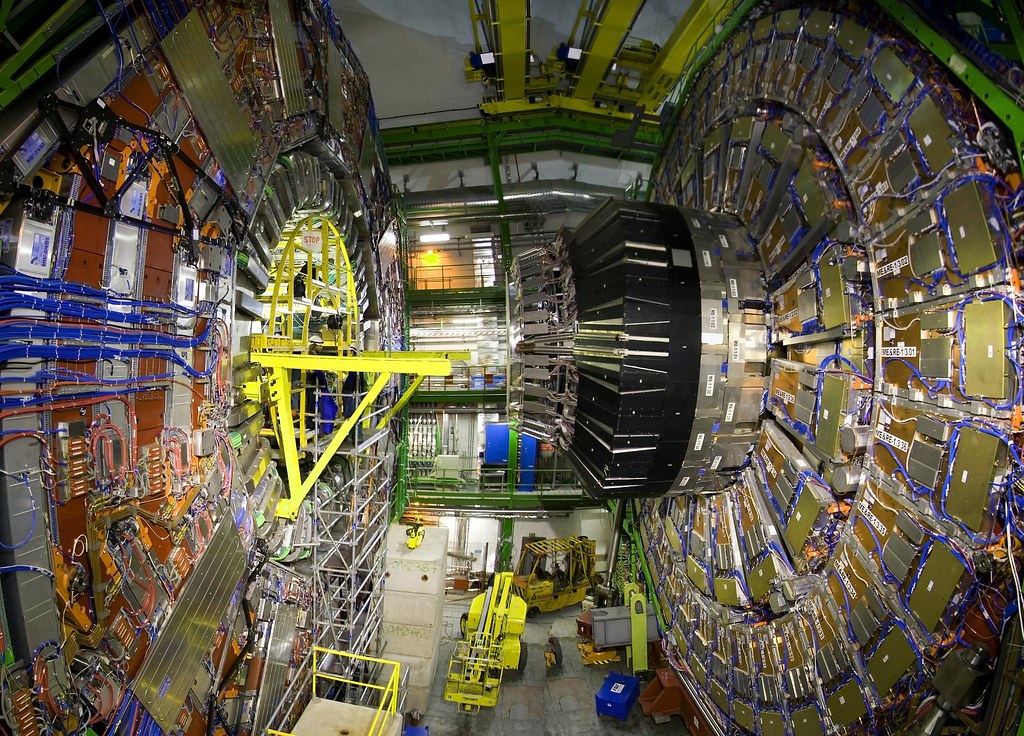
The largest component of the CMS detector weighs in at 2000 tonnes. Your average crane cannot carry this sort of weight and so in order to lower it into the cavern they had to construct a specially designed pulley system. The two towers on top of the CMS building housed the wheels for this pulley. In the background of this picture is Mont Blanc: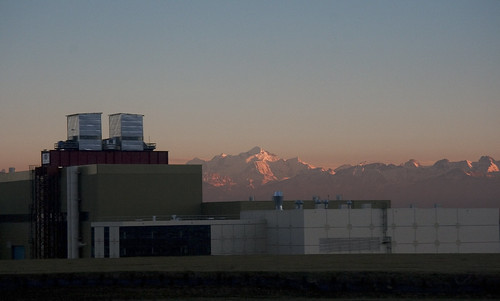
Mont Blanc can be seen more clearly in this picture which I took as we were taking the bus to the site. The new polarising filter for my camera works very well at removing the reflections from the glass in the bus. the extreme blue in the sky in the picture of the helium tanks also comes from using a polarising filter which helps to remove any haze:
See here for a couple more from the detector.
Subscribe to:
Posts (Atom)


