Tuesday, January 29, 2008

Is there intelligent life out there?

I was asked three questions by a friend, in the comments section a couple of posts back. These were:
1)Do you think that extra-terrestrial life is likely?
2)What is the smallest galaxy there is?
3)Can you explain what happened before time?

The second question I have to look up in the appropriate source, the third question I will have to clarify my own thoughts before imposing them on the world. The first question however I have relatively clear views on and so give the following answer:

The probability of there being extra-terrestrial life is made up of many factors, but I think that it's most useful to break it down into two main parts. Both of these are still somewhat unknown but we are learning more and more about them all the time.

The two factors are:
1) How many planets in the near vicinity/observable universe are there which are suitable for supporting life.

2) What are the chances, given the right conditions, for life to form on one of these planets?

The chance of there being extraterrestrial life out there comes from appropriately combining these two numbers.

I'll deal with each of the above factors separately.

Up until about 10 years ago we didn't have a good idea about whether we were special in terms of having a planet of our size, with water, going around a star at the right distance for water to be in liquid form. (Although the first published discovery of an extrasolar planet was in 1988, later confirmed, it is only more recently that we have had a good handle on these observations.)

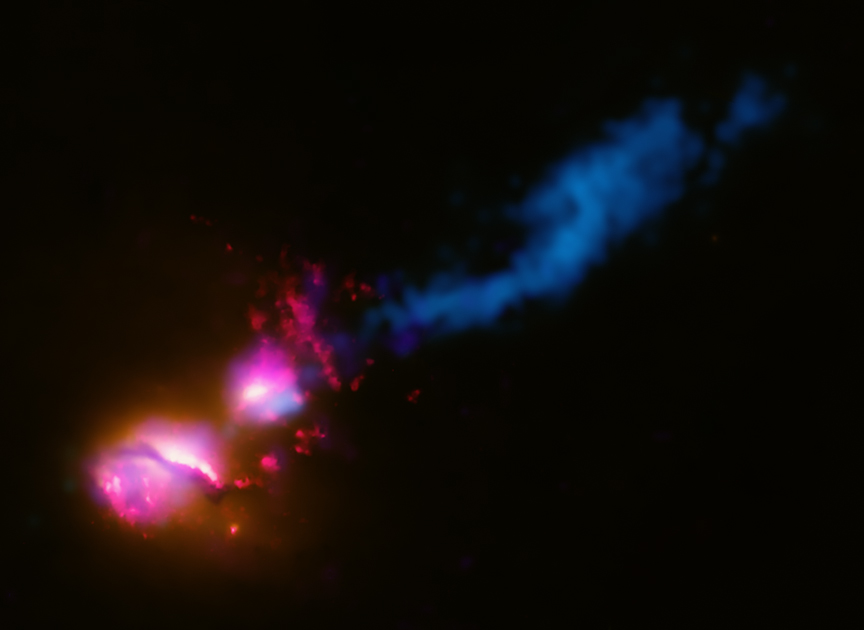
The power and accuracy of our telescopes is constantly improving. Not just for the case of telescopes which view in the visible range of the electromagnetic spectrum. There are giant telescopes on earth which view radio signals and, at the other end of the spectrum, there are telescopes which we've put into orbit which look at very high energy rays in the x-ray and gamma-ray range of the spectrum. These see some of the most energetic events in the universe and we're learning a huge amount about some incredible phenomena which happen out there.

Credit: X-ray: NASA/CXC/CfA/D.Evans et al.; Optical/UV: NASA/STScI; Radio: NSF/VLA/CfA/D.Evans et al., STFC/JBO/MERLIN

What the improvements in technology have allowed is for us to study stars in much finer detail. We can look at the amount of light coming from a distant star to a very high accuracy, as well as knowing where it is to large precision. If one of these stars has a planet circling around it there can be several effects. The easiest cases are when the planet is rotating such that it comes between us and the star. The star will block out some of the light as it passes in front of the star and it will also make the star wobble as the gravitational pull of the planet will mean that the star is also circling, though round a much smaller circle than the orbit of the planet. Of course the larger the planet, the easier these effects are to see but we're getting better and better at seeing even small planets. In the last ten years we've gone from thinking that we might be unique to finding that in fact there are planets circling many many stars just in our neighbourhood of the Milky Way. Our observations are now so good that we can even look at the chemical composition of the atmosphere of the planet. As the light from the star passes through the atmosphere, certain wavelengths are absorbed by the molecules in the gases and we see this effect in the light that reaches us. We're learning more and more about these extra-solar planet and are finding planets which are more and more Earth-like all the time.

So, it seems that there are plenty of planets in the stars nearby us. There are a few hundred billion stars in the Milky Way and around the same number of galaxies in the observable universe. So the number of Earth-like planets (or even not that much like earth, but at least with an atmosphere and a solid ground) is probably huge, almost certainly it's millions of billions in the universe. That's the good news!

Digital Sky.LLC

(NB. There are actually somewhat more strict criteria for a habitable planet)


So, it seems that the first number is a really big one!

How about the chances for life forming? Well, before I come onto that, how about the chances of forming intelligent life from the first very simple life-forms through billions of years of evolution? You might say that if it happened here, it should be quite likely to happen anywhere else. One could raise a warped version of the anthropic argument to say that even even if it was only us in the whole universe who had been lucky enough to become conscious beings, it would also be us who asks the question: "what's so special about us?" (this is a slightly twisted form of the anthropic argument, but it's the same basis).

We are a long way from understanding consciousness and there are a variety of schools, from the extremes who believe in a soul and think that consciousness doesn't come from something physical in our brains, to those who believe that consciousness is simply a matter of the firing of neurons in the brain which could be modelled equally well on a sufficiently complex computer program. I'm of the latter school.

Some systems which evolve genetically (many such systems can be modelled on computer) will end up in a similar state, relatively insensitive to the environment or the starting conditions. Other systems are very sensitive to what is around them and how they start. It's my belief that given a somewhat different environment and a system which can evolve (reproduce, mutate and compete within its environment) will evolve into something which may not look like us, but will probably have a branch which develops consciousness - I don't see consciousness as anything magical, just very hard to understand! This is simply my gut feeling as a non-expert.

So, I think that once evolution is in place, as long as there are not events which halt that evolution (meteor impact, lack of resources, violent changes in environment) given enough time, conscious beings will evolve which will end up with something comparable with our society and technology.

For me the hardest question is how likely it is for all of this to start. If you look at the structure of DNA, RNA, amino acids and proteins, it seems incredible that this has come into being, but we have to remember that these things themselves have evolved from something simpler. This original structure only had to have the properties which I mentioned above: reproduction, mutation and competition for environment. It is likely that given enough complexity in an environment (perhaps a large selection of molecules to play with), once you have a simple molecule which can reproduce with some variation, the creation of a DNA-like structure isn't that unlikely. From what I understand, there are many people trying to make this (abiogenisis) work in the lab. I don't know much about the levels of success so far, starting from a very simple molecule. It seems likely that the beginnings of life probably started in the chemical-rich, hot environment in a volcanic system - deep sea vents being the usual suspect, though there are possibilities of more exotic beginnings.

Volcanic environments shouldn't be that rare on earth-like planets so it seems that the likelihood of planets with the right conditions for life to start is still a large number, even when you specialise to those with water and volcanic activity. The question of whether life will form there seems to be a tough one, but I believe (with no qualification) that the chances are pretty good.

So, my view is that the small number that you have to multiply by the very large number (the number of earth-like planets) probably isn't that small and so I believe firmly that there is life out there and what's more, intelligent life.

How about spotting them? Well, we've been sending out radio waves for around 100 years. These will now be 100 lightyears away and the very first ones which were sent will, at that distance, be very very weak. Somebody with more knowledge of astronomy than me could probably tell you the ratio of background radio noise to our most distant signals and whether A) It would be theoretically possible to detect it and B) whether we could detect it with the technology we have if we were on the receiving end. Note that there are of the order 10,000 stars within 100 light years of us (extrapolated from densities in closer regions where we can detect the fainter stars).

The signals that we are sending out now are stronger and in 100 years, there will be a large number of stars and possibly planetary systems which will be receiving these signals. The same question could be asked about these signals that one could ask about the signals which are just getting to those distances now. If we were on the other end, could we see the signal? If the answer is yes and there is intelligent life somewhere in the near vicinity then as our detection techniques improve, the likelihood of finding a signal goes up - this is really exciting!

There is already a search on (SETI - the search for extraterrestrial intelligence). Radio signals are picked up and the data is sent around the world where it is analysed on the personal computers of individuals and organisations who have agreed to put in a percentage of their processing time to looking for the mark of intelligent life out there - the sort of signal which would be unlikely to come from one of the many events which give out radio waves all the time.

There have in the past been hints that signals have been seen, but up until now we've been disappointed. My view is that it's only a matter of time, the signals are out there and I think that we are likely to see something in the not-too distant future. However, if the chances of the original formation of life, even given the right conditions, are very small, then we may remain alone for some time to come. As we find out more about what's out there and where we came from we are getting closer and closer to an answer.

That's my tuppence anyway :-) I'll try and answer your other questions when I have a bit more time!

(Edit - Strangely enough there has been a post from Isabel on a part of the above topic, talking about diversity from evolution - read it at God Plays Dice).
Sunday, January 27, 2008

Photos from CERN

As I mentioned a couple of posts back, we were lucky enough to go the 100m down into the chamber for the CMS detector. I got a few pictures while we were there.

First of all, on the surface before going into the cavern and indeed all around the CERN sites you see huge gas tanks. These tanks are for storing helium. The detectors and accelerator have to be cooled to just above absolute zero (there are superconducting magnets for the accelerator which only work at very low temperatures). If there is a problem with any of the components they may have to be taken apart, or at least looked at in detail. In order to do this, the helium will be released and the parts will warm back up. CERN has the largest supply of helium in the world and this is both expensive stuff and not easy to produce. It is still being produced now in order that they have a large enough supply. So, when you release the helium you want to store it somewhere, not just let it off into the atmosphere, and that is what these enormous tanks are for. The circumference of the tanks is, I guess, around 2 or 3 meters.
LHC helium tanks
100m down into the cavern and we were lucky enough to see the last two pieces of the CMS detector being readied to slot into place. The following panorama is from 6 shots, which don't go together perfectly, but give a pretty good impression of the complexity of the detector:
CMS detector panorama
The largest component of the CMS detector weighs in at 2000 tonnes. Your average crane cannot carry this sort of weight and so in order to lower it into the cavern they had to construct a specially designed pulley system. The two towers on top of the CMS building housed the wheels for this pulley. In the background of this picture is Mont Blanc:
CMS and Mont Blanc
Mont Blanc can be seen more clearly in this picture which I took as we were taking the bus to the site. The new polarising filter for my camera works very well at removing the reflections from the glass in the bus. the extreme blue in the sky in the picture of the helium tanks also comes from using a polarising filter which helps to remove any haze:
Mont Blanc
See here for a couple more from the detector.

RTN recap part 1 and gauged supergravities

I'm back in Santiago after a week at the RTN winter school in CERN. I have a full list of topics that I want to go over from the school, and this time I REALLY will do it (I may have said that before, but this time I really mean it). In particular Henning Samtleben gave an excellent course on gauged supergravity and flux compactifications which was extremely clearly presented for what is not an easy topic to get your head around. There's a reading list which was supposed to be read before the lectures but I feel that I will get more out of them now. I'll put up a link as soon as the videos are up online.

I'll see if I can give a basic overview of gauged supergravities, if only to get it clear in my own head.

Gauged supergravities can be understood from two points of view.

The first route is to take an ungauged supergravity which comes from a compactification of 10 dimensional supergravity on a torus of some number of dimensions. This will give you an effective theory in D=10-d dimensions where d is the dimension of the torus. The second route is to compactify on a less trivial space and to turn on n-form fluxes in your theory.

For the first route, the D-dimensional theory which you obtain from compactifying on a torus will have both gauged and global symmetries. The gauged symmetries will be abelian and there will be a gauge field for each of these U(1) symmetries. Then there will be a global symmetry, which typically will take the form of an exceptional group (one subset of the semi-simple Lie groups).

The theory you now have is an ungauged supergravity (although it does have gauge fields, the name comes from the fact that there are no non-abelian gauge symmetries). A gauged supergravity is formed by gauging some subset of the global symmetries.

There may be many ways to do this (to choose the subset of global symmetries to gauge) which will put the abelian gauge fields that you already have into the adjoint representation of the now non-abelian gauge group. The way in which you do the gauging (choose the subgroup of the global symmetries to gauge) is all defined in terms of a single tensor. This tensor has a series of constraints which must be imposed in order to form a closed algebra when you perform the gauging and also to keep supersymmetry (though you may wish to break some number of the supersymmetries in the gauging - giving you a maximally or non-maximally supersymmetric gauged supergravity).

As I said, there are two routes to gauged supergravity. The second route is to go back to the 10 dimensional supergravity that you started with, and rather than simply compactifying on a torus, you compactify on a more complex manifold - a d-sphere, a torus with torsion, or you may turn on some fluxes which wrap closed cycles in the compactified directions. This process results in the same gauged supergravity theories that you would have obtained by gauging a subgroup of the global symmetries in your 'trivially' compactified theory.

The point about these theories is that you have gone from a 10 dimensional theory to a lower dimensional theory with a non-abelian gauge group. This is clearly an interesting area to explore and has many applications, from the AdS/CFT correspondence to model building and more...

Anyway, that's the very basics (the flow chart as I have picked it up over the last week) of gauged supergravities.

As far as I can tell, the main subtleties come from 1) applying the constraints on the tensor which encodes the gauging of your global symmetries and 2) finding a realisation where the gauge transformations act in a manifestly covariant manner on your fields.

I may try and do the same thing for the other lectures if I get some time. For now I'll upload some photos from the trip.

Wednesday, January 23, 2008

Strings in CERN

I'm currently in CERN, in Geneva at the RTN winter school on Strings, Supergravity and Gauge Theories which is proving to be both extremely interesting and exhausting in equal measure. With five hours of lectures a day and several hours spent every evening working with my collaborator, it feels like we've had weeks here already although the whole thing will be over on Friday. Though I hadn't been particularly looking forward to the topics, the lecturers are all excellent and I'm learning more from these courses than I have from a school in some time. Many of the lecture notes are up online and the videos I presume will follow.

Today we were lucky enough to take a trip to one of the two main detectors for the LHC, the 27km circumference proton accelerator to be turned on later this year. The CMS detector had its final segment lowered 100m into the ground yesterday and so the bulk of the machine is now in place, getting ready to start taking data from the particle collisions some time in the summer (data is already being taken in the detectors from cosmic ray events). At 12,500 tonnes, and around 21 by 16 meters, this is in essence a huge piece of electronics which will be a general purpose detector (one of the two, the other being ATLAS) monitoring some of the 40 million collisions per second when the machine is running at full pelt.

I'll get my own photos up online when I'm back in Santiago. Having spent some time working on Babar it was impressive to see the next generation of machine which we hope to give us some of the missing pieces which we know must be out there to complete our understanding of of elementary particle physics.

In the time outside lectures I'm working as quickly as possible with my collaborator on a project which has taken far too long and we are finally trying to get it finished off. Having spent almost all of the time working on this project in different continents we're taking full advantage of our current state. Will update more when I'm back home.

Saturday, January 12, 2008

Christmas roundup

A few more pictures to get back up to date with the Christmas break back in the UK.

I mentioned in a post a week or so back that I'd been with a friend to the South Bank to see a couple of exhibitions. The usual skateboarders and bikers were falling off their respective pieces of equipment in the concrete playground by the side of the river. There was however one guy who seemed to be consistently not falling over and he gave me a chance to try some shots in the shade at high speed. With a bit of playing around I got this image:
IMG_4543
The next day, the changing of the guards at Buckingham palace drew a huge crowd, and I'm still unsure if I missed seeing the Queen by a matter of minutes. Anyway, in one of the doorways of the palace I spotted this royal pair who were clearly interested in taking my photo:
IMG_4577
For New Year's Eve I was back in London and we headed for the London Eye to get prime viewing position for the fireworks. Waterloo was mayhem and there were apparently 700,000 people out on the streets for the event. The fireworks were spectacular and the slight drizzle didn't put a damper on the atmosphere:
fireworks1
manonbridge2
Next week I head to Madrid for a couple of days before going on to the winter string school in CERN which I'm thoroughly looking forward to. I hope to report on some physics from the school - there will be a working group on AdS/CFT with flavour.

Friday, January 11, 2008

Astrophotography first steps

My first attempt at non-lunar astrophotography. Taken in a village in Leicestershire, UK, with a 30 second exposure at f/4.5 and a focal length of 17mm (fully zoomed out on the Canon 17/85). I've never been able to see Orion's nebula with the telescope I bought when I was 13 as well as I can with this long exposure on the camera. If the rain ever leaves Santiago again I'll head out to the countryside to try some more shots.
orion
(The highlights in the tree are simply where I attempted to brighten the highlights and caught a few spots I didn't want to) Another shot here which includes an airoplane trail streaking past the Pleides, sadly not a comet.

Thursday, January 10, 2008

Reversal Of Alzheimer's Symptoms Within Minutes In Human Study

Sorry for the lack of commentary but these days I rarely blog in any depth from work. However, this article is well worth a read!

(From TMT)

Final adventures of the Pisco Kid?

Perhaps your last chance to get a copy of The Adventures of the Pisco Kid - the book I reviewed several weeks ago with high praise.

Sadly the distributor is in difficulty and soon (perhaps today) will be the last chance to buy the book (at least in its current incarnation). I'll leave you with the words of Michael himself:

One of my New Year’s resolutions was to have no shame. No, that’s not true. The main one was to be as honest as possible. That said, I don’t enjoy self-promotion, but circumstances dictate drastic measures. My publisher informed me a couple of days ago that Biblio, the distributor, is close to dropping them from the roster. This means they’ll also try to get the publisher to fit the bill for the unsold stock of my novel, The Adventures of the Pisco Kid. And that, likely, will be the final suffocating nail to seal the lid on Arriviste Press and force it into bankruptcy. I’ve also just found out that the remaining 1,350 copies of the book are likely bound for the shredder. We’ll know by Friday.

The latest news comes just a week after Publishers Weekly put their review of Pisco back up for their highlights of the best web reviews of books that fell through the cracks in 2007. Here's that review:
http://www.publishersweekly.com/article/CA6515492.html?industryid=47159

Other than the PW review, we’ve had a review in GUD and another one on a weblog. No print coverage and we still managed to sell around 150 copies. Who these crazy people are, I often wonder.

So what am I asking? Basically I’m asking you to just take a look and see if Pisco is of interest to you. We also have a few review copies left over I believe, so if you’re interested in one of these, message me and I’ll see what I can do about getting one to you. One stipulation: We’re not giving out “free copies” so you have to give your gentleperson’s word that you’ll review it somewhere. This does not hold you to a good review either. It is the Year of Being Honest, you know. It is also the Year of the Rat (as of February 7) and there are plenty of rats in Pisco to satisfy all so vermin enthused.

So help us jolt Biblio into hanging onto the book for at least a little while longer. There isn’t much more time. The shredder blades are being sharpened and the gears are being greased.

The Intro …

"In the not so distant future a hero will come—some say a messiah—to save us from ourselves. To save us from the destruction, hopelessness, death, tribulation and the haywire weather; to save us from the cabal that has taken over the shining city on the hill, and from the powerful forces of evil that seek to control the world; to save us from ourselves. Could Pisco be that hero? Find out as he discovers his purpose driven life, finds love and adventure, and how eventually, he finds his albedo. At once a surrealistic love story, an adventure story, a satire The Adventures of the Pisco Kid is really just the simple story of a rodent exterminator tapped for greater things.

What others are saying about The Adventures of the Pisco Kid:

The Adventures of the Pisco Kid does something that many books featuring inexplicably expanding fat chicks don’t: it makes you think... and not in a dorky math way either. Pisco Kid will have you reexamining your life -- your goals, your relationships, your job -- and it reafirms that life is much better when it contains meat. — A.J. Daulerio, “Cultural Oddsmaker” for Deadspin.com

A delightfully damaged mash-up of toxic punk fury, inbred bluegrass madness, and a thousand other forgotten and priceless rhythms. Michael Standaert will take you on a journey of fear and loathing on the trail of rats, hypocrisy, and redemption. — Mark Swartz, author of H20

From Greatest Common Denominator: http://www.gudmagazine.com/review/archive/2007/6/18/the-adventures-of-the-pisco-kid-by-michael-standaert/

The thing about Pisco is, he can't catch a break. The kid is winless. But he keeps moving, keeps reaching despite the waves of destruction that follow him. Surfing his wake is worth the risk, though. Michael Standaert takes the reader on one hell of a trip in The Adventures of the Pisco Kid.

From Jon's Travel Adventures: http://jonstraveladventures.blogspot.com/2007/11/adventures-of-pisco-kid-review.html

If Kafka were to have gone to Las Vegas on a drugs bender, or Hunter S Thompson had tried to rework The Trial, they may have come up with something along the lines of The Adventures of the Pisco Kid. Surreal, satirical, moody, funny, chaotic and extremely eloquent, it's rather difficult to write a review about this book and not look like I'm simply writing a good review for a friend. However, I promise this isn't the case!

From Jason DeBoer at Goodreads: http://www.goodreads.com/book/show/1350968.The_Adventures_of_the_Pisco_Kid

Standaert revives a now sadly neglected genre: the picaresque novel. Full of savage humor a la Burroughs and Celine, there are few subjects that Standaert's acid does not rain upon. If you're sick of wimpy contemporary satires, you'll be delighted with the downright dangerous Adventures of the Pisco Kid.

From an Amazon.com reader: http://www.amazon.com/Adventures-Pisco-Kid-Michael-Standaert/dp/0974627038

Mr. Standaert has created a whole new writing style with his effort, The Adventures of the Pisco Kid. Clearly a disciple of Hunter S. Thompson, Charles Bukowski, with maybe a hint of Robert Hunter mixed in, Standaert's first novel is a good one. When I grow up I know for sure.....the rodent business is not for me. Long live Pisco!!!!


Join the Facebook group to add your support, or even better, buy a few copies of the book!

Monday, January 07, 2008

recipe intermission

After a virtually non-stop couple of weeks in the UK I'm back, safe and sound in Santiago, where it's already feeling like home. One of the many lessons I learnt from living in China was that I should make my house as personalised as possible as soon as I can. Two years didn't feel like long enough in China to invest in decorations for my flat and consequently it was always rather utilitarian - read bare and boring. After two years I realised that this had been a mistake and so I'm trying to make up for this in Santiago. I've now printed out some of my favourite photos from China which are up on the wall (as well as a few which are now in a cafe in the old town) and have found a second hand book shop which sells unusual movie posters (Chungking Express has a wonderful poster). I also never had a TV in China which again was perhaps a mistake as I now see it as a great tool to learn the language. So, TV and a selection of Spanish DVDs are on almost constant play while I'm pottering about.

I'm looking forward to getting back to work, too. One of the negative sides of being a physicist is that it's rather difficult to completely switch your mind off from research. I guess that just about 100% of us in this field are here because we enjoy what we do and therefore the problems in the office come home with us, not as a matter of diligence, but as a matter of it being such a large part of our lives. Somehow I put this in a different class from that of being a workaholic, though if people in non-academic fields worked the hours that most academics do I would put them firmly in the workaholic's category. Anyway, I've now been away from my papers for far too long and I'm looking forward to getting back to them tomorrow.

In the two days between getting back to Santiago and getting into the office I've spent my time equally between catching up with Spanish and Chinese and getting my kitchen into the state that I want. This consists mostly of making large batches of stocks and sauce bases which I'll be using over the next weeks. The nearby Carrefoure has also been a great sauce of jars to fill with grains, pulses and dried fruits.

I don't think it's simply because I was bought up in a Jewish household that I have a seemingly spiritual yearning for good chicken soup. The fact that one can buy a chicken carcas for less than a euro here suits me just fine and so Friday night was spent making enough stock to last a while. Boiling up the chicken with onions, leeks and carrots with a couple of bay leaves, salt, pepper and a few woody herbs for around 3 or 4 hours leaves a deep, rich stock which can be sieved, cooled and separated into the jelly (which goes in the freezer as stock for risotto amongst other things) and the fats which make a really tasty grease for future roasting and frying (also add a teaspoon of the clear fats when cooking couscous instead of using olive oil or butter - really tasty). The rest of the stock which doesn't go through the sieve is then picked apart by hand (making sure to remove all the little bones) and gives enough chicken for a few more meals.

Secondly I've found that one can buy pig's trotters in the shops here which have been salted and, when left to desalt in cold water for a few hours, can then be boiled up in a similar way to the chicken (though these need a good 5-7 hours to become really tender). The gluten in the bones and cartiledge makes an extremely thick jelly which is flavoured with a little star anise and sichuan pepper along with the vegetables. The fat is used just as the chicken fat and the meat, cartiladge and remaining fat from the feet makes another couple of meals - see good recipes here and here - My taste for fatty meats was nurtured in China. Try and mix some of the meat from the feet with some pork loin meat (reducing the percentage of very fatty meat) and a few slices of chorizo with a little Chinese chilli paste and vegetables, fried up for a few minutes together for a really simple and tasty dinner.

Finally for this weekend I prepared a base for curries which I've found is vital for making a really rich, authentic Indian meal. In contrast to Chinese food, I found that the food in Indian restaurants in England is actually pretty close to the food that I ate in India (perhaps not that surprising). The only cook book I've found which really captures these flavours is The Indian Restaurant Cookbook which gives not only the basic recipes but also a large number of techniques to use for getting the most flavour out of the spices used - The bhuna method I now used regularly. The puree recipe from this book takes sweat and tears, if not blood to make but is well worth it:

Chop up 10 onions, 20 cloves of garlic and 4 oz of ginger into thin slices. Heat half a pint of oil (Ghee is more authentic, and richer but I don't have this at the moment - ghee isn't too hard to make either) in a saucepan and then add the onions, garlic and ginger. Fry lightly for about 15 minutes (not browning, but softening the ingredients). After 15 minutes turn it off and let it cool a little. Then blend the whole lot together - it doesn't need to be perfectly smooth, try for the consistency of a well cooked porridge. Then heat another half a pint of oil in a pan and when it's hot, add the pureed mixture. It won't seem to mix very well at first but keep stirring and make sure it doesn't bubble all over the place. Keep cooking it for another 15 minutes, again, not browning but keeping it as a white, smoothish mixture. After 15 minutes let it cool. I then bag it up into sandwhich bags and put it in the freezer for future use. This should make enough curry for at least 20 servings. When you're making a curry, take this out, defrost it and fry it quickly to the point you want. The half an hour of cooking at the beginning brings out the sugars and reduces the harshness of the ingredients. The rich sauce really does add a great deal to a curry but can also be used for many other dishes.

Anyway, I hope those are actually of some use. I find they all add greatly to a kitchen store and although stock cubes are just as flavoursome, I like to be able to choose what goes into mine, for flavour, for piece of mind and simply because I enjoy the process.

Back to the Spanish vocab which has gone into deep freeze in my mind over the last couple of weeks and now needs reheating!

Saturday, December 29, 2007

From all angles

In my days back in the UK for Christmas and New Year I'm trying to pack in as much as possible, seeing friends, and family and some of the exhibitions I've had to miss out on while away.

My first trip to London was an enjoyable couple of days catching up with friends. We took a trip to the South Bank to the Hayward Gallery, a rather fine space where I've seen a number of exciting exhibitions over the years (Howard Hodgkin being one of the most memorable). The Painting of modern life is a rather strange show of paintings made from photographs of subjects from the mundane to the revolutionary. A large percentage were close reproductions of the original photographs using some style that the artist thought would bring out an aspect of the subject matter, though most of these I thought I'd rather own the original in its unadulterated form. In the age of Photoshop, even the pictures which had been dramatically altered didn't have the impact that they may have had in the age before digital photography, when the manipulation of the photographic image was a much less trivial affair. Anyway, a mediocre exhibition in a pleasing space with a few gems (Liu Xiaodong amongst the top) made for a relaxing morning.

Going back a few weeks, but the exhibition of photography in Santiago by Sebastiao Selgado was absolutely mesmerising. His work in war-torn African over the last 3 decades is one of the most powerful sets of photographs I've ever seen, not only because of the subject matter, but his technical abilities are incredible. His photographs along with a few other exhibitions I've seen over the last few weeks are teaching me that for real impact I need to tell a story with my shots, not just get a pleasing configuration of angles and tones. This is one of my new year's resolutions. Others surely to follow.

We made our way to the Tate Modern where the crack in the turbine room continues to generate discussion. Apart from being technically very impressive, the whole thing feels rather tired to me. The Louise Bourgois is still on display which I thoroughly enjoyed last time I was in London, but forking out the huge prices for two exhibitions in a day is a little beyond me for now.

Sadly the Terracotta Warriors and Tutankhamun exhibitions have waiting lists of several months already, so that was out of the question.

In the evening we went to the Clapham Picturehouse cinema to see I am Legend (see review at Bad Astronomy Blog for a pretty good picture of it). Sadly the film is only 3/4 of the way to being a great zombie movie and the very sudden ending is a huge anticlimax to the combination character study and suspense fest of the first part of the film. I'm still not sure whether this detracted from the film or added to it but I've just read a book entitled The Hot Zone (recommended by a good friend from Beijing) which tells the tale of the Ebola virus and how in the 1980s it found its way into an US monkey house just outside of Washington. This is a nightmarish story about an even more nightmarish virus, the effects of which are simply beyond belief. The illness in I am Legend looks is a mild head cold in comparison. The book is well worth a read, though don't be surprised if you end up waking up in the middle of the night, sweating, and checking for one of the endless list of symptoms which come on before you end up a big bag of mush.

I want to end on a slightly lighter note so I'll point you back to some art. First to Hare and Bear designs who have a few of my photographs in their collection of unusual greetings cards. and secondly to the webpage of a friend of mine, David Crooks who is living and working in Santiago as an artist. Formerly a string theorist and an ex student of my PhD supervisor in Southampton as well as an ex-employee of the department in Santiago, he's now a full time artist and his work is displayed in various cafes around the city. Take a look around his website. Though he confesses that it's a little out of date it has some great work, the drawings I think are particularly fine.

I now have 4 more cities to get to before heading back to Spain in a few days and I think that getting back to research is going to be wonderfully relaxing after this. I've projects which are heading in the right direction and it's a lot of fun to be working on slightly new things...

Friday, December 28, 2007

Beijing smoking

I've spoken many times about my love of Beijing. Sadly, these days she's a sick, sick city and I'm glad I'm not there. The API (pollution measure) which usually hovers around the 100-150 mark (compare with London which is rarely above 40 on the same scale) today hit 500 (which seems to be the top of the scale from what I can tell).

This is really serious for the inhabitants of the city. China has around 400,000 deaths directly related to pollution every year and I can't see that number lowering with the current trends. Beijing has just eight months to get its act together before the curtains open and everyone comes coughing and spluttering to the start line. I hope for everyone's sake that the media frenzy is enough to shame them into getting this sorted!

Monday, December 24, 2007

Season's Greetings

My first Christmas back in the UK since 2004 is a lovely chance to catch up with family and friends. The weather is crisp and a little misty and so walks out on the nearby fields are wonderfully atmospheric. Season's greetings to all!

Christmas card

Monday, December 17, 2007

The year's best astronomy images

No rest for the wicked, but I didn't want to miss pointing you to this year's top 10 astronomy photos, from Bad Astronomy Blog - another awe-inspiring set of images!

I think that anything more detailed from me is likely to have to wait until the Christmas break. Setting up home, settling in and trying to get a project finished before the break has been filling all hours.

Thursday, December 06, 2007

Advanced study in Dublin

Sorry, things are quiet on the blog front and I'm very busy with running round in circles.

Having spent a very enjoyable few days in Cambridge at the Newton institute with my former supervisor, chatting through ideas both new and old and possible new directions for further study I have now made it to the Institute for Advanced Study, in a very rainy Dublin, where I'm spending a couple of days. Today I gave my talk and tomorrow we will be hearing from one of the professors here on some interesting work related to emergent geometry.

Hopefully I will have a few hours on Saturday to see the city before flying back to England for less than 48 hours, and then back to Santiago to try and furnish my flat (my first night in the new flat, just before flying to England, was spent on a half inflated airbed covered only by a winter coat!).

A 4.15 start this morning to catch my 6.30 flight means that I'm a little tired, but the talk seemed to go ok and the questions were all interesting. Now, with a few loose ends to tie up I'm going to see if I can get me a Guinness.

Thursday, November 29, 2007

I'm a Cyborg, but that's ok

The fact that there has been a month of great cinema on (10 films a night) in Santiago and I have made it to just one of them is testament to my current state of chaos. I've been getting ready to go to Cambridge and Dublin, with stops in London and Oxford, starting tomorrow and have had a great deal of work to get done in the meantime. All good though...

Spanish has also been coming along reasonably, though I will have to take a new direction for it next month. I've learnt around 1000 words of Spanish vocab this month (not that difficult as many are very close to English and/or French) though knowing vocab is vastly different from being able to speak a language. Next month I will cool it on the vocab and attempt to learn 10 or so new, useful phrases a day.

A test of my Spanish vocab came when I took a late evening out to see the film mentioned in the title. I'm a Cyborg, but that's ok, is a Korean film by director Chan Wook-Park (director of the revenge trilogy starting with Old Boy) is a strange but rather beautiful film. Telling the story of a young woman who believes she is a cyborg and is sent to a psychiatric home, the story revolves around her relationshop with another of the patients who believes that he can steal people's souls. This second patient is played by the Korean singer Rain. Anyone who has lived in Asia will probably have seen pictures of Rain showing off his six-pack and prancing around onstage, his voice drowned out by that of his screaming fans. So, I was a little worried that he was going to be a rather hollow actor.

Quite the contrary however, he really is a superb actor and a rather fine yodeler, and moreover, never uses his looks to cover any lack of skill on screen. The performances of the patients are knowingly over the top and play up the various behavioural eccentricities that they display. These eccentricities are in general suitably caricatured for this not to feel exploitative.

As is usual in his films, Wook leaves some loose ends but more for effect than out of carelessness. He wants you to leave the film feeling puzzled as well as satisfied. He also can't help but put in a bit of relatively needless violence for his personal touch and the balletic scenes of the 'cyborg' getting revenge are typically Wook with tongue firmly set in cheek.

The love story which develops is touching and as the film finished the audience was impressed enough to give a round of applause. This is my first time in a Spanish cinema so I don't know how unusual this is, but it felt well deserved on this occasion.

Luckily, the month of solid vocab learning I've put myself through seems to have paid off as I could understand perhaps 80% of the subtitles - not the grammatical subtleties, but at least the general meaning. Having the beautiful tones of the Korean language (which I like a lot) with the Spanish subtitles was rather confusing for the first few minutes, but became decipherable after that.

This success with reading spurs me on to continue the rather tiring effort that I've been trying to keep up so far.

Anyway, if you're a fan of love stories set in psychiatric hospitals then your sure to enjoy this rather curious film from Wook.

Tuesday, November 20, 2007

The Adventures of the Pisco Kid - A Review

I met Michael Standaert, after reading on his blog that he'd written a novel, was in Beijing and was looking for people to review it. I e-mailed him to say that I was interested, having read a review on another site which looked intriguing.

We met up for the launch party of the book which was a small but enjoyable affair at Hutong Pizza along with a few other friends. After that we met up in Beijing regularly, though not frequently enough and I was sad to say goodbye to him, his wife and all the other friends I met through them, I'm looking forward to catching up with them next time I'm back in Beijing. As a parting gift I received a signed copy of his book, and one of the few to have made its way to China.

Of late, the only time for reading has been between about 1.30 and 2 in the morning when I'm trying to slow down before sleep. However reading The Adventures of the Pisco Kid, is not an exercise in slowing down.

If Kafka were to have gone to Las Vegas on a drugs bender, or Hunter S Thompson had tried to rework The Trial, they may have come up with something along the lines of The Adventures of the Pisco Kid. Surreal, satirical, moody, funny, chaotic and extremely eloquent, it's rather difficult to write a review about this book and not look like I'm simply writing a good review for a friend. However, I promise this isn't the case!

I started reading this with moderate to high expectations. Michael has been a journalist for the LA Times, has written for the Huffington Post and is now an editor for a Beijing magazine so I knew he knew what he was doing. However, the difference between a writer who can string a story along and someone who can play with words as Michael does is a huge one. The characters in the book have the wonderful caricature of those in A Confederacy of Dunces, the flaws in the characters melt off the page in a slimy mass of neurosis and physical repugnance, bringing the whole thing to life in a vast, Daliesque psychedelia.

We follow the adventures of Pisco, a boy found in the bull-rushes, adopted and bought up by a Jamaican, heavily Christian woman, filling him with skepticism and bitterness having set him up to be a modern-day Messiah. A rat-catcher, and rock band reject, Pisco gets ever deeper into a crazy world where he seems to have no say in how his is pin-balled from one calamity to another. Perhaps if Cervantes had lived in the '60s he would have given us something similar.

The language of the book flows fantastically, and although the author whom I write about most frequently (Steinbeck) is a minimalist when it comes to fancy word play, I'm very happy to read a book where the words and phrases have been picked carefully to develop a rich atmosphere. This is exactly what happens here, and I love it!

The story is punctuated by lyrics from the band that Pisco left before they became big, along with sayings from Navajo and Inuit and the words of Soft Cell and David Bowie. This only adds to the surrealism.

Michael would never really tell me what the book was about, and I shall not do so either, but would recommend this to anyone who is a fan of very witty and well crafted writing, and doesn't mind being taken on a surreal journey which makes the writing of Marquez or Bulgakov seem pretty plausible! I namedrop here simply because I was reminded throughout of the different styles of many of my favourite authors.

I have a good number of people in mind who will like this, though it's not for the faint-hearted reader. Let yourself be taken on the trip however and you'll be very pleased you did. I look forward to reading Michael's next novel, whenever that comes along.

-----

Michael has written a previous non-fiction book "Skipping Towards Armageddon: The Politics and Propaganda of the Left Behind Novels and the LaHaye Empire" which looks similarly intriguing if rather more scary.

Sunday, November 18, 2007

Getting in on the act

It's taken me a long time to start using the RAW format for my photography, but as soon as I did, I've noticed the huge difference it can make. I really hadn't realised how much was lost when the camera applies its algorithms to determine what settings should be used on the raw data in terms of white balance, color saturation, contrast, and sharpness before compressing to jpeg.

I spent all of yesterday working through a series of papers, relevant to the work I'm about to start, plus writing out flash cards to speed up my intake of Spanish words - up to around 500 in passive use, not much in active use yet. With a good day's work under my belt I headed back, and took a detour to a sculpture that I'd previously spotted and thought would make an interesting subject.

This is the sculpture, though the obvious angle wasn't the one I was particularly interested in:

Santiago reflections_181107_01.JPG
I often get strange looks as I'm taking photographs, as I often find myself in strange angles, under objects to get what I think will be an interesting shot. These were a few that I managed from the above sculpture:
Santiago reflections_181107_14.JPG
Santiago reflections_181107_12.JPG
Santiago reflections_181107_07.JPG
Santiago reflections_181107_03.JPG
This set of buildings also caught my eye, and it's the much higher dynamic range that I seem to get with RAW that has me so excited for the prospects. Perhaps it may not look like much, but I can see a big difference. Click on the photo to see more detail in the larger versions:
Santiago building_181107_01.JPG
and finally, one, before I started with the new format, of the Cathedral, as seen through Santiago's winding alleys:
Santiago cathedral through street_281007_09.jpg

Out in the cold

I believe that making a good first impression on ones neighbours is a good idea for peaceful community life.

I thought long and hard about how to best do that here in Spain. My innovative way was to lock myself in my garden at 11 o'clock at night when the temperature was plunging and I was wearing nothing on top but a thin shirt.

As I walked out to hang my washing I thought, cleverly, that I would close the door so that the mosquitoes which have been plaguing me would be shut out. At the click of the door I realised the subtle flaw in my plan.

My back garden is a walled affair with 10 foot of concrete all around. The flats above me also look out onto the garden but don't have any access. I assessed the situation for a few minutes, trying the doors and windows to no avail. I realised that I may be able to scale the wall at the back and make my way around to the front - I did at least have the front door keys on me. As I scaled the wall in the pitch black I looked down on the other side to see a 50 ft drop into the foundations of the block of flats they have just started building, a short distance from my window.

Standing there in the cold I realised that I was actually pretty helpless, imprisoned and quickly chilling.

There is one other flat overlooking the garden, though with barred windows perhaps 8 foot up, and no other access. I peered in from the other side of the garden and saw the shadow of a man, making movements which looked like they probably shouldn't be disturbed! His humiliation versus my freezing I realised was a fine line, but not one which I was willing to cross with enough language to explain myself.

The other side of the garden is a wall and on the other side of the wall is another garden leading to the flat of what I believed to be an elderly couple. I could have scaled this wall and banged on their door, but doing so without immediately being able to explain what the hell I was doing, inappropriately clothed in their garden did not seem like a good idea.

I tried to shout across, with the few appropriate words of Spanish I could muster, but ten minutes of this, plus banging on the wall, did no good. I could see that they were in, with the television on, but I was worried that they would soon be going to bed - probably not a real worry here in Spain.

After half an hour in the garden, pacing, scaling, shouting and banging, in the near pitch black I fashioned a suitable device to tap on their patio doors without actually going into their garden. Perched precariously with one arm over the wall I lent as far as I could and tapped on the window, attempting to start softly and build up the volume, with intermittent shouting. Five minutes later and I saw movement, the woman came to the door and peered around. I spoke to her, and managed to mime that I was locked out and could she possibly open the door for me. After she finished laughing and telling her husband what I'd done she took the keys, went to my door and let me in, beaming at the stupid foreigner!

Anyway, I'm left with nothing but humiliation and a slight cold today and took round a box of chocolates to show my gratitude. Had she not been there, I probably still would be!

-----------

I should fill in some blanks about where I'm at these days. I'm currently sharing a very nice house with a couple of Argentinians, who are working on the Auger project which has been reported on in detail recently in regard to their recent results on ultra high energy cosmic rays coming from active galactic nuclei.

I was privy to the results before most as they had a party at our place and, after an 8 o'clock watershed, were allowed to tell me the exciting news. Had I not been working till 2 in the morning that night anyhow I would have written something about it. Thankfully others did a great job!

I was planning on living in this place for the next 3 years, as the two others will be leaving here at the beginning of December, and I'm really looking for a place of my own. Sadly the owners of the very nice flat want it back and so, in less than a month I'm out and looking for somewhere new. With academic travel plans for December including trips to Cambridge and Dublin, and lots of work to do before that, I'm a bit pressed for finding spare time.

Tuesday, November 13, 2007

The problem with Macs

So, no sooner have I arrived in a new country, but they're trying to get me to use a new operating system. As a native XP user I was a little concerned with having to go over to Mac and my worries were well founded.

For a start, the people at the Mac shop are clearly either lazy or stupid. They came along with my computer in a box, but forgot to actually bring anything but a keyboard, mouse and monitor. Luckily there seems to be some widget in the monitor which presumably connects wirelessly to the hard drive, motherboard, CPU and memory which must still be in the shop, or even the factory, I still haven't got to the bottom of that.

Secondly, when I switch the computer on, I have absolutely no time to make a cup of tea, eat my breakfast or read the paper. I switch it on and then it's on. With XP I could clearly get a lot more done in the time between turning it on and actually being logged in.

Next, I'm horribly confused with where all my little files have gone. Normally if I want to install or uninstall something I have to make sure my dlls are all in the right place, and then make sure they've all gone when I remove the program. It seems that they've forgotten about that too. What am I going to do without a thousand files flitting around that were nominally used by a program five years ago?

Next, and most embarrassingly the user interface to Mac OS X is such that everything swirls around the screen, zooming in and out and warping to fit into the appropriate spaces so much that I occasionally find myself lost in the user interface from Minority Report, I spend several minutes waving my arms around in front of my face, one eye closed, trying to move my icons around and save my documents, while those around me in the office are trying to work out what I'm doing. Lucky most of them are on XP and so have programs to look after.

I also miss the friendly Windows task manager which I would have to pull up every hour or so to manual close a temporarily frozen program. At these points I felt I was really at one with my computer.

By the end of the evening I am left with a surplus of frowns, which would otherwise have been used up throughout day on the fascinating panoply of errors which would colour my day. This is making my nights considerably more depressing.

These things and more make me think that I will have to go back to Windows where I am safe in the knowledge that I am working with a thinking, delicate, edgy machine that I have to at all times nurture and feed. I am distraught without this bond.

Sunday, November 11, 2007

Weekend musings

Santiago is dead at the weekend (until 2 am at which point people start tentatively coming out to the bars). The reason Santiago is dead at the weekends is because all the students have gone home on Friday. They go home on Friday because there are no lectures on a Friday. There are no lectures on a Friday because all the students go out on a Thursday and nobody would turn up on Friday morning. They go out on a Thursday because it´s the last day of the week they can all go out together, because they´re all going home for the weekend. They do so because they don't need to go to lectures on a Friday.

Somehow I see a circular argument here and if the professors aren't careful the students will call a moratorium on Thursday lectures too.

In lieu of the fact that there is almost nothing to do here at the weekend (many shops are closed on Saturday, all are shut on Sunday. The gym closes at 1 pm on a Saturday for the whole of the weekend, many cafes are running at half capacity) it means that I have a chance to catch up with reading some research papers and going over the Spanish from the previous week; this week, week one of my Spanish lessons I estimate I have around 250 new words to learn!

A major difference between life here and in China is that coming into the office here at the weekend is a pretty solitary experience. In China the offices were usually just as busy at the weekend as in the day. Given the cafe culture already in place here I'm likely to relocate at the weekends to a place with a bit more going on.

My major success this weekend was that I may have tracked down a Chinese teacher. Santiago has a large number of Chinese shops selling all manner of imported cheap knick-knacks and I've popped into most of them now, chatted with the owners, all of whom seem to be from Zhejiang province, and may finally have a source for a tutor.

I'm also already on the hit-list for being an English tutor but this is definitely out, given that spare time is pretty non-existent.

--------

For now I'll leave you with a couple of photos taken as we flew into Northern Sichuan and the mountains poked through the cloud line.

IMG_3555
IMG_3551

Saturday, November 10, 2007

A very rough guide to Jiuzhaigou

This post has been a long time coming, but other things have taken much higher priority as I've settled into life in Santiago. It's been an exceptionally busy week for work and getting started on Spanish, but I enjoy this rather non-stop method of getting things done, so I´m currently quite content.

I wanted to write about one particular part of my trip which I took before coming here, before the memories faded completely.

In my two weeks traveling in Southern China before I left to come to Spain I spent three days in an area of Northern Sichuan called Jiuzhaigou. This is often said to be the most beautiful place in China, and although you will hear this about countless other areas, it is without a doubt truly stunning. However, the fact that it is truly stunning makes it a tourist hell hole and, if you follow along with the crowd you're journey is likely to be marred by the fact that there are thousands of others jostling to marvel at the serene beauty of this natural wilderness. Not my idea of fun!

Somehow, more through luck than judgment I seemed to get Jiuzhaigou right and so I would recommend the journey that I took, if you are able to.

Jiuzhaigou would not be easy without any Chinese. The hotel which I found at 9 in the evening on my arrival had no English speakers and I only spoke to a single person in the park who could speak more than a couple of phrases. That said, it´s always possible to stumble your way through, and I would suggest trying to do so, rather than coming on a package tour, the method that 99% of people opt for, as it is without a doubt much easier.

Jiuzhaigou nature reserve is made up of two valleys which come together in a Y-shape. The entrance to the site is at the bottom, at somewhere around 2500 meters above sea level. The top is closer to 4000 meters and the length of the valley is around 30 km (from the top of the Y to the bottom). Along the two branches run rivers of crystal clear water, through forests, opening into magnificent lakes, surrounded by mountains with spectacular waterfalls every few km along the river´s length. The very top of the right fork of the Y is an ancient forest, with a floor padded in thick moss, which you can look at, but can´t walk in.

Along the length of the park is not only a series of rivers and waterfalls, but also a winding road, upon which the park's buses run constantly through the day, ferrying tourists from one spectacular spot to another. As I got to the entrance and saw that this was the way to get around the park, my heart sank. The last thing I wanted to do was to spend a day in a paradise going from breathtaking points A to B with 50 other people on a crowded bus.

I generally prefer to turn up to a place with knowledge only of the basics and stumble around for a while finding out for myself how things work. For this reason I never booked any hotels in advance before my trip, but always turned up in a city, found a local restaurant or tea house and then worked out where was best to go - this worked well for me throughout the trip. Consequently my knowledge of how the system worked in Jiuzhaigou wasn't up to much. On the advice of my hotel, I turned up at the entrance very early (a little before 6.30 am) to get my two day ticket, which allows entrance to the park on two consecutive. Officially you are not allowed to stay in the park over night, but there are guest houses in some of the villages which pepper the lower areas of the valley.

By 6.45am I was on one of the coaches, not really knowing how this was going to play out and we started making our way up the valley. After 15 minutes or so we got to the first lake and everybody trudged off the coach, taking snaps in the early morning mist. The couch disappeared and we were left to wander around the little area by the road side, shivering in the rather chill air. A few minutes later another coach arrived with another load of people who disembarked and we took their place, to go up to the next scenic spot. As we drove up I could see the footpath, a sort of board walk, some way away from the road, which appeared to be going even more directly up the valley, next to the river, than we were. This was clearly the way to be doing it.

Not knowing how it was going to work, I stayed on the coach at the next stop, as everyone else got out to take more photos. I stayed on the bus for another 45 minutes or so as we continued to climb and more people got on and off. Eventually we made it to the top by which point there were perhaps 5 people on the bus.

The trip to the primeval forest at the top was by footpath only, which took perhaps another 15 minutes. I strolled ahead and within four or five minutes I was suddenly, completely alone! The mist was still thick and the forest was just waking up. The air was thin at this altitude and I struggled for breath, but knew that this was exactly what I´d come for: the absolute tranquility of being away from it all! Getting to the top, I spent some time looking around at the ancient forest feeling for the first time in a long time, in complete peace. I miss Beijing very much (though Santiago is wonderful) but peace is something that you get very rarely when you´re there!

Soon the other hikers arrived and the peace was broken, so I started back down. Getting back to the top most coach stop it seemed that others were getting back on the coach to go back down, but I saw the planked foot path and took that option instead. Again, I was completely alone, walking beside the stream which at this point in the valley was little more than a trickle. I walked reasonably quickly but not so quick that I couldn't take in what was around me, and stop for the occasional photo. It must have been about four hours until I saw another person, as everyone else sat, packed into the coaches winding up and down the tarmacked road.

As I descended to the area where the lakes started I could see the opposite side of each one, packed with tour groups and coaches as they jostled to get the best position for photos. More and more people joined the footpath as I got lower, but it was rarely crowded with more than a few hikers.

I had a vague idea of how long the path was but in the end it took me around nine hours of pretty constant walking to cover the 25 km, not even down to the bottom, but to the lower most spots of particular beauty. The day was spectacular. The lakes and waterfalls are truly magnificent and I was extremely happy to have found a way to see the park without following the usual trail. The sky was constantly overcast and I missed the snows by a day, but nonetheless it was possible to get a few nice shots. Searching through the hundreds of photos afterwards I realised that I find it particularly hard to get striking shots of places which are already very beautiful.

The second day I got to the park early again, and took the coach up the left arm of the Y. This time I did take the coaches a few times because I wanted to see several areas in different lights and with the time available, I wouldn't have been able to do so on foot. My enormous blisters from the first day were also not helping matters but I hiked for a good 15 km the second day to see more of the incredible scenery.

Anyway, the moral of the story is that you should definitely pay Jiuzhaigou a visit if you´re anywhere nearby, don´t be too put off by the crowds and dive off the road and onto the footpaths at the top of the site, in order to walk back down. Be warned of course that it´s quite some way and I take no responsibility for those who take the above advice and get into trouble.

The town attached to the park, is a not particularly pleasant area, heaving with hotels, guest houses and trinket shops, catering to the tens of thousands who descend on it every day. The food in the restaurants is fairly basic, but the yak meat stews are really very good.

Anyway, that's my roundup of Jiuzhaigou but below are some of the photos I got from the two days walking.


I've posted this panorama before, but it was one of my favourite shots from the two days:
Jiuzhaigou panorama 1
The crystal clear blue waters are breathtaking:
IMG_3497
The top of the left most fork has a lake, surrounded by wonderfully gnarled trees:
IMG_3348
IMG_3376
These are the sort of crowds you can expect at some of the spots where there's just no getting away from it:
IMG_3481
The hundreds of waterfalls are also tourist magnets, but you can find the occasional one without all the crowds:
IMG_3097
IMG_3257
The footpaths are also not terribly picturesque, but are probably the best option for this area which is regularly very rainy.
IMG_3305
and one of my brief companions:
IMG_3066

Thursday, November 08, 2007

In the mean time

All is currently well for me in Santiago. There's just no time now for serious blogging. I've been going non-stop every day from 10 am until 2 am, what with Spanish lessons, starting new projects, continuing with current ones, reviewing old ones, writing talks, planning trips (Cambridge, CERN and Dublin are coming up on the academic front) and getting the admin polished off.

Perhaps this weekend I may have a few spare minutes, but that's not guaranteed. Anyway, an informal talk to give tomorrow has to be prepared now.

Friday, November 02, 2007

Memories of Lijiang

I'm almost a week in and I've now got most of the administrative bothers out of the way. In fact, thanks to a lot of help from those around me it has been almost entirely painless - give or take a medical exam which is to come on Monday.

I'm now officially a number in the Spanish system which means that I can get contracts/bank accounts/mobile phones etc. without too much problem.

Monday evening I start Spanish lessons, but even before this the work is piling on as I try and catch up with the couple of weeks I took off. The brain is slowly getting back in gear but I'm currently a little overwhelmed with different projects which all need my immediate attention.

It's now around midnight and the work I'm trying to do is not getting anywhere so I'm going to call it a day. I thought I'd post a few photos from Lijiang, in Yunnan where I happened to be for one of the traditional Chinese festivals. I can no longer find any information on the web about this (some time around the middle of November this year) but this day one could see all the old people of the town walking around with roses, chatting with each other in the old town square. Those not talking with others were sitting around, some thinking of lost ones and some remembering good times, by the looks on their faces:

IMG_3914
IMG_3902
old woman with rose copy

Plenty of work to be getting on with this weekend but I plan on getting some photos before settling down in a cafe.

Thursday, November 01, 2007

Comet 17/P Holmes

The science blog community has been awash with news about this comet which suddenly increased its magnitude by a factor of some 400,000 making it easily visible with the naked eye. I'm aware that some readers of this blog are not regular science blog readers, so I urge you to go and take a look before it's no longer visible with the naked eye. I took a look this evening in a relatively brightly lit neighbourhood but could clearly make out the extended nature of the comet and although its span is only a tenth or so of the diameter of the moon (my guess) you can still make out that there is a central core and a diffuse region around the outside. So, go and take a look. See here for directions - very easy to make it out close to Cassiopeia.

Lots of information at these sites (more here, and more photos here)

Evolving clocks

I've always had a fascination with genetic algorithms, and have played around with them a good deal in the last few years. This started when a good friend wrote a simple logic based game where one could play the computer. He set the computer going against itself and evolved it through a simple genetic algorithm. Soon enough we weren't able to beat the computer and it would play moves that we simply couldn't understand until later in the game.

The following is a lovely example of a relatively simple genetic algorithm used to create a time keeping device from its constituent parts:


(Noted on Pharyngula)

Wednesday, October 31, 2007

Characters

I spent five days in a predominantly rainy Lijiang, in Yunnan province, just before coming to Spain. It was perfect for sitting in cafes and reading, although this did mean that I didn't get to see Tiger Leaping Gorge, which is supposed to be spectacular. There was a single day when it was mostly clear and I took the chance to get as many photos as possible. I'm still not happy to take photos of people without asking their permission and this often gives rather unnatural effects, but sometimes it works out pretty well. I would always try and chat with the people first. They would generally be very happy when they found I could speak a little Chinese and this usually lead to a reasonably high percentage of people willing to let me take their photo. I chatting with this guy who was chopping wood outside his house. He had a wonderful smile and seemed incredibly happy to talk with me. He invited me in for dinner but unfortunately I was already meeting some other people and had to decline. He did however pose for a couple of photos and this was one of my favourites of the time I was away. (taken using the Canon 50mm f/1.8 II):
IMG_3934

Culture Shock

I arrived in China, two years ago, knowing that my new life was going to hold things which I had never previously imagined. Time does funny things to memory and of course I've left things out of the blog which it didn't feel right to talk about, but I don't remember having any sort of culture shock as I settled into life in a city of 14 million, in a country of 1.3 billion, with cultures, and social practices I had never come across.

Inevitably as I settle into life in Santiago de Compostela I will have to draw comparisons with my past two years, some of which will be good, and some of which will not. Exactly the same thing happened in Beijing.

I arrived here on Saturday and had the weekend to myself to explore and get to know my surroundings. On Sunday as I walked around in the afternoon and evening, having spent the morning getting down to some Spanish grammar in a cafe, I started to feel the closest I've come to culture shock on my travels.

Santiago de Compostela (which I shall from here on call SDC) is a city of 90,000 and the main city areas can be walked across in around half an hour. The centre is made up of an old town, with windy streets, built around the Cathedral, and a new area, with shops, cafes and flats traversing the sides of the hills upon which the city is built.

My feelings of shock are rather hard to explain and have gone away ever since I arrived in the office on Monday morning, met the group and have since learned much about life here.

Sunday it turns out is a bit of a strange day in SDC. Shops are of course all shut, people are it seems mostly with their families, and those who are not (predominantly men) are filling the bars to bursting point, watching the football.

I certainly didn't want to spend my second day sat in the residence reading so I walked around the area, not particularly wanting to join the football fans (I regularly shocked people in China by explaining how I was an Englishman who genuinely had no interest in football). So, I just wondered, rather aimlessly, covering the same ground again and again, feeling rather a lot like I was rattling around in a cage, with nothing to do and nowhere to go.

By 7 I wanted a bite to eat and so started trying to find a suitable cafe or restaurant to indulge, but none seemed to be serving. I went into one where the woman (one of the few people in the city who has admitted to speaking English) called me sweetheart for being so naive and told me to come back later.

So, I continued to walk around the same area, getting more and more hungry, until eventually restaurants started opening their doors and I dived in to get some food in me (I'd missed the fact that the clocks went back and so had last eaten some 9 hours previously).

Anyway, the lesson it seems is that on Sunday this city is dead, and my tour was not illustrative of the place in general. My worry as I walked around was that I was going to spend 3 years in a place with nothing going on except football and a cathedral, but I have since learnt that this is far from the truth.

All of November sees the SDC film festival in a variety of cinemas around the city, the modern art scene seems to be flourishing, as does the music (both classical and contemporary) and the guests who come to visit are impressively varied (this goes both for the town itself and the department - David Berenstein will be out here shortly, among a list of people I look forward to meeting).

Yesterday evening saw a talk given in the museum of modern art by Peter Lax, recent winner of the Abel prize in mathematics. He spoke for an hour on the life of John Von Neumann, a fascinating and important character in many areas of mathematics, physics and engineering. I would rather have liked to hear something about Professor Lax himself, but hearing his stories of Von Neumann was interesting too. In a week or so we will have John Nash coming to give a talk which I'm extremely excited about and will try and report on that in detail.

Anyway, along with slightly claustrophobic feelings over the weekend which have now gone away, the language issue turns out to be rather stranger than I had expected. As I arrived in China I was entirely cut off from any Chinese conversation. Here however I can understand what people are talking about perhaps half the time (though I miss most of the details), yet can't say anything back. This feeling of vocal paralysis is extremely frustrating for the time being, but I imagine it's something I will get used to in the time before I can actually interact properly.

And finally, tomorrow is officially a holiday for all of Spain so I shall be looking out for an appropriate cafe to sit and get on with some work, now that administrative duties are quieting down.

----------

Photos from Chengdu and Jiuzhaigou are slowly coming online. (Apologies for the first two which those who don't like strange foods may not enjoy). At some point I'll pick a few to post up here.

Inside out

Thanks to Bee at Backreaction comes this fantastic video illustrating how a sphere can be turned inside out. It's around 20 minutes long and you're not actually going to learn much solid mathematics, but the process is very very well explained and the animation is excellent.

Santiago snaps

A couple of quick photos from my first day in Santiago. Things are pretty busy now, sorting out all the administration and getting back into work. It's now a little past 1 in the morning and I have another packed day tomorrow. Sunday's writeup will have to wait I'm afraid.

For now, this is a view from my current flat (until Sunday):
IMG_4009
And the Cathedral which is the hub of the city:
IMG_4030

Creepy

I haven't posted a video for a while, but this one has rather startled me. I had a room mate while I was staying in Jiuzhaigou in the form of a large myriapod:

Jiuzhaigou myriapod
(Larger versions available)
It seemed friendly and never bothered me so I let it move about. I'm scared of few animals, but I really don't like the way centipedes and millipedes move, somehow it just creeps me out. In fact this one was ok, but the huge one I saw in the Australian outback still haunts me.

Anyway, I was taking a look around to find out more about the beast above and came across some information about the Amazonian Giant Centipede which can grow to over 30cm. This video from Youtube is pretty graphic and shows what such an animal can do to a small mammal. It's startling to say the least, and frankly gives me the creeps.

Tuesday, October 30, 2007

Santiago de Compostela, day 1

It's a little after midnight on my first day in the office, having spent the afternoon looking for flats and having just come back from dinner at the house of a couple of students. Eating at 11 in the evening is something which I will have to get used to having spent the last two years regularly finishing dinner by 6!

I wrote the following on Saturday, the day I flew here, but have not had internet access until now.

------------

I flew into Santiago de Compostela today with stories of rain and gloom and was greeted not only with stunning blue skies and temperatures around 20 degrees but also with simply one of the most beautiful cities I've ever seen. I spent the day walking round the old windy streets up and down the narrow alleyed hills, buying replacements for all the things I had to leave behind and throw away because of Ryan airs pitiful baggage allowance (total of 25 kilos for carry on plus stowed. My laptop and camera probably approach 10 kilos alone).

I had been told by Spaniards that this city was lovely and I was going to like it a lot, but I wasn't prepared for quite how stunning it is. It reminds me of Florence, of the back roads of Montmatre in Paris, and of small Tuscan villages. I sat having a lunch of chorizo and good bread - I've missed good bread so much in Beijing, though the wealth of other wonders never made me crave for it - in the Cathedral square as the sun moved around to illuminate the front of the wonderfully ornate building which Santiago is famed for. People having just completed El Camino - 'the way' - on foot or by bike made for a constant stream of tired but happy pilgrims.

Trying to find information on Santiago on the web is rather difficult because almost everything focuses around the Pilgrim trail and the Cathedral, so in my time here I hope to find out what else the city of 90,000 has to offer. Stunning countryside (excellent for hiking and cycling) is one thing which made itself abundantly obvious as the plane descended this morning.

After lunch I made my way to a small cafe, ordered an excellent coffee and started writing the extensive list of things to buy. I've yet to get a flat so I'm staying in the residence on campus until I have my own place, but there's still much to get in the meantime.

It being Saturday, only half the shops are open and I'm promised that all of them will be closed tomorrow - the man in the computer shop rolled his eyes, made the sign of the cross and tutted - clearly not one of the large percentage of the population who are still practicing Catholic.

The small restaurants stuck in the back alleys around the cathedral square decorate their windows with displays of some of the most impressive seafood I've ever seen and, though I thought I'd never say this, I think that Galicia may just give Japan a run for its money on the fish front! (Having now tried the octopus I can safely say that this is the best I've ever eaten).

One other thing which has greatly surprised me has been the scarcity of people who speak English. This isn't just the older people in the shops, but the administrative staff in the reception for my residence and even the students - I've been attempting to connect to the wifi and have asked half a dozen students, all of whom tell me they don't speak English. I think that having spent time in a scientific institute in China I have been somewhat spoiled for ease of getting around. It was compulsory for all of the students at the ITP to obtain a reasonably high standard of English to get into the PhD program and so all of them could hold at least a basic conversation, most of them a lot more. Here I have simply been greeted with 'no' from all those I've asked on campus if they could speak English. It seems that Spanish is going to be even more vital to learn than Chinese was. Thankfully it should also be somewhat easier!

---------

There's a follow up post from Sunday but that will have to follow at some point tomorrow.

Wednesday, October 24, 2007

Quick update

I'm back safely in the UK, which having not been here for 15 months is rather strange. I'm staying here for a couple of days before heading on to Santiago de Compostela.

The last couple of days in Beijing were filled with paperwork needed to be completed before I could officially leave. Boxes had to be ticked left, right and centre in order to prove that I was up to date with bills, canteen payments, doctors, finance offices, keys, internet, books, office space and more but in the end , after much running around (literally) all appropriate duplicates were filed and after a final dinner with my boss and his students I had my final night in Beijing.

Packing was somewhat panicked as I realised that my bags were well over weight and had to throw out or, in most cases give away, a large percentage of my belongings. So, two pairs of oldish shoes, all my novels, toiletries, stationary and various weighty pieces of winter clothing have to be repurchased at some point. There was a nervous moment when I was told my carry on was too large and would have to thow much of that out too, but some gentle pleading pursuaded those concerned that the extra couple of centimeters were allowable.

I'm now in an even tighter position as I find that although my flight with Ryan air to Spain is very cheap, I'm only allowed a total of 15kg stowed luggage and one bag weighing 10kg carry on luggage (I took around 28kg carry on and 20kg or so carry on back from Beijing). Seeing as I'm going to be living in this, probably until Christmas, this is really not a lot, given that the computer and the camera plus a pair of shoes (I wear something akin to canoes on my feet) probably take up a fair percentage of that weight!

Today I've spent in London getting various bits and pieces done and popping into the Tate Modern to see the Louise Borgeois exhibition, which is very interesting (the earthquake crack in the main turbine room does little for me). As I walked around I was struck by many things, probably the largest being the racial diversity which is in general not visible in most parts of Beijing (there are exceptions). This included the number of foreign languages I heard on the trains, in the cafes and on the street. I was pleased to be able to chat briefly in Chinese as I heard the waitress in a cafe talking on the intercom in Mandarin.

People, expats especially, complain bitterly about how crowded the trains are in Beijing but I was rather taken aback that the London underground is far worse. Taking a train back to Wimbledon (where I'm staying with some friends, my parents currently being out of town) I was forced to see four trains go by without being able to get on them. Football fans in the front two carriages of one of the trains singing and shaking the car didn't do much for my feelings of patriotism either.

Still, cups of tea and baked potatoes have bought back feelings of homeliness and yesterday's wonderful blue skies over London have made it lovely to come back home, if only for a couple of days.

Much to get done in the meantime so best be off for now...