Wednesday, February 14, 2007

A melodious tip

First of all a tip for anyone coming to Kyoto. Japanese cash machines generally do not accept foreign cards. I've spent the last three weeks hunting for one which will, to no avail. However, scouting around on the web, the most convenient one can be found just outside Kyoto station in the basement of the building below Kyoto tower (very easy to spot). This is a niche tip perhaps but it may come in useful for some weary traveler.

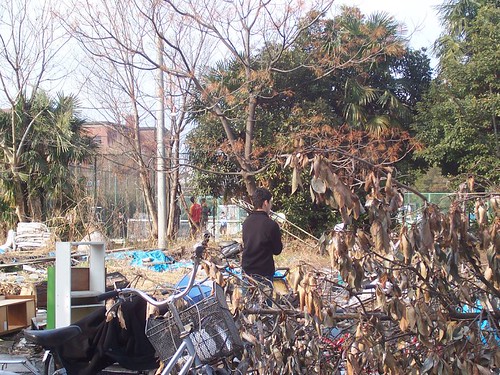
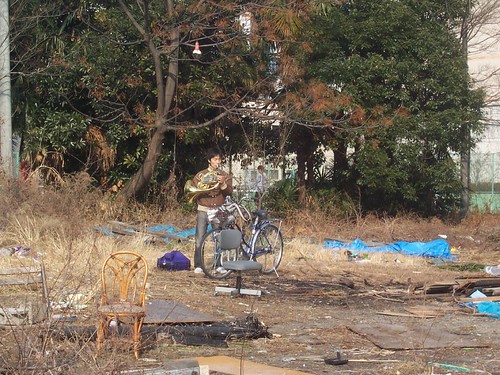
On Saturday, on the way back from the station I spent some time wondering in and out of buildings, cafes and areas which looked interesting. I was drawn to the mildly cacophonous sounds emanating from what looked to be an old scrapyard. I carefully peaked inside to have a look and was met with the surreal sight of musicians, dotted around randomly, playing their various wind instruments, standing between the mangled bikes, scrap metal and garbage blowing around the ground. It seemed to be some piece of conceptual art, though when I found someone to ask I was told that they were university students and this was simply the best place for them to practice. Somehow the strange contrast was rather relaxing and I stayed for a while listening to the practice and sneaking in a few shots.

Tuba practice:
Tuba practice
and trombone practice:
trombone practice
Looking back now, I probably should have found a chair and stayed longer. Enjoyable in its rather eccentric way.

All the Hallmarks of a holiday

No Valentine's day post would be complete without a link to the eternal embrace.

Valentine's day in Japan (and Korea) differs from the traditional form that we celebrate in the West. On this day it is only the woman who gives the gift (usually chocolates). The man then thinks he has got the better deal. However, this is a double bluff. A month later is the man's turn to give a gift to the woman. With a month's warning now the man is in twice as much trouble when he forgets!

In fact this tradition has become somewhat of a burden as the women in an office are often expected to buy chocolates and flowers for all their male co-workers. The translation of this gift is 'obligation chocolate'.

Anyway, enjoy your day and if you don't, then partake of the Korean tradition whereby the men who don't receive a gift get together in March to mourn over bowls of black noodles.

Monday, February 12, 2007

Catch-up summary

I had assumed that many people who read this blog will by default read all the other blogs that I dip into each morning. I also tend to reason that if an article is on a BBC website that they will pick up on the story. This is clearly not the case and I hope that by doing what I'm about to do, I may be able to bring to those who wouldn't normally hunt around for such articles, what I consider to be an interesting selection.

I thought I would summarise, once a week or so, the most interesting articles I've found, which may include a list of papers I've been reading, news articles on any subjects and blog posts of note. I'll see how it goes over the coming weeks.

So, for this week I list the following as particularly noteworthy:

  • On top of my own posts on the subject, including my review in the previous post, there have been articles about Nick's online popular science/ murder mystery book on both Asymptotia and Not Even Wrong. From what I hear it's going down well and getting a lot of hits.

  • Cosmic Variance has had an interesting and important discussion about the uses and future direction of blogs as tools for outreach, teaching, collaboration, scientific dissemination and more. This has been followed by an interesting response from Flip Tomato. I know of several pure research blogs which I dip into from time to time and the dynamic of input and breadth of discussion is impressive. I have my own research wiki though currently I'm using a none-too-impressive free online wiki service, having no web space of my own. If anyone knows of a good, free web-server on which I can setup my own wiki that I can tweak, I'd be very interested to know.

  • An important point in the development of the International Linear Collider, the successor to the LHC, was announced in a press release here, and follow ups from Cosmic variance and Asymptotia are both fact filled accounts of the physics, technology and politics involved. The announcement is related to the completion of several design aspects of what will be a most spectacular piece of engineering and a huge leap in our understanding of the forces of nature. Some of Clifford's comments are a good summary of the physics discussed in the Newtonian Legacy (see previous post).

  • Over at Retrospectacle there's an article for those who have always wondered where prions (the proteins responsible for mad cow disease and its human counterpart) fit into the biological family tree. Certainly five or six years ago if you had a tonsillectomy in England, they would test the removed appendages for prions. I'd had such an operation just before starting my undergraduate studies and so this post clears up some of the questions I'd had.

  • Prior to this article, still on Retrospectacle are some interesting, relatively technical (to the non-biologist) articles on the workings of the auditory system, Shelley's particular area of research.

  • Also tied in with Retrospectacle is this article from the BBC about the incredible language skills of one particular African Grey parrot with a vocabulary of almost 1000 words and the ability to combine these into new combinations when shown never before seen objects.

  • From way back in the year at Bad Astronomy blog are the top ten astronomy images of 2006. All of them are stunning photos, but the number 1 spot blows me away every time I see it.

  • In research papers, there have been several preprints over the last couple of months on baryons in the Sakai-Sugimoto model - in particular this one, which came out not long ago. The Sakai-Sugimoto model of AdS/QCD includes a non-abelian chiral symmetry, using a stack of D8 anti-D8 branes. In the most recent work a five-dimensional soliton is studied on the world-volume of the D8s and the potential is taken to be that of a field configuration holographically dual to the baryon. The spectrum is then calculated by finding the eigenstates of the Schrodinger equation with this potential. Lots of interesting things to look into further with this work, I feel. (I can see that this review is too brief to explain what's really going on but if any of the words match your area of research, take a look at the paper).

  • I came across this paper by Green and Bachas "A Classical manifestation of the Pauli exclusion principle" from 98. This is related to the existence of two, unique holomorphic curves in M-theory describing fermionic states in IIA string theory. The two solutions correspond to no fermions and to one fermion, but the lack of any other solutions is said to be a 'classical manifestation of the Pauli exclusion principle'. If anyone knows of more work that has been done on the spin-statistics connection in relation to string theory objects I would love to know. Looking through the citations I can't find any other papers which discuss this for more general systems.

  • In Chinese blogs, The Weifang Radish reports on a new post from Chinabounder which has caused the violent spectrum of replies it was expected to. For those out of the China loop, Chinabounder is a blog by a British expat in Shanghai who seduces Chinese women and then writes about his exploits. A Chinese professor got hold of the story, started a witch hunt to find the guy, give him what he thought he deserved, and wrote a large number of extremely aggressive articles about the behaviour of expats in China. Some of his articles are also discussed here on The Weifang Radish. The whole story is completely over the top, somewhere between amusing and terrifying and seems to be a lot of people venting their collective spleens over the web.

  • This BBC article on queuing in China is an interesting one, though I can see many similar situations ahead as China gears up for the Olympics. Taxi drivers will only be licensed to drive during the Olympics if they reach a certain fluency in English speaking and listening. I'm yet to see this progress, but I'm beginning to feel that just about anything is possible over there. There's a famous, modern saying that in China nothing is possible and nothing is impossible - this sums up life there pretty nicely.

  • I've discussed in previous posts about my wonder at some of the incredible engineering feats which are somehow not only dreamed up but actually come to fruition. The LHC of course being one which I've spoken about in the past, in detail. However, away from science and into the commercial world, Dubai has somehow jumped onto the world scene of spectacularly lavish buildings. Though the Taipei 101 is currently the world's tallest building at a little over 500 metres, this is going to be dwarfed by the Burj Dubai, due to be completed in 2008 at somewhere in excess of 800 metres tall (One official website comments that the latest redesign puts the final height at 1100 metres, but I don't know how official this is). Marvel at the photo at the bottom of this page for an idea of how this is going to change the landscape.

OK, that's probably a little overwhelming, but I hope that there's something interesting in there for most.

The Newtonian Legacy reviewed

I wasn't expecting to write about Nick's book just yet but starting it on Saturday evening I couldn't bring myself to shut down the computer. Not willing to go to sleep with so many unanswered questions I stayed up until late Saturday night reading through it, thoroughly engaged and amused.

So, it's a murder mystery set in and around historic Winchester in Southern England at the PHI Institute. This is perhaps the English, fictional equivalent of the Perimeter Institute or the IAS (have a look here for a very good read about the IAS). A post doc is murdered and the affairs that he was engaged in and the circumstances of his death become more and more intriguing throughout the story. A fellow postdoc who finds the body gets involved. Not only does he assist the police in uncovering what was going on but along the way he and his colleagues explain to the police officer involved (who happens to have an undergraduate degree in physics) what the people at the PHI Institute actually do and why they do it. It goes without saying that he also gets caught up in several steamy affairs, the local narcotics scene and arms traders - it comes with the job, you know!

As we follow the exploits of the wide array of characters (drug dealers, bohemian artists, hit men as well as the physicists and police), we discover about the Higgs mechanism (from the basic ideas through to composite Higgs models), possible alternative scenarios at the LHC, the interesting and highly strung politics of just about any physics institute, the basics of string theory, some cryptography and the history of alchemy. Along with this are the philosophical musings of the postdocs at the institute, all pretty accurately portrayed.

The idea of mixing in science with an engaging storyline for the general public has a long history and I thoroughly enjoyed the stories of Mr Tompkins from George Gamow when I started learning about quantum physics and special relativity.

The weighting of science to storyline is different in The Newtonian Legacy, but for an interested reader I think it gets the balance right. As long as they have a basic grounding in school physics and a keen mind they will come away, not fluent in the language of technicolour, but they should have a good idea of why we are all getting so excited about the LHC and understand more of what being a theoretical physicist is about. This book is a very enjoyable read, and it's free, so go take a look.

Anyway, I'm sure this took a lot of time and energy and I hope Nick won't be under too much more pressure if I suggest this would make a great series, I hope to see more from the PHI institute in the future.

Kenkoku Kinenbi

Though the students and staff here work outrageously hard, the Japanese calendar seems to have a surplus of holidays, on average a couple of days every month. It seems that some of these are ignored and people still work, but today many people are out of the office because it's Kenkoku Kinenbi, the day celebrating the nations foundation. I've heard a few alternative interpretations including that this celebrates the day that Japan was literally formed when God dropped a clump of mud from the heavens. However, the official line seems to be that this celebrates the date in 660 BC when Emporer Jimmu took to the throne. It appears that celebrations are kept low key and the people are urged to reflect on the meaning of Japanese citizenship.

--------------

I was wondering about what to write for the trip last weekend to Nara. Listing temples is pretty tedious for readers and there are dozens in Nara and the surrounding area. However, Nara is well worth a trip from Kyoto, just an hour away by train. The deer parks surrounding the temples and the giant seated Buddha are all worth the short day trip and the stroll up the very scenic hills to the temples overlooking the city makes for a fine afternoon. Again, most of these are working temples and feel wonderfully peaceful as you look over the modern cityscape below. Well worth the trip there. The extra, short train journey to Horyu-ji temple, around 1400 years old is certainly a good choice and the museum with a collection of national treasures is small but very impressive.


The simple code for an embedded flickr slideshow comes from here.

Thursday, February 08, 2007

Q+A

A few random bits and pieces for now. I still have to discuss the trip last Sunday to Nara including the visit to a temple with some of the oldest wooden structures in the world. The post needs some serious editing and will have to wait.

Some quick links for now. First, the excellent videos from the ASTI summer school are back online, having been unavailable for some time. These are perfect for first year particle physics students and would probably be good for keen undergraduates, too.

Secondly, a software tip: I'd used Google Desktop Search as a superb way to search within files (specifically for searching through the jungle of PDFs in the mire of folders on my computer) for a couple of years now, expecting by default that Google software would be the most convenient for a windows user. However, after a little searching I realised that there are many other very good free products out there. In particular, I've found that Copernic Desktop Search to be better at pinning down particular files and you can organise how the search is displayed. There's also a window where you can preview the files on the search page. It's not integrated within Firefox, as Google Desktop Search is, but I still prefer the interface. Anyway, if you haven't come across these products, they are vastly quicker than the default windows search function.

While we're on the subject, if you're a high energy physicist working with Firefox, I recommend the Spires search plugin. I can't find the original Mozilla page I installed the plugin from but there is one which looks identical to the one I use here. Save valuable seconds on your searches!

Having just had a good chat with Hari Dass, who gave an interesting talk on QCD strings from the lattice perspective, I have lots of leads to follow up...have a good weekend folks!

Wednesday, February 07, 2007

Rite of Spring

Saturday was an important festival in the Japanese Calendar: Setsubun marks the start of Spring and the day when the evil spirits are banished. Traditionally, in a household with children, the father will dress up as a demon and the children will throw dried beans at him to ward off the bad spirit, until they return the following year.

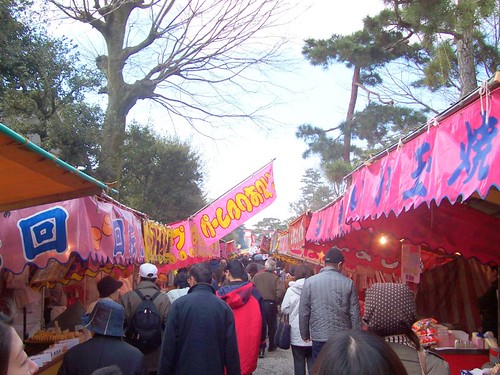
Kyoto is one of the best places to be for this festival and within Kyoto the Yoshida temple is a highlight, which happens to be 15 minutes walk from where I'm staying. It was packed with people and stalls selling all manner of local delicacies.
Snack stalls
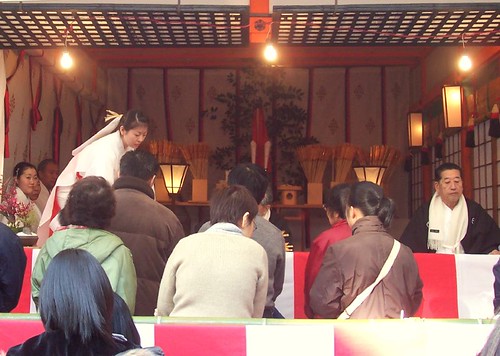
Within the temple itself people prayed and received blessings from the monks, and a huge bonfire was in the final stages of construction.
Blessings
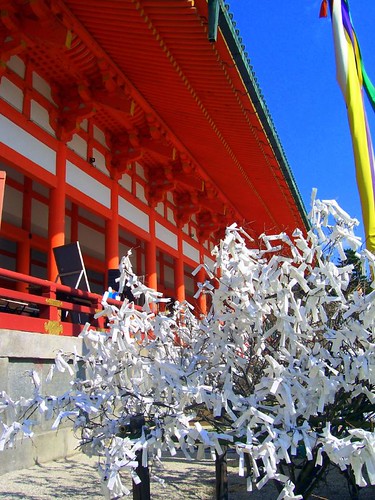
The Japanese like to burn things; Due to lack of space there are very few land-fill sites and so virtually all waste is incinerated (something which has currently caused political unrest in an outlying town to Kyoto where a brand new incinerator has recently been opened). The bonfire at the shrine was not, however, for burning household rubbish. Throughout the year people come to the shrine and inscribe their wishes, either on pieces of paper which are attached to tree branches, or on blocks of wood, in the hope that Buddha will grant these blessings.
Prayer tags
At the end of the year, whether these wishes have been fulfilled or not, the wooden blocks should not simply be thrown in the bin, hence the fire which is used to burn the now defunct prayer tokens.

Near Yoshida shrine is the Heian temple where we walked to see what promised to be the highlight performance of the day. The temple is stunning and because we had some time before the show, we walked around the very beautiful and equally empty temple gardens.
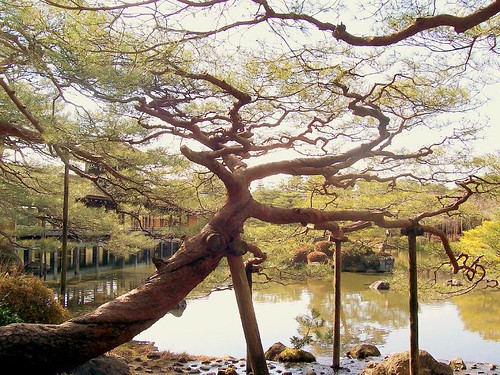
ancient tree - Heian Temple
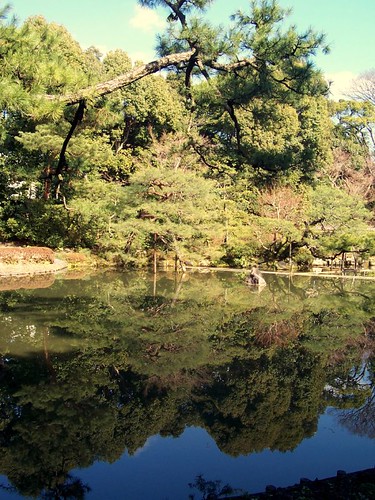
Reflections 2 - Heian Temple
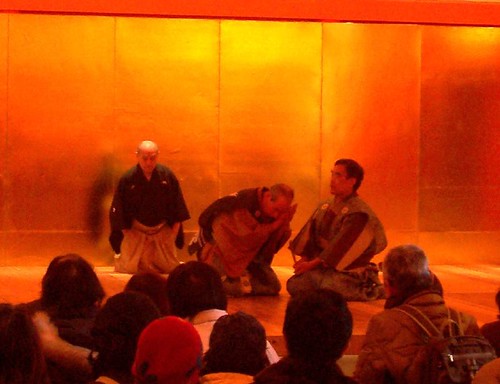
We also watched a short play in one of the temple side-buildings. Though it was modern theatre and, I presume, an amateur company, some of the traditional aspects of Japanese drama are still firmly entrenched. Having been completely spellbound watching the Kabuki theatre last year at the Kabuki-za in Tokyo, I was hoping to go and see the local speciality next weekend. Noh theatre is supposed to be rather harder to follow than Kabuki. I sat through and enjoyed the Kabuki performance last year because I had an audio commentary in an ear-piece which explained every aspect of what was happening, from the costumes, stories, history and actors to the alien music and the cries from the audience throughout the performance - this is really highly recommended, but pay the extra for the electronic commentary, otherwise you will be bored within half an hour (of the total five hour performance). Unfortunately the Noh theatre here does not have audio commentary so if I can't find a translation of the performances I'll probably have to give this a miss. A return to Kabuki in Tokyo will not be a bad second choice.

Anyway, the modern drama was short, pretty confusing and moderately enjoyable. It was however free and as I was sat drinking a warm, mildly alcoholic rice-porridge drink (perhaps the Japanese equivalent of mulled wine) it was a pleasant place to spend half an hour.
Modern theatre
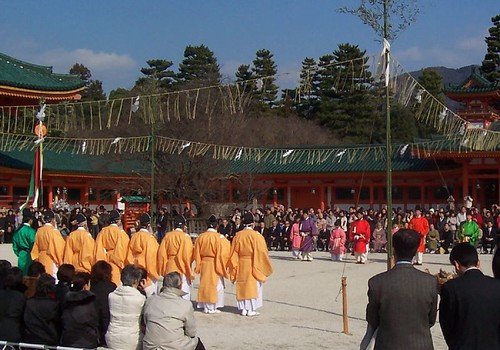
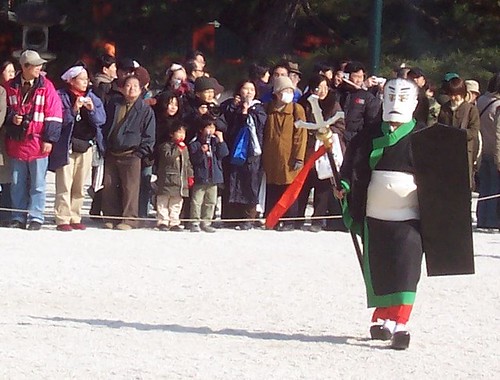
The central performance was in the main forecourt of the temple and, cordoned off by ropes and surrounded by onlookers, the stage was set with various props placed around the arena. Local dignitaries sat within the stage watching from prime position. Seven monks appeared, dressed in yellow garbs with white veils around their mouths, and opposite them were three warriors each with a child, carrying various weapons, in tow. (Any analysis of the events from me is speculation as I've little idea of what was really going on).
Monks at Heian
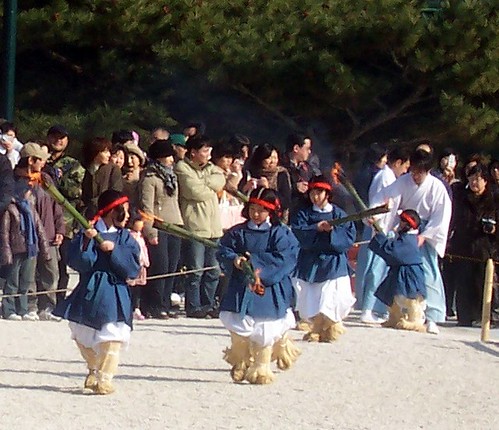
At this stage Evil showed up, face covered with a multi-eyed mask and followed by more children, this time carrying flaming torches. The children were extremely young and had some considerable difficulty keeping the flaming torches not only upright but also away from each other. It seems common sense that making your shoes out of the same material as your torches is not great planning. Anyway, I waited with baited breath for one of them to set alight to their neighbour as they waved the flames around and bits of torch scattered the ground in the wind, but none ignited.
Evil
Flame carriers
Evil then marched to centre stage and was held off by the warriors, the first one firing arrows (not terribly pointy, but arrows nonetheless) into the crowd, the second one fighting with a stick. The method of the third eludes me. With interludes of talking and chanting, the players and dignitaries circled the arena several times, Evil chanting 'evil' and the rest replying with 'evil, be gone, good luck, come in'. After several times around they headed out to the front of the temple where the chanting continued.

It seemed that this was the climax and having watched for some time we headed back to Yoshida shrine for local refreshments.

This all took up a good few hours of the day so I headed back for a quick nap to catch up from the previous night. Later on I headed out for dinner alone doing the usual trick of trying to decide which restaurant will be good as well as having a reasonable chance of my being able to order something not outrageously expensive. Eventually I stumbled upon a suitable place, bursting at the seams with Saturday diners. This particular cuisine (the name of which is currently in a notebook elsewhere) is Japan's answer to the shish kebab. Meat, vegetables and fish on a stick, flame grilled or fried and eaten with a selection of sauces.

I was rushed to the round counter surrounded by other diners, thrust a menu and the indication was made to order straight away. There was enough English on the menu to select a range of treats which showed up over the next hour or so and, washed down with a local drink, was a fine dinner. Definitely worth a go if you find a restaurant offering this. I can't recommend the sticks of chicken cartilage particularly highly - very crunchy without much flavour.

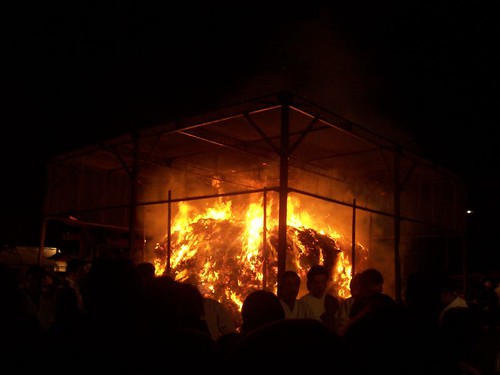
Post dinner I went to do some work in a local cafe and stayed until 11, at which time the giant bonfire at Yoshida was due to be lit. Following the herd I got back to the temple and joined the enormous queue waiting to climb the stairs to the bonfire. The two or three thousand people surged up the stairs and walked around the bonfire, some throwing things in, many taking videos and photos, the majority simply warming themselves up.
Bonfire 1
Having been thoroughly singed and jostled by the crowds I left, headed back home and had another troubled night.

OK, Sunday still to come but I'll leave it there for now. More photos of Saturday are in and around this page on my flickr site.

The Newtonian Legacy

As this is a physicist's blog in which I attempt to include a little 'kultcha', on occasion, I now have the perfect combination. Usually I don't blog about books if I haven't read them and I'm hoping to have a chance to read this very soon.

From Nick Evans, my former PhD supervisor, comes the mixture of crime, intrigue and popular science you've been waiting for. The following is taken from Nick's site where the book is freely available to download.

"A younger researcher, Andreas Born, is found dead at the particle physics institute where he works. A policewoman is assigned the job of penetrating the intellectually charged atmosphere his colleagues work in. She is forced to unravel the mysterious world of subatomic particles to understand the dead man's motivations.

Meanwhile, Carl, one of Andreas' collaborators embarks on an exploration of Andreas' murky life outside physics including sex, drug dealing and bizarre alchemical experiments. Carl is followed by a mysterious stranger and must fight to preserve both his life and the relationship with his girlfriend.

Learn about the frontier of particle physics within a fast paced crime adventure."

Anyway, I may be biased but I think it looks like a great idea. Along with the murder are discussions of string theory, the Higgs, quotes from Feynman, the odd equation and diagram, and all in a style which looks to take the reader through some good pop-science while being a fine mystery.

As I say I haven't read it yet but I'll put up my thoughts when I have. Anyone else who has a chance to read it, please tell me, and Nick, presumably, what you think.

Tuesday, February 06, 2007

Permutations

This afternoon I found my eyes doing funny things when reading a white on black blog. I'd been told in the past be a reader that this was not ideal and so, with Blogger's new template wizard, I've done some alterations. Suggestions are welcomed: font size, colour, layout, etc. and I'll see what I can do if there's a consensus.

Late debate

Though work is very much on the boil, I don't want to miss the opportunities while I'm here to take in a good deal of the area in and around Kyoto. So that's taken up both Saturday and Sunday. Friday night was an extremely enjoyable evening spent chatting over drinks, do-it-yourself sushi and many other fine foods at a local postdoc's house with physicists from a good range of international locations.

Seven hours spent sitting on tatami matting took its toll but it was great to talk about a huge range of subjects and learn a good deal about Japanese history and culture, both ancient and modern. It was particularly interesting to hear views about the present Prime Minister who, it seems, has thoughts on altering the constituation which currently does not allow Japan to have an army (imposed after the second world war).

"Article 9: Aspiring sincerely to an international peace based on justice and order, the Japanese people forever renounce war as a sovereign right of the nation and the threat or use of force as means of settling international disputes. 2) In order to accomplish the aim of the preceding paragraph, land, sea, and air forces, as well as other war potential, will never be maintained. The right of belligerency of the state will not be recognized."

(The constitution makes for interesting reading in general.)

This absence of army has saved Japan both lives and money and it appears that the money saved may have helped the electronics boom over the past few decades. Though views from the evening seemed very sensible, I've since discussed the issue with others and heard a spectrum of opinions on the subject.

Anyway, the restriction imposes a protectorate relationship between Japan and the US which some would like to get away from, the point being that if relations with the States soured in the future Japan would be forceless except for the defense Army. In fact the defense army did go to Iraq in order to dig wells but, as they are not allowed to carry arms, they were guarded by Dutch soldiers.

It's a thorny issue and in the turbulent climate, while the ideal is clearly for everybody to have only a defense army (which would therefore be needless), many Japanese feel vulnerable. It seems that the current Prime minister may also be more likely to avoid the prickly relations with China and Korea which are ignited every year by going to visit the war memorial at the Yasukuni Shrine (including the spirits of 14 class A war criminals which are remembered there - this is the main controversy).

The relationship between the two nations is one that I often find a difficult subject, though one that I continue to be interested in on the level of individual Chinese sentiment. Almost every Chinese person I've spoken to (though not 100%) has gone from placid to raised hackles at the mention of Japan and strikingly strong language is frequently used. This is not just on a national level but many people I've spoken to have said that they could never be friends with a Japanese person.

A sad state of affairs and one which I initially tried to parallel with Germany's post war relationship with the rest of Europe - these are not appropriate parallels to draw. The continued bad feeling stems mostly from the lessons taught to children in Chinese school and the many films on Chinese television about the cruelty of the war (this is not to trivialise the subject in any way) - it seems they are taught that Japan would enact the same atrocities if given half a chance. The situation is also perpetuated greatly by the continued trips by Japanese politicians to the war memorial and by the publishing of Japanese textbooks with extremely biased discussion of the war - speaking with people and reading around a bit it seems that though the children may be briefly fooled by these books, the general knowledge of the well-educated population is closer to the truth.

(There's a TIME article here on the education of Chinese children on the subject of the war.)

I had the pleasure when my Japanese collaborator came to visit Beijing to introduce him to various friends who afterwards claimed, to their surprise, that in fact some Japanese could perhaps be good people and though true friendship would still be difficult, some of the prejudice had clearly been lifted. Though it's only a small step it was extremely pleasing to be part of this link.

Anyway, so the evening continued and we went from discussing links between Nordic and Asian language structures through Japanese cuisine and whiskey manufacture to the current boom in wine sales in Japan, into European history. It turns out that my knowledge of English common law is pitiful and if I'm tested on the differences between the continental and English judicial systems I'm likely to be left floundering. This was after the others had waxed lyrical about their nation's past, present and future legal systems.

By three o'clock the Euro debate and the price of pizza was being hotly contested and as my legs were beginning to make noises they shouldn't and with a schedule to keep to the next day, I left at just 3 o'clock. It turned out that the drinks kept flowing and the conversation continued on past 7am, and though it would have been enjoyable I would have been even more exhausted than I am now.

Whatever the conversation, it's a lovely change to sit around and chat like this. It's something that for various reasons I haven't had a chance to do as much as I'd like in Beijing.

Monday, February 05, 2007

The buzz and the daze

It's been a busy week of work followed by a full weekend of sightseeing. Currently it's Sunday night and I'm tired, both from being on my feet for perhaps ten hours this weekend and from sleeping pretty badly for the last few nights. (Having written up details of the last few days the whole post has become a little unwieldy so I'm going to postpone the sightseeing bit for a day or so).

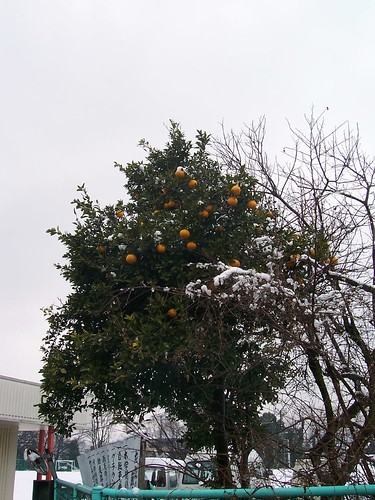
Thursday morning we woke up to an inch of snow, something rather uncommon in Kyoto but it made for a beautiful few hours until, by 11am there wasn't a trace of it left.
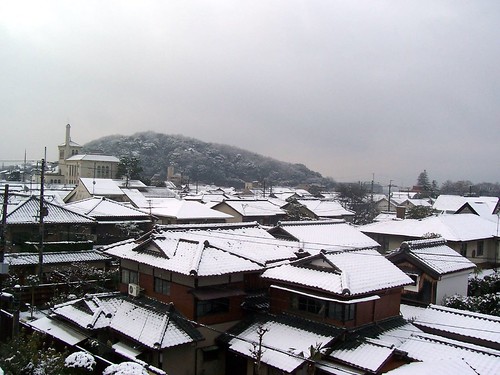
Home view snow
Oranges in the snow


So, I'm knackered, but I'm happy with the cause of the lack of sleep. It's related to an aspect of research which I haven't experienced for a little while. My last few projects have been enjoyable, medium concept and relatively high on computation. I've explored some interesting work with my collaborators which has been enlightening and fun. This means that once you've come up with the idea, carrying through the computation has tricky aspects but they can usually be worked through by staring at the screen for long enough or arguing over the meaning of the problem at a white board.

A few days ago a paper came out which sparked off a series of thought processes for me, linked to something I've been thinking about for a while. The ideas are now swimming around in my head, forming solid foundations as others fade and reform in new configurations. I'm afraid I'm not going to go into any details what the idea is but I wanted to talk a little about some of the enjoyable levels of thought process that go on as such an idea is forming.

What follows hasn't happened this way for quite a while, until now. In the hazy line between wake and sleep, as the shackles of normal consciousnes are lifted I find is the optimum time to make conceptual leaps which I couldn't make normally because life and conscious thought are just too noisy. Trying to imagine higher dimensional objects just doesn't work (at least for me) in a fully conscious setting, but somehow the faculty of conceptualising such things is in there, hidden deeply somewhere - or at least the illusion of it is.

As I've been drifting off to sleep over the last few days my thoughts have been swimming with pictures of the problem I'm tackling and the equations which govern it. I'm not trying to say that the ideas I'm coming up with are exceptional. For a start I wouldn't judge such things and on top of that I'm sure bits of what I'm coming up with are way off the mark. I'm also sure however that some of it is right and rather exciting. This is part of the buzz that drives us (or at least me) to do what I do - starting with a problem which looks like a tangle of creeping branches with a speck of light the other side, as you discover the way the branches really fit together in a beautiful pattern which you can slowly decode is a great intellectual rush.

Unfortunately, within an hour or so of this semi-dream-like state I may have solved some problem. The next stage is to go into the office the next day in a fully awake state to carry out the calculations in detail. Unfortunately it's very difficult to switch these thought processes off and the possibilities keep sweeping in and out to make real sleep very difficult.

I spent many weeks of my last year as an undergraduate in this state as I was spending a great deal of time on one particular problem - coding for selection methods for particle event searches in Babar data. This sounds low concept, high drudge work to a theoretical physicist perhaps, but I found that similar intellectual leaps were needed with parts of the computation as can be found in many problems in particle physics.

I would spend the day tackling a conceptual problem with the code and only in the twilight of semi-sleep would my subconscious be heard long enough to tell me what the answer was.

In fact this was a fun problem. It was necessary to take a set of data from a particle accelerator, including many parameters from each collision (number of electrons, missing energy, transverse momenta, total charge, etc.) and put cuts on the data to look for a particular set of events (in this case we were looking for lepton flavour violating tau to mu, gamma).

The basic procedure is to put constraints on the data - bounds on the total missing energy, a cut on the total charge etc. in order to include only certain events. This is done in order to cut out as many unwanted events (background) and keep as much of the particular event we were looking for, as possible.

This was all tested and tuned on 'toy' data, generated by Monte Carlo simulation, such that when the cuts were optimised and the accuracy known, it could be used on the real data in order to give a bound on these lepton flavour violating events. It turned out that there were three useful parameters which were uncorrelated and therefore were valuable to be used as variables to cut the data on (three momentum in centre of mass frame, missing mass squared and missing energy squared as far as I remember - it's been a long time). You could then plot the data, point by point, in this three dimensional space and place a box around it which you hope will include as much of the data you want and exclude as much background as possible.

However, instead of defining a box region with straight sides in parameter space, it seemed better to design a shape which cut the data more efficiently from the background. The question was what shape to choose. In the end it was possible to describe a relatively generic shape with six parameters.

Running through a large range of six free parameters on the data was going to take around 20,000 years if I remember rightly (10^12 iterations) and marks deducted for such late work would jeopardize my degree. A genetic algorithm on the other hand was just the job. The procedure is simple and I've used this on many occasions when I want to optimise something which has a large number of possibilities - it's not perfect for all such problems, but many.

Here's the general idea: Create ten randomly generated shapes with a random set of six numbers (in a sensibly chosen range). Apply this shape as a cut in the three dimensional parameter space and define a way to grade each one - (good data)/(bad data) would be about the simplest, but not necessarily most intelligent. Keep the best shapes, throw away the worst and breed the best shapes in some normalised fashion such that their offspring look something like each of their parents. Add in a little random mutation as well and throw in a few more completely random shapes. Do the same thing again, and again, and again until the system has settled to an ideal shape. This is a pretty general procedure for such problems.

Rather than 20,000 years this took around five hours. It all sounds rather easy now, but the actual design of the genetic algorithm, its tuning and weighting system gave me many sleepless nights floating about in the code and turning the possibilities around in my dazed head. Anyway, it was a fun project and we got some really nice results.

As I say, during these periods where the conscious and subconscious talk freely with each other (I still don't know whether this is pop-psych babble but it certainly feels right) the buzz of hitting on an idea that you absolutely know solves all your problems not only makes up for the zombie days following but is a motivation for what I do.

Sorry, I got a little carried away there, but I'm enjoying the possible prospects for the current ideas coming to fruition. Now comes the hard work of (in this case) coding up the ideas, reading many more papers to solidify some of the formalism and actually getting real results. Maybe it won't work out but I'm enjoying this current state of work very much. I'm sure that the tranquility of Kyoto is helping with this.

-------

I've written up accounts of this weekend but will post them over the next few days.
Thursday, February 01, 2007

Tea for one

Having spent a good deal of Saturday evening in a vegan restaurant, with bookshelves stacked with all manner of literature plus a few useful Kyoto guides I wrote down a several places to go and visit. I'm still not sure if the food was one of the many traditional Japanese vegan cuisines, where mucking around with the food is frowned upon, or whether it was simply a hippy, student hang-out where vegan was the in thing. It certainly had the feel of the latter but the range of classic Japanese food stretches a lot further than sushi and tempura.

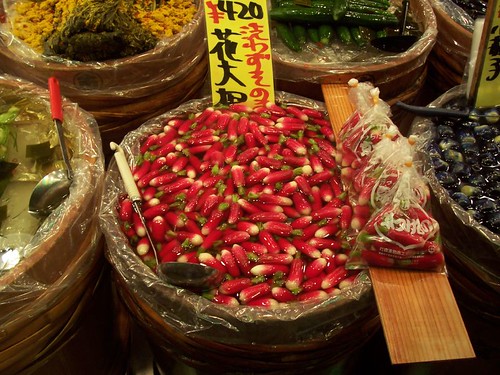
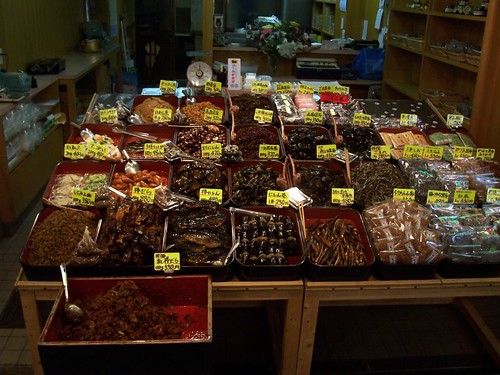
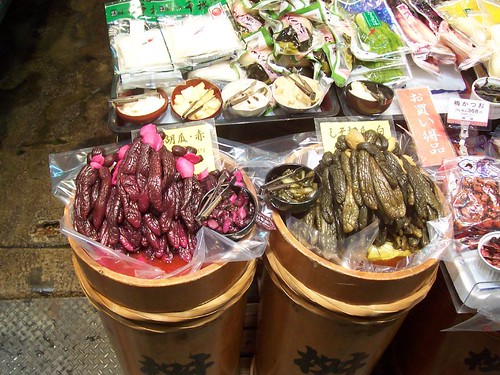
So, on Sunday, with notes from the previous evening in hand, I headed to Nishiki market, said to be the kitchen of Kyoto. It's a covered market with roughly 400 shops selling every possible ingredient and piece of kitchenalia that one could want for authentic kyo-ryori (kyoto food). Vegetables in pickling vats (Tsukemono), vast arrays of sweets, all manner of fish including dried bonito being sliced into strips so thin that they fill the air around the shops, make for an amazing range of sights, sounds and smells. Many of the shops have sample dishes and though you wouldn't want to fill yourself up purely on pickles and sweets you can certainly try a good selection as you walk around.
Japanese radishes
100_3462
100_3461
(Click on the photos for clearer images)
I was drawn to a knife shop where they were sharpening the stunning blades on whetstones at the counter. The knives are very very expensive but quite simply some of the best in the world. In Beijing I'm just not cooking these days but when I'm back to full speed in the kitchen I'd love to buy a traditional Japanese knife. My Global is my pride and joy in the kitchen but a hand made one directly from Japan may surpass even that.

Having whetted my appetite on the samples, I walked into one of the restaurants which sit above the shops and line the market street. Pointing at a picture was the only means of communication and when the meal arrived I was rather bemused as to the next step. Amongst other side-dishes the meal consisted of an empty bowl, a pot of rice, a small plate of grilled eel, a plate of pickles and wasabi and a pot of tea. It was clear that I didn't know how to proceed so the waitress came over to help and mimed that I had to put all the ingredients in the bowl (to my personal taste in pickles) and then pour the tea over them. Making a pickly, fishy, tea broth doesn't sound great but the subtlety of the flavours means that it's actually a very fine meal.

Anyway, I'm going to leave it there, I didn't get much sleep last night having had an exciting idea yesterday. Today I'm frantically working out the possibilities and consequences.

Wednesday, January 31, 2007

On video lecture resources

Spurred on by An American Physics Student in England (who writes much more eloquently on the subject than I will) and Asymptotia's follow up I've been spending a couple of hours each evening back at the guest house winding down with videos of theory seminars from various graduate summer programs - With a Chinese budget, going out on the town is not on the cards, though I've spent a few pleasant evenings in local cafes. Anyway, I thought I'd talk about these video lectures in general and try and add to the original voice and push to make this more widespread.

Learning theoretical physics is hard - it takes time and effort in equally large helpings. There's so much of it that it's easy to be distracted by a million questions and one could spend years following leads from one confusing point to another. It's clearly very complicated though with practice and time the confusion clears and the mass of formulae converge into a meaningful whole. Sometimes books and people explain things in such different ways that it's hard to see that they're talking about the same thing. Often this can be beneficial however because you build a more structured picture of the given subject - physics for cubists perhaps.

Before I say anything about sitting back and watching videos I should stress that the only way you will learn to use the tools of quantum field theory, string theory, advanced areas of mathematics and the like or indeed far simpler topics in maths and physics is not just to read the hundreds of books on the subjects but to do it.

Many people claim that they don't give advice. This is all very humble but those with experience have been through the system and seen what pitfalls lie in wait. I am keen to hear advice from anyone who has been there and done it, however subjective it may be.

Though I'm not that far from being a graduate myself I think that my memories are fresh enough to provide my tuppence worth on the subject.

I think that the following is one of the most important points to stress to first year graduate students: Now is perhaps the only time that you will have the luxury to be able to sit down and go through all the problems in a book. Do it! Do every problem you can get your hands on. Don't just look at the problems and think if you can do them (though of course thinking about problems abstractly is a useful skill) but write out the indices, dot your alphas and make sure your factors of two are right. This will be obvious to most I'm sure but it's so easy to fall into lazy habits of simply reading books in a comfy chair with a cup of coffee. My opinion is that daydreaming is also an integral part of consolidating understanding in these subjects but in general it won't solve the nitty gritty of calculations.

In my first year I tried to take this approach of going through problems but probably not in a very organised way. I had pieces of paper flying all over the place and ideally I should have ended up with neat notebooks full of the correct solutions which I could easily look back on if I need to do a similar problem in the future.

After this, when you start doing research you (or at least I) won't have time to devote to spending several months going through a book. Currently I do spend a lot of time reading papers and books on various subjects but this is often piecemeal and is on top of pursuing research problems. I usually have to devote evenings and weekends to the former and it's frequently interrupted by the latter.

So, do it, speak to people who've been there and find out what books they found useful and go from beginning to end. If it's an appropriate book you will learn how to solve real research problems for yourself. If you don't do the problems and work through the examples then you will probably be able to sit through a seminar on the subject and know what's going on but you wouldn't have been able to get there yourself.

OK, that said lectures are vital because they give the interaction between student and expert. It means you can follow the thought patterns of someone in the trade and you can ask the questions you can't pose to a book, this is pretty obvious. On top of this if the lecturer is good they will take you at an appropriate pace through a subject. As all good books on learning techniques will stress, stimulating different areas of the brain during learning is a good way to memorize things and so using both the auditory as well as visual inputs will surely be beneficial. I wonder if because our brains have evolved since the advent of language if we're better at learning through speech than through the relatively recent addition of the written word.

Still useful but without the benefit of interaction is to watch the lectures on video which is what I've been doing for a couple of hours each evening. I probably haven't learnt how to solve any of my research problems from them but they've taught me new ways to see things and given me motivation to go and look stuff up in books. Institutes are slowly but surely videoing lectures and making them available to the public. I would urge all institutes to do this. It's a waste not to. There are some wonderful lecturers out there and for something that costs so little, so many people could benefit. This is a treasure trove of resources waiting to be utilised.

As an addition I would hope that at some time there can be a real central repository rather than hundreds of sites dotted round the place with small catalogues of lectures. Spires has a search function for videos but they're not all there. Perhaps it would be possible to include a comment or voting section. I'm sure there are hundreds of courses around the world on QFT but if through time people gravitate towards a particular set of lecturers that's even better for newcomers who don't want to search through all the others.

The lectures I've been watching have mostly been of a relatively basic level but I've learnt things from each one and spent a long time following up leads on the web and in the Yukawa Institute library. If nothing else it's a great chance to sit back at leisure and contrast what makes a good and bad lecturer (though almost all of them have been great) and get a few tips.

Most of the lectures from the ASTI summer school are excellent, ranging from true pop-science level to some reasonably technical first year graduate material. Don't be put off by the fact that occasionally the audio and visual get out of synch, this simply adds to the different ways your brain is having to function and makes the learning experience richer ;-). Lectures from Tony Zee on beginner's QFT, Clifford Johnson on strings and branes, Jeff Murugan on solitons (great but the synch is testing), James Gates on supersymmetry, Don Marolf on black holes and Robert de Mello Koch on the fundamentals of group theory are particularly recommended, though there are many that I still haven't seen. (See below for some hints on downloading these).

The lectures from the PITP school aren't quite so clear but there's still a great range of courses (mostly four lectures each) from the basics of string theory by Richard Szabo and the AdS/CFT correspondence by Mark Van Raamsdonk to slightly more technical lectures by Leonard Susskind on de Sitter space (really not very clear visuals at all).

From the Perimeter institute is another fantastic resource though unfortunately I've not found a way to download them (only viewable as far as I can tell in Internet Explorer). The summer school on strings, gravity and cosmology has extensive introductory lectures.

Serkan Cabi has a long list of pages with videos online and I've spent a long time searching through for the most appropriate. Many of them are streaming but if you want to download them there are programs out there that allow you to do this. In particular I've been using a program called Hidownload which is free for something like two months. For the ASTI lectures the link seemed to break easily and I found a program called DAP which allows resumption of downloads meant that I could go away and over a long time the lectures would end up in one piece on my computer.

Anyway, I hope that's of use. In particular if anyone has the knowhow, energy or power to get a real central repository or search engine which enables comments I think it would be very beneficial. Bottom line - don't waste lectures. Make them as freely available as possible.

Tuesday, January 30, 2007

Minimal ado

The opportunity to get steady work done here is just too great and though there are a few other things that I hope to talk about briefly, a full description of Saturday's tour will take too long if I want to include all the photos. Consequently I've set up a Flickr site which has a few of the highlights of the tour (some of which include me looking both slightly awkward and very awkward - enjoy). The titles are working titles and I hope to give some more explanation when possible.

In summary I spent about five hours walking around the stunning temples in the foothills of the Eastern area of Kyoto, close to Gion ending up at the famous Kiyomizu temple - nominated to be one of the new Seven wonders of the world. It is a beautiful setting but if you want to see it in its full glory I've no doubt that the Spring cherry blossom season and Autumn maple seasons are the peak time.

----------

If I have time I'll be back to talk a little bit of food and a little bit of physics, in no particular order.

Friday, January 26, 2007

Temple hopping

Blogger is really playing up at the moment so I'll give this weekend's adventures in installments if possible.

--------

It's difficult to think of Kyoto as a city most of the time, indeed even as the former capital of Japan and a place where many bloody battles were fought between the samurai, most areas just feel too peaceful to give it city status.

As I mentioned previously the view from my guest house room over the local streets is a typically classical Japanese scene.

and from my office the view is a rather distracting one


I seem to be spending most of my time staring at the clouds puzzling over brane interactions. I'm counting on it being written in the sky.

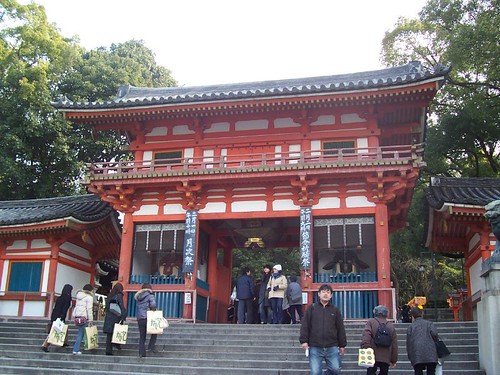
Though I've got a few weeks here I headed the way all tourists in Kyoto must and on Saturday I went wandering through a few of the 400 temples. Kyoto is networked by a very easy bus system so getting anywhere is pretty trivial. All stops are announced on both the speakers and the display at the front in English. I headed to Gion, the area famous for the Geisha (though I hear there are less than 100 true Geisha left) and really the heart of the city and went towards the closest temple to hand.
templeentrance
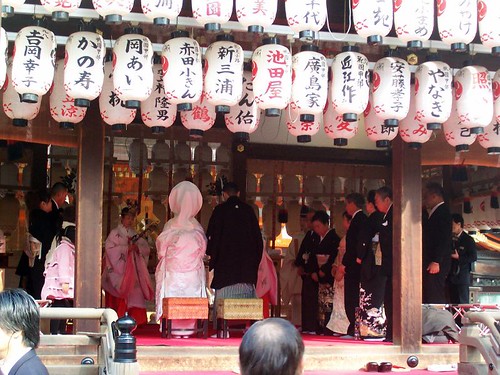
Fortuitously there was a wedding going on at the time in an open-walled building and with chanting and incense burning all around it was a stark contrast to the busy shopping street outside. That said there are enough tourists (mostly Japanese) in most of the temples to make it all seem pretty busy. The power of the gardens and temple buildings are that even with the throng of onlookers they still feel stunningly peaceful places.
marriage
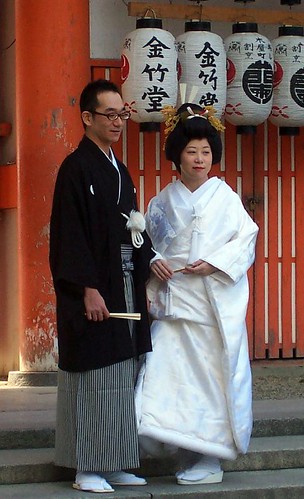
A recently married couple (I presume) were also in the area having their photos taken.
Couple
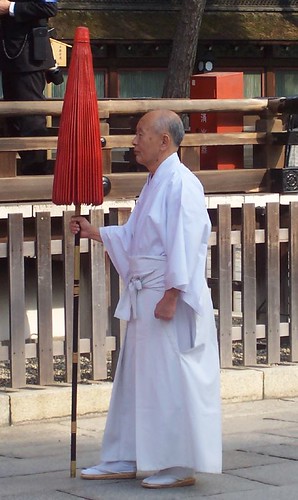
This monk was one of the overseers of the ceremony.
Monk

End of installment 1, blogger doesn't want to comply today.

Thursday, January 25, 2007

Strange Fruit

Taking time away from work isn't easy here. The institute is extremely conducive to steady concentration which is wonderful but it does mean I probably haven't been taking it as easy as I should have while I'm on the road to full recovery from the flu. Still, with long hours in the office followed by a five minute stroll to the guest house, there's not much to do there except read and continue with the work. No TV, currently no other guests and no internet makes for complete peace!

About the only distraction is the stunning view from my office window with the green mountains, the red trees and the almost constantly changing sky.

Photos don't seem to be uploading to blogger at the moment so they will have to wait.

I've seen more talks in the first four days here than I normally would in a month at the ITP. The Yukawa institute is unusual in its international feel, with many foreign visitors and postdocs.

On Wednesday we had a great talk from Frank Wilczek. He spoke about the high pressure, low temperature phase of QCD, which is the condition found at the centre of neutron stars (low temperature here is not in the astrophysical sense, but on the scale of the QCD phase diagram). In this region the phase is said to be colour superconducting and one can perform a weak coupling expansion using BCS theory and find the spectrum of states.

In particular in this phase there is a diquark condensate formed which induces colour-flavour locking and the SU(3) colour symmetry along with the left and right flavour symmetries are broken to the diagonal subgroup of the colour and flavour symmetry. The condensate which is formed has non-zero electromagnetic charge but only a particular combination of the electromagnetic U(1) with the SU(3) colour symmetry remains unbroken, meaning that the asymptotic states of the theory are integrally charged under the new U(1).

The asymptotic states of the theory are found to be single quarks, gluon bilinear pairs and goldstone modes. Though this looks rather different from the non-extreme phase of QCD it turns out that the quantum numbers of these states in the basis chosen by the particular symmetry breaking pattern are exactly the same as in normal QCD: an octet of baryons, an octet of mesons and an octet of pseudo goldstone bosons.

It is found by studying the fermi surface from the point of view of colour superconductivity that the numbers of u,d and s quarks are equal and because of the equality of the number of quarks in this phase, the whole is electrically neutral, meaning that there is no sea of electrons to counter the positive charge that one would have in ordinary quark matter (just u and d quarks with a quark bilinear condensate). Photons (of the unbroken U(1)) are neither absorbed nor reflected, meaning that though the particle density is very high, the substance is also transparent. This has been compared to a very high pressure diamond and it's thought that in the centre of neutron stars may reside a huge diamond like phase (though the edge of this region will merge with the low density region on the outside of the neutron star complicating astrophysical comparison with the weak coupling expansion from the theory).

(See here for a review of the subject, though this doesn't contain the more recent diquark studies of baryon spectra)

It's fascinating to see that there are places in the universe where not only such strange matter may reside but that we can make predictions about it from our knowledge of QCD. Frank mentioned that once we get measurements from gravitational wave detectors (and here) to high enough precision we will be able to make measurements of coalescing neutron stars which we can test against the predictions from the above theory. Exciting stuff indeed. There have been some nice articles detailing quite how unbelievable the gravitational wave detectors are. As an example of how difficult these machines are to construct and use, in order to make a measurement of a gravitational wave it is necessary to measure the changes in the length of a beam several kilometers long which will be on the scale of one hundred millionth the diameter of a hydrogen atom. It's been said before but this is simply preposterous!

(It's very likely that I've misunderstood some of the statements made in the talk so if anybody knows that I've made mistakes, please do correct me. Unfortunately the current valuable research time means that I haven't had a proper chance to read up in detail on this subject yet).

In addition to this lecture there have been a couple of highly theoretical string theory lectures and, as I remembered from being here last year, the questioning during the lectures can be rather intense. Whenever I give my lecture here, which will be on a topic I haven't discussed in detail before, I'll have to aim to a pretty high level. There are many all-rounders here (lattice QCD experts who know their way around an M2 brane for instance) so you never know where the questions may spring from.


Anyway, I gotta get back to work. Projects are progressing reasonably well but as always there's much more to do

Monday, January 22, 2007

Kyoto Story

I look forward to returning at some point to Korea to get an uninfected view of it, my opinions this time being clouded by a mucusy, feverish mist. On Saturday I left, another week's worth of antibiotics in hand having missed all but two lectures this week. And now, I'm in Japan, having landed in Osaka yesterday.

I can't put my finger on what it is about Japan but, although it's just as confusing and alien a place as Korea, I feel instantly peaceful and at home. I still don't understand the menus and the profusion of train lines is a mystery but the quiet, smoothness by which everything works (perhaps another example of mono no aware) just makes me smile.

I was picked up by Tatsuya, from the Yukawa institute and we communicated for the hour and a half back with me using a pen and paper (the voice is now returning today but it's still croaky) on the Shinkansen, through the lights of Osaka to the nearby lights of Kyoto. By taxi we made our way through Kyoto and I was reminded immediately of what a stunning city this is, with its 400 or so temples and palaces and its ring of mountains.

I'm staying in a minimal but comfortable guest house for the next month in a little street with a view from my window of the mountains and the classical Japanese houses surrounding it. Though the external architecture of the building I'm staying in is the least aesthetically pleasing around, I realise that this is the best situation. Who wants to be stuck in the most exquisitely designed palace when you can't appreciate it?. I'm rather looking forward to staying here. The minimal nature is rather monastic which feels very conducive to good work.

In my drugged up, deafened (my ears did funny things on the plane) state I managed to start ticking off the ways to offend people here straight away by stepping over the threshold of the hotel with my shoes on (not the done thing) and in my humble apologetic state, tipping over a vase of flowers. The elderly hotel manager smiled knowingly but appeared to accept my quickly drooping face as sign of true humility.

After the first good night's sleep for a week I wandered around the area and picked up some simple food for breakfast. Last time I was in Tokyo I had a local cafe for breakfast where I would drink coffee, eat toast and jam and listen to the barista's favourite CDs of Thelonious Monk and Oscar Peterson, those were very happy mornings. I look forward to finding something similar here.

Tatsuya then popped by and walked me the five minutes to the Yukawa institute to show me around. I stayed for a while to get myself settled in and attempted amongst other things to try and work out why none of my bank cards work here. I had presumed it was just a Korea thing so I'm getting a little concerned. (An update from the institute tells me that Japan just doesn't accept Lloyds TSB visa cards!)

Lots of great talks coming up here including Frank Wilczek on Wednesday which I'll report on. The Yukawa institute, though mostly made up of Japanese researchers has an international feel with several Western postdocs and visitors so most of the talks are in English, a wonderful change for me.

---------------

I just came back from dinner and am reminded of a tangible reason for my love of the place. I wandered around the quiet streets looking into the restaurants for one that caught my eye and that I thought I had a chance at getting roughly what I wanted. In the end the restaurant closest to me had some nice pictures in the window so I plumped for that. The elderly waitress in the kimono showed me to the sushi bar (though bar makes it sound modern) made of wood with comfortable wooden stools and tatami matting, signs above the bar saying how much each cut of each fish was and a selection of sake bottles filling those shelves not stashed with sashimi knives. Behind me a tank in which, amongst other things, swam fugu, the infamous puffer fish floating peacefully around. I don't know if this is for sale, I seem to remember that all licensed fugu chefs had a hanging paper fugu outside the shop which wasn't in appearance. Anyway, I'm only going for this dish when I'm with someone else who knows what they're doing!

Beside me at the bar were three generations of a family out to dinner and the mother and highschool daughter started chatting in English about whether I liked the food and where I was from amongst other niceties. My continuing inability to equilibrate the pressure in my ears made this a little tricky but I still appreciated the friendly chat - and then the food came, so simple, so unadulterated, such a contrast to Chinese food (which of course I'm a huge fan of too). It's almost certainly that it's been a while since I ate in Japan but the tempura seemed lighter than ever, the sashimi more succulent and fresh than I can remember and the miso soup a beautiful contrast of white tofu and bright green watercress in a lacquered mahogany coloured bowl. I have two words of advice for sushi lovers. First: come to Japan, the sushi will absolutely blow you away. I've been for some reasonable expensive sushi meals in various capitals of the world but none of them come close to the real thing. I can't understand why this is, surely really fresh fish is really fresh fish, but there seems to be something extra. My second piece of advice is: never come to Japan, you will never want to eat sushi anywhere else ever again, or when you do you will feel ultimately slightly disappointed. Strangely my advice for people who are fans of Chinese food differs slightly. The reason is that Chinese food in Western restaurants is so far removed from most (not absolutely all) genuine Chinese cuisine as to be non-influential on your likes or dislikes when you return home.

Another preposterous piece of ying and yang occured when I tried to pay by card. The restaurant accepted it but when fed into the machine there was a malfunction and the machine wouldn't stop printing receipts, even when rebooted. This went on for about ten minutes with about 15 m of tape spilling out onto the floor. I sat back unable to do anything but look like it was probably my fault. Finally it stopped, they tried again and it worked, no bad feelings apparently, all smiles. I left mildly confused, perfectly sated and very happy.

--------------

So, now that I'm in a more settled, better adjusted mood I can formally announce that I've accepted an offer of a postdoc position at Santiago De Compostela in Galicia in Spain. It's a great group, headed by Alfonso Ramallo with many excellent researchers and I'm hugely looking forward to starting up there some time towards the end of October. I've been doing a bit of scouting around about the city and the surrounding area and so I'll write about my findings soon. I'll also write about some of the research which goes on there some of which is very close to my own interests and some of which is in directions I'd like to turn at some point.

My last trip to Spain was when I was four in Ibiza. I remember little more than the loud, late music, the plane trip and, of course, the food. I'm looking forward to discovering a little more than that this time.

OK, I have more that I've written but most of it doesn't fit comfortably into this post so I'll save it for the next few days.

Thursday, January 18, 2007

A little wallowing

This post has been a while brewing and will be an unapologetically self indulgent one. I would normally try and stay clear of this but events this week have, at times, been so farcical that I need to get it out.

Almost two weeks into Korea (just three days left) and I've spent most of my time here tucked up in 'bed' feeling sorry for myself. After seeing the doc on Saturday in Seoul who prescribed me a huge list of medicines to obliterate this bug we headed off, on Sunday, to the ski resort at Phoenix Park. By this time I could barely talk and for the last four days have barely said a word - conversations have involved me with a pencil and paper. I've been impressed at people's patience and lack of funny looks.

I reasoned that going to one of Korea's biggest winter tourist attractions I would surely be able to get out some money when I arrived so I turned up with almost no Won. Unfortunately though the docs have given me a good range of pills and capsules I have to take them after meals and just three times a day. This includes the pain killers. By the time we got to Pheonix Park the germs writhing around in my head had made it firmly to my ears and they felt like someone was pouring molten lead in there. I was pretty desperate and despite the fact that I was informed that though there were no doctors in the resort (unless I had a broken leg) there was a pharmacy. I wondered weakly, meekly to the pharmacy where I managed to scrawl that I could do with some pain killers. These were produced but all my cards were turned down, cash only. The cash machine next door rejected my card as did those by the main reception. As I pleaded with the receptionists they said that there was nothing they could do and I was simply trapped here with no money. This major tourist resort accepts neither visa nor mastercard.

It seemed I was stuck and until I'd eaten I wasn't allowed to take any of the prescribed medicines. Exhausted and in quite considerable pain I wondered round feeling helpless until I found a restaurant which did offer to take my credit card. The only thing on the menu which wasn't spicy was a stew of old beef and some rice of which I forced down a decent portion. My taste buds have been doing strange things in the last couple of weeks and almost no food, especially bland food which is all I can manage currently, appeals to me.

The accommodation in the resort is, in theory, fine. I'm in a flat with two Japanese students and a Korean. A fine cultural mix where, if I could talk it would be a great opportunity to chat and get to know them. However, instead I've spent the last four days, ghost-like moving silently about the rooms. We each have a futon which in theory looks to be a nice little bed setup that can be neatly folded away. I presume I'm just not used to it but the fact that I'm not made solely of fat and muscle seems to cutout a reasonable night's sleep - hips, elbows, shoulders and knees push themselves painfully into the floor. The other factor that adds to the discomfort is that the rooms are heated from the floor, so we're on a 1cm (not an exaggeration) piece of material above a searingly hot floor (seemingly unaltered by playing with the thermostat). On top of a throat swollen and made of sandpaper and ears that want to jump off my head I haven't had more than ten minutes sleep at a time since I got here. Because I can't sleep at night I'm a zombie in the day and have made it to just two lectures this week, both of which I slept through. One of the main reasons I came here was to see Ken Intriligator talking about dynamical SUSY breaking which has been a fascinating advance in the last year. In fact there are lots of great lecturers here but I just can't make it through a lecture at the moment, the doc has also told me to have complete bed-rest.

So, in my hour of need, I very sheepishly accepted an offer of 20 dollars worth of Won from one of my new room mates which has been seeing me through on pot noodles for the last four days. Lunches which are provided by the organisers are Korean and again spicy so lunches have consisted solely of a plate of plain rice.

Running out of the first lot of antibiotics two days ago with no effect I went back to see a local doctor, having been driven there very kindly by one of the organising staff. Docs here seem to like taking photos of your insides and showing you them and it was quite a shock to see the state of my throat and ears, I shan't go into details. Having been given another three days worth of meds and an injection which seemed to do nothing more than give me a numb bottom I headed back to the resort to watch people frolic and play in the snow and whiz down the mountain as I had imagined myself doing just a few weeks ago.

Anyway, this is all feeling a bit unnecessary but it is part of my travel adventures and it has been a truly unpleasant, completely useless and very expensive way to spend two weeks in bed. In theory I fly to Japan on Sunday though if my ears still feel like this I will have to make sure it's not a bad idea. In a minor complication British nationals are only allowed two weeks in Korea without a visa and that time will run out on Sunday so I'm not sure what happens if I'm not better by then.

Huge frustrations and unless the fever has gone down by tomorrow I'll be back to the docs to see if three weeks with no respite for a bug like this is to be expected.

As I mentioned before, I do have good news to share but will wait until I'm in the right mood to write about it.

Saturday, January 13, 2007

Mild Irritation

My tales of exotic Seoul are sadly few and far between. In fact I've spent most of the conference not being able to get out of bed. Having finally seen a doc today who was willing to take a look at me I've been diagnosed with laryngitis, pharyngitis and rhinitis, which could explain why I haven't been feeling on tip-top form. My throat is currently so swollen that they felt it necessary to pass a camera up my nose and down my throat to have a decent peek, not something that I'm particularly keen on repeating. Anyway, with a few days worth of antibiotics I should be better soon.

This doesn't recover the lost days from this week and those in the coming days that I've been so looking forward to for the last couple of months. Anyway, I'm going to attempt to stay reasonably positive, though that may make this a rather short post.

We're a 45 minute commute from the KIAS which isn't a great arrangement, so to get to lectures on time we have to get up pretty early every morning. There have been some great lecturers here including talks by Ooguri on calabi yau geometries and topological strings culminating in the OSV conjecture and a nice set of talks by Sugimoto on his D4D8D8bar construction of chiral symmetry breaking. In many ways it's very different from the models of chiral symmetry breaking I've worked on in the past with some very positive aspects (you start with a full U(Nf)L x U(Nf)r symmetry) and some rather troubling points (I'm not sure there's any way of introducing finite mass quarks into the picture). I'd like to talk in detail some time about the difference between this D8 flavour model and the D7 flavour models I've worked on. What was particularly interesting was hearing some of the questions about these sorts of models from somebody who comes from a deeply stringy background, Ooguri amongst others, and hearing questions that with my background I usual wouldn't consider.


Unfortunately apart from a couple of talks by Ashoke Sen and Spenta Wadia I simply haven't been able to stay awake for more than ten minutes at a time in the lectures. I've just been lying in the accommodation flicking between repeats on the Discovery Channel and unintelligible Korean game shows. The language sounds to me a little like Japanese spoken with a Welsh accent, a strange combination indeed and I'm not going to get a chance to learn more than a few basic words. The writing system is a compact alphabetised one and from sitting on the train for a few commutes one can learn most of it from studying the transliterations of the stations. It hadn't occured to me that I might actually miss speaking Chinese but the realisation that it's going to slip quite substantially in the 10 weeks I'm away is quite a shock. I now speak a reasonably amount of Chinese every day in various situations and I'm quite comfortable with the (very) little I have mastered.

I'd love to be able to write more about the food but apart from some street food and meals in the canteen I've been limited to popping out to get meals from the local convenience store. One of the staples of the Korean diet is kimchi, a pickled cabbage dish which is often rather spicy. The food seems to be extremely healthy (other than some of the street food, including what appears to be battered deep fried chips on a stick) with lots of vegetables and fish, plus extremely small portions. That, sadly is about it for cultural commentary, apart from the fact that every Korean music video I've seen ends up with one half of a couple falling of a cliff or being blown up. I'm not sure what that indicates about the national psyche.

Anyway, a couple of photos from the times I have made it out of the guest house. This rather strange display of Christmas lights and giant transformer greeted me as I made my way to the accommodation on the first day.

I popped out for street food having failed miserably to get anything in a restaurant. Some good soup, tasty sushi and Korean fried dumplings went down a treat.

Though I've been told to rest up (and not talk) I don't have a choice but to go on the bus tomorrow to the ski resort where I shall not be getting any skiing done. It may be that we have no internet access for the next week so apologies to anyone for e-mails I don't get a chance to reply to for a week or so.

Shortly I'll talk in more detail about the postdoc position I've just accepted :-)

Monday, January 08, 2007

No Seoul jokes

I'm a day into Seoul and lots of impressions to write about but I still have a few things from the last days of Beijing to get down. I'm also still recovering from what appears to have been the flu and after 10 hours sleep last night I awoke this morning still feeling utterly exhausted with big black bags under my eyes. Though the lectures were all good today I'm still not in proper form to appreciate. It's going to be another couple of days yet I fear.

Anyway, last time I wrote, Tim was staying with me in Beijing eating any weird and wonderful delicacies Beijing could throw at him. His description of fermented Mung bean milk as "like drinking cabbage boiled in bile through a sock made of stilton" is a pretty fair assessment.

I'd never planned to give any money to Beijing zoo having heard enough about the conditions. Unfortunately it was too late when we realised that having bought tickets to the Beijing aquarium (Asia's largest) entry to the whole zoo was included. We didn't go into the elephant world which, from the outside, looks like some monstrous concrete prison, nor did we see any of the other land animal exhibits. We did go into the aquarium which is an impressive centre with a vast variety of fish in the same conditions I've seen them in anywhere else in the world.

From there we headed to the CCTV tower to have a look at the Beijing city lights. My body decided to go into shutdown mode as soon as we got to the top and the biting wind whipped through every layer of clothing I'd carefully worn. Attempting to warm up with a hot drink in the observation room clearly wasn't going to do the trick so we headed back for a foot massage instead.

After an amusing Korean meal (no pictures, no English, lots of pointing, lots of laughing) we headed to Lush to see the live music. If anyone is in the area on a Friday night I'd really recommend going to see some of the regular singers who play there. Though it's not a professional event some of the singers are truly exceptional with one particular male blues singer standing out from the crowd. Every Friday in Wudaokou.

On Saturday we headed out to the hutongs though our taxi driver was most perturbed. I explained to him that I didn't know where we wanted to go, we were just looking for somewhere that looked good. He raised his arms in desperation exclaiming "how can I drive you if you don't know where you want to go?" Anyway, after sufficient aimless wondering we ended up at a suitable hutong and wandered the little alleys for an hour or so peeking in at the discretely hidden restaurants along the way.

We were making our way to Houhai lake with its mass of neon bars which I generally try and avoid at all costs. The bars weren't our goal as the frozen lake was covered in people performing all range of icey activities. Only out here does one realise how deprived we are of fun with such stringent health and safety laws. Have a look here for some ideas of what's more fun than being pulled slowly on a plastic bag across a frozen pond. You can get up some serious speed on them. Slowing is not easy and turning at speed is very tricky as we found several times to our cost. Also on offer were chairs strapped to skates with ski poles for propulsion and some sort of motorized, two-man, sitting, sliding contraption. All good fun though after 20 minutes we were very very cold. It probably didn't help my recovery much either.

Unfortunately I wasn't able to take Tim to any of the superclubs as I'd hoped, partly because my headache procluded me from being able to bear it and partly because Beijing seemed all partied out from the weekend before. Still, a trip to Beijing wouldn't be complete without a trip to Sanlitun so we headed to some of the usual haunts there for some final night orange juices. A couple of hours was as much as I could handle so we headed back around midnight.

So, give or take a few busses, underground rides, taxis and planes, that takes me to Seoul, Korea where we have the first week of the two week winter school. I'm going to leave it there for now and write my initial impressions of the country in the next post as I still feel like I need a full 24 hours sleep.

Friday, January 05, 2007

Paying the Price

I think that the last day I had completely away from my work was sometime around 5 months ago. I reckon the last two months I've been running on adrenalin fumes only. Somehow my comments in a post awhile ago about the easy life of a postdoc seem rather meaningless now, though at least it's all self-imposed and I don't have a boss telling me to work overtime.

So, New Year's Eve I finally let myself go, relaxed completely and went to the biggest party in the city. The Yen New Year's Eve party has been advertised for weeks and was clearly going to be a popular event. We turned up at the Dashanzi art district early to be on the safe side though the atmosphere was still gently simmering. The venue was one of the old factory spaces which is now used as an art gallery. At 10 the industrial bass was already warming up and the Jeigermeister girls were mingling with the crowd with their dangerous test tubes of German alcohol. The mix of people was as expected. About 70:30 expat to locals and, as usual many of the expats were in their unattractively arrogant mode. Still, getting past that there were enough people who simply wanted to have a good time. At midnight as the ball dropped (and apparently a fire-extinguisher into the crowd) the usual jollities ensued. Something strange happened to me at this point though (not stimulant induced I must add) as the music turned to manic jungle I felt transported back to my early days of clubbing and, well, just went a bit crazy. For two hours or so I danced my little feet off, oblivious to the strange looks I was undoubtedly getting. Drenched in sweat and thoroughly enjoying myself as the music slowed down and we had some fun house DJs on I continued at a reduced pace for a few hours, leaving at a relatively early 3.

It was with little surprise that with the sudden relaxation and completely overdoing it, the next day I came down with a fever. Having recovered from the fever, four days on I've still got a pounding headache and my limbs just don't want to move. It's generally tedious to read about someone else's minor health hiccups so I'll leave it at that.

On a positive note I have one of my very good friends from England staying here at the moment. I thought I'd start him off with the alternative Beijing tour and, as he also enjoys art galleries I thought we'd go to see the rather surprising world of Chinese contemporary art, back in Dashanzi. I continue to be impressed that not only are the 50-100 galleries chock full of interesting art but that they change continually.

That rather whacked me out so next day I sent him off on the more regular tourist trail to the forbidden city and eventually Wangfujing snack street where he sampled some of the famous delicacies. It's good to see that someone with no Chinese whatsoever, a page of instructions and a decent smattering of common sense can make his way around Beijing without a problem. I mentioned before but I become a little over-protective when my friends come out here, thinking that I'm going to send them off unprotected into the dragon's lair.

I'm also pleased that my friend is as adventurous as I am when it comes to exotic foods, so a Chongqing hotpot last night went down a treat. Though the pig stomach, duck intestine and solidified slabs of blood didn't shake him, we were both a little taken aback when our fish turned up and jumped off the plate! Though I'm pretty sure they were actually dead, the latent muscle movements meant that the waitress had to hold each fish in the hotpot for ten seconds or so with chopsticks to make sure it didn't thrash about. Animal rights activists need not apply!

So, today I'm in the office finishing off some odds and ends before heading off to Korea on Sunday for the winter school followed by a two month stay at the Yukawa institute which I'm very much looking forward to. The pollution in Beijing has recently been truly aweful and that's the main thing I'm looking forward to escaping from briefly. Wunderground stated yesterday that the weather in Beijing was 'smoke'. This site appears to be indicating that on the 11th of December the pollution levels went off the top of the scale at 500 microgram per cubic meter of pollutant (80 or so being the safety limit as far as I can tell with minimal scouting. cf. annual average in London at around 20). Today however we are at a mild 180. If anyone has any more concrete information on these figures I would be very interested to learn more. Anyway, I'm not terribly surprised that my recovery isn't very speedy in this atmosphere. Even if the air in Seoul isn't much better, the ski resort where the second week of the school is being held should help my recuperation no end :-)

I don't know what sort of access I'll have to web connections for the next couple of weeks but I hope to be able to give frequent updates from the school.