Wednesday, November 29, 2006

Spaghetti Soup

So, I promised to write about my impressions of the workshop I attended last week at CCAST, the top floor of my building, the ITP.

It was an extremely interesting meeting for many reasons, both from the physics perspective and the sociological perspective.

The workshop was a satellite meeting from the quark matter conference in Shanghai which had happened in the preceding days. It seemed that most people left that conference talking not about the physics but about Larry McLerran's comments on those who were 'shamelessly enthusiastic' about using the AdS/CFT correspondence to study heavy ion physics. In fact I'm not sure I heard much else about the conference in Shanghai. You should really have a look at the file here so as not to take the above comments out of context.

The workshop here in Beijing could be subdivided into three parts. There were two sets of review lectures, one on AdS/CFT in general and one on AdS/CFT with respect to quark-gluon plasma. Then there were lectures by heavy ion physicists using these techniques in their work and finally there were AdS/CFT people who were going into these calculations from the other direction. Oh, and there was me. I had been invited off the back of a talk I gave in Wuhan to give a seminar on AdS/CFT and hadron physics. Slightly off the main subject but it turned out, for me, to be one of the most enjoyable talks I'd given. The difference between this and talks I gave a year or so ago is pretty big. Still a long way to go but at least it feels like progress.

I spoke with many of the physicists there about their past, present and future work and from these conversations and both the lectures and the questions being asked it seemed that this subject is currently extremely dynamic. Physicists coming at the problem from both directions are finding their way and meeting in the middle to come up with some extremely exciting results.

Probably the most exciting results come in those regimes where not only do the lattice results not predict those seen at RHIC but those calculations where one simply can't ask the questions on the lattice. These are questions of dynamics, in particular, transport coefficients.

One of the most interesting talks was by Urs Wiedemann who seems to have been a key player in a lot of the work in this subject (I say this with little knowledge of the subject other than reading some of the recent AdS/CFT - QGP papers before coming to the workshop). I believe it was he who conjectured the non-perturbative definition of the jet-quenching parameter in terms of Wilson lines.

These Wilson line expectation values are pretty easy to calculate in the AdS/CFT correspondence for pure AdS_5xS^5 or the black hole background, or even in more complicated backgrounds. It turns out that the results one gets from these calculations give good agreement with the results at RHIC. What is more is that predictions are continually being made and these will be tested at RHIC and at the LHC.

There are many other interesting results, related to the dependence on the number of colours, the temperature and the wind velocity amongst other things plus evidence that all gravity duals are in the same universality class, giving exactly the same result for the ratio of the shear viscosity to the entropy density. This result again ties in very well with the low viscosity of the quark gluon plasma seen at RHIC.

I would recommend these overviews (1,2) of the subject and these recent papers showing where we're at now.

Calculating the jet quenching parameter from AdS/CFT - Liu et al.
Holography of radiation and jet quenching - Sang-Jin Sin and Ismail Zahed
Strongly coupled quark gluon plasma: The Status Report - Edward Shuryak
Drag force in AdS/CFT - Steve Gubser
Dissipation from a heavy quark moving through N=4 super-Yang-Mills plasma - Friess et al.

(This is another good overview. Anyone who wants to suggest their own or somebody else's pdf or ppt here is free to do so. Backreaction has a recent post though the link to the original post with more detail about AdS/QCD and the QGP doesn't seem to work from where I'm sitting).

At the end of the conference was a banquet where the AdS/CFT quark matter workshop joined the heavy flavour workshop at Tsinghua university. A fine meal and some very enjoyable chat at the table with physicists from around the world. When I was asked what research I did I naively mentioned that my work was related to string theory. This was received with a few chuckles but followed by some quite aggressive remarks and the usual questions about what string theory has done for us and isn't ten years quite enough time for the AdS/CFT correspondence to have been proved. I know that this is probably a daily occurrence for most string theorists but in my somewhat sheltered position here at the ITP, this is the first time I've got into such a discussion where those asking the questions sounded more angry than amused. Speaking with one physicists, a very friendly chap on all other physics subjects, whenever we got near string theory a sneer of derision appeared and another haughty comment as to the facile nature of the quest was made.

This was an eye opener to me to see the other side of what appears to be a fence where before I wasn't even aware that such a fence existed. Naive, I know! It's a rather strange situation where I'm sure that both sides feel like they're talking to proponents of intelligent design (I don't equate string theorists or non string theorists to intelligent design advocates). The other side seemingly won't listen to the debate and the evidence is clearly stacked up with the illusion of perspective. This debate has been had many times on many blogs and though I will not to censor anything (unless it is, in my opinion, in bad taste or overwhelming the overall aim of this blog) I'm not going to try and start something here which seems to have failed many times already. It's clear that whatever the situation, there will be many who are not going to be completely happy until either string theory is ruled out or proved beyond all reasonable doubt. As we gain more and more understanding into the fundamental nature of the universe it seems, unsurprisingly, that such definitive decisions become harder and harder. I've made comments on this previously in relation to The Trouble With Physics.

Still, these few negative exchanges aside I felt that the flow of ideas at the workshop I attended more than made up for those people who believe that a wild goose chase is in progress. It was an extremely enjoyable opportunity for me to learn from those working in a different area to mine and also to be able to provide helpful advice. Several quark matter physicists left the conference with lists of references, jotted diagrams and explanations of equations which I'd happily provided. Such exchanges are part of the joy of the subject I work in and, though I regularly go to talks telling me how high-energy particle physics has been in the doldrums for the last 20 years (though things will soon change), it's wonderful to be in a subject that really is growing, developing and producing results all the time.

Thursday, November 23, 2006

Rhetorical Answers

As Mathematica chugs along and I attempt to bully it in the right direction I have a few moments to write about another interesting week.

I will talk shortly about some of the comments which have been made recently on Asymptotia, and Backreaction about a certain presentation at the quarks meeting in Shanghai. I attended a satellite conference to this where the talk was discussed with both amusement and frustration. The conference was particularly interesting as many of the people there are heavy ion physicists who have recently moved into AdS/CFT as they really see it as a promising step forward. Shamelessly enthusiastic some would say but I think it's a great sign that there is renewed exchange between these disparate communities. However, I have to leave that to a time where I can think a little more clearly. The end of a tiring week with lots still to do is not the time.

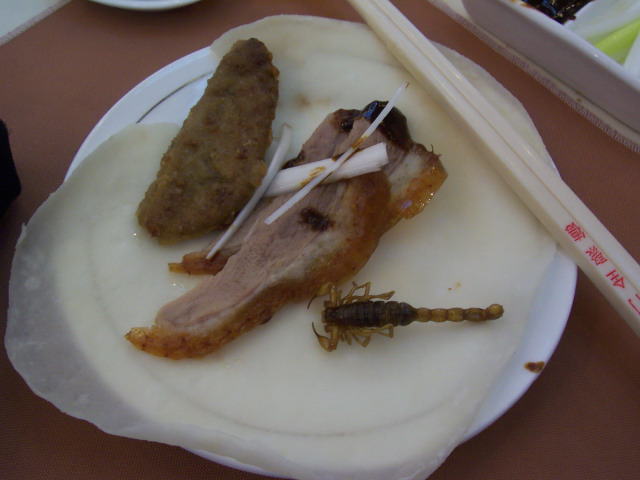
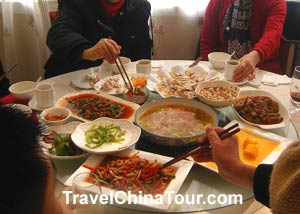
One picture from the conference however is, as usual, gastronomically related. We were taken to one of the best Peking Duck restaurants in town and, unusually, were given a good range of dishes, not toned down for the foreigners. This included the following which is worth trying simply for novelty value.

Monday's English corner was as usual full of surprises. Recently I haven't had time to prepare anything in detail, however, because the previous session in which we'd read through, acted out and analysed Ibsen's The Doll's House, had been a success I trawled the web for some more plays to go through. Finding free, short plays online turns out to be a none-too trivial task. After a good deal of searching I found two plays, both of which were abstract enough to keep discussions of the interpretation going for a long time while having language which wasn't going to be a burden. This worked well and we had multiple interpretations of both stories after an hour and a half of playing with them.

I'd struggled to come up with anything terribly inspiring but, as it's an English corner for students who already speak pretty fluently I thought that a discussion on rhetoric would be worth pursuing (both of the plays had included interesting structures of argument which had exemplified tricks of persuasion).

In fact I was also interested to know about rhetoric in China's history and whether there was a similar idea to that of the Greek system of structured argument. Having looked on the web I could find many famous speeches from the Western world but nothing from China so wanted to know whether this was just a language thing. Speaking to the pupils they said that, unsurprisingly, with China's recent history great public speeches of protest were rare and though there had been a few politicians who had persuasive techniques, such a skill was not considered such a great attribute as it was in the Western world.

We moved on to the case of Corax and Tisias and I was impressed to see that several of them had seen this example before. I now realise that getting them to read through a passage in silence in the class disturbs the flow quite considerably so I shall try not to make that mistake again. Still, we discussed this for some time and subsequently started talking about the ancient Chinese philosophers and in particular the language used many centuries ago.

The language in China at that time was filled with even more degeneracy than it is today and a single word, and character could have a vast wealth of meanings. Such sparsity seems initially to be a bad thing, but when used intelligently this means that ancient Chinese writing can conjure an entire story in just a few words. The modern example of this is the four word idiom, which I'm only starting to learn about, but can give a few of examples:

入木三分 means "one with a keen, penetrating intellectual strength" but literally it is translated from "ru mu san fen" as "enter tree three centimetres". This particular example comes from an ancient calligrapher who's forceful brush strokes would penetrate deep into the wood.

囊萤映雪 "nang ying ying xue", (capture firefly reflection snow) - Means to read by the light of bagged fireflies or the reflected light of snow.

望洋兴叹 "wang yang xing tan", (watch ocean breath out) Means to lament one’s smallness before the ocean.

悬梁刺股 "xuan liang ci gu", (suspend beam stab thigh) Tie one’s hair to a beam to keep from nodding off or prod oneself awake with an awl in the thigh.

OK, a few examples but it seems that they are still used in conversation and writing today to express concisely a metaphor for some sentiment or action. I'd be interested to hear from any Chinese speakers about your favourite idioms or correct me on any of the above comments

Lots of photos and comments from the conference I attended this week to come, including the joys of giving a talk which seemed to go successfully. For now my program is calling me so I must get back to work.

Monday, November 20, 2006

Beijing Resummation

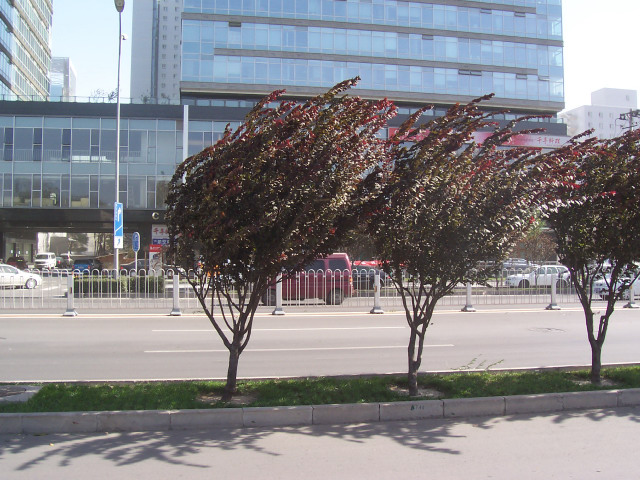
The winds rolled into Beijing a couple of weeks ago making even short excursions outside a treacherous event.


Things have been really busy of late, hence a lack of posts. I finished another paper on Friday which is online today. We've got some interesting results related to AdS/QCD. We've calculated the back-reaction on the pure AdS geometry of a quark bilinear condensate. From this we can perform the usual five-dimensional holographic calculation to get the vector, axial vector and pseudoscalar sector masses and decay constants. The important point about this is that an IR cutoff can be dynamically generated (as you would expect from some sort of brane-distribution in the IR) leaving you with just three free parameters, as in QCD. We get consistent results, of the same order as those without the back-reacted geometry. The check here is that adding this singular behavior to the geometry doesn't mess up all the good results you already get from AdS/QCD. There are additional directions that we want to take this, in particular to investigate linear confinement. In particular the paper was motivated by these two papers (http://arxiv.org/abs/hep-ph/0602229,2).

Anyway, so, that's been taking a little time to finish off. On top of that I gave a one and a half hour talk on Friday to some of the students on 'hadrons from holography' trying to introduce the idea of holography independent from the AdS/CFT correspondence (which is the most concrete example we have of a holographic theory). There's a very good talk by Raphael Bousso here on holography which is probably fully understandable by anyone with a degree in physics and still interesting to anyone with a keen interest in the subject.

Tomorrow there's a conference in my building on AdS/CFT and quark matter where I will be giving a talk on the first day. Most people will be talking about the recent, interesting work on quark-gluon plasma so my research will, I hope, be an interesting diversion. I'm also looking forward to chatting with some of the researchers and finding out the latest developments.

So, along with keeping up Chinese lessons (my two co-flounderers and I attempted to translate a Chinese version of Kurt Vonnegut's A Man Without a Country into English with reasonable if slow success!), English lessons and English corner (for which I still need to plan two hours of activities tonight) life-has been hectic as ever.

On Saturday night I met up with a friend who is about to leave for Singapore to become an air-stewardess. We went to a superb Thai hot-pot restaurant called The Lemon Leaf and spent three hours chatting while dipping all manner of exotic flora and fauna into a tom yum broth. It's expensive but well worth it. After that we headed for a foot massage to let the food digest. It's constantly amusing to see the faces of the masseuse when they see the size of my feet, often never having seen any quite so flipper-like. I had a new treatment this time which involved the use of hammers, little ones with rubber on the end. Though they sound soft, when they're perccusing your legs vigorously the feeling builds up pretty steadily to a fiery ache. I didn't try the scraping treatment however which I was told with a grin leaves you red-raw but free from bad energy, or something. I'm actually a fan of some Chinese medicine (though most of it should be investigated for long-term side-effects) though removing bad moisture with suction cups and bad air with pins and needles is something I've avoided so far.

--------

So, this is the long-promised post attempting to sum up my feelings so far on the ultimate reason that I'm out here; not as one may perhaps imagine the cheap food and fine night-life but my research. So, I'd like to try and identify what it's like to be a post doctoral researcher and, in particular, one in Beijing.

Even with the inherent pressures of getting the next position, advertising myself through giving talks and contacting other researchers, getting interesting papers published and trying to stay on top of the recent results, life as a postdoc is generally a pretty relaxed one when compared with most office jobs. That is not to say that what I do doesn't require a great deal of effort and I don't spend some considerable time stressing over calculations and understanding the latest papers but in terms of being in charge of my own time and efforts, I'd say I'm pretty well off.

I don't have someone watching over my shoulder to see that I turn up at nine on the dot (though I usually do) and there are generally few deadlines. This lack of obvious, listable pressures presents its own problems as, in order to keep yourself motivated when calculations inevitably go awry and you haven't given a talk for a while is not trivial.

Especially out here where one is easily cut-off culturally from the discourse that one may have in a native English speaking department an extra effort has to be made. One year in and I'm fully aware that my lack of Chinese is an added burden to interacting fully with the group. There's currently an American Professor in Chengdu who is absolutely fluent in Chinese after three years here though I'm told that he doesn't spend much time with the laowai and immerses himself in Chinese culture and language. Clearly the way to go but this is a step into the dark which I've been hesitant in taking. Doing this and research seems a tough juggling act.

The structure of the department is a little different from that which I've experienced in the West, though not vastly. My boss has four postdocs and around 10 PhD students which unsurprisingly makes him a busy man. As he will also be head of the KITPC when it opens for real his juggling act between heavy burdens of administration and research must be very difficult indeed, but he does seem to manage. This group of 15 or so has a diverse range of interests from perturbative and non-perturbative QCD through cosmology, supersymmetric model building and more. The group gets together fairly regularly for one of the students or postdocs to give a talk, as I did last Friday. They're casual affairs which usually culminate in getting a food delivery. It seems that this way of organising the group has made for a good, relaxed atmosphere for the students to learn and research in.

A normal day is a little difficult to pin down but the general pattern goes something like this:

I tend to get up around 8.30 when the diggers and angle-grinders outside my window make sleeping impossible (they often start at 6 but I can now cope for a couple of hours with them disturbing my rest). I stroll towards the office about nine o'clock from the accommodation campus (with its 5000 or so students) through to the ITP site, about five minutes walk. On the way I usually pick up a snack from the stand serving students with a plethora of fried treats and cups of milk.

It's often this walk between my flat and the office which sets the mood for the day, whether or not I get charged down by a speedy cyclist or whether the lights turn in my favour as I get to the road, whether I get cut in front of at the food stall or whether the sky is a particularly glorious blue. The shuffle function on my ipod can also set me bouncing, or not, though currently I'm listening to some superb Chinese lessons which a friend has sent to me. I will talk about them some time as they're the best material I've yet come across for learning the language (this isn't Chinese Pod which is also a great resource).

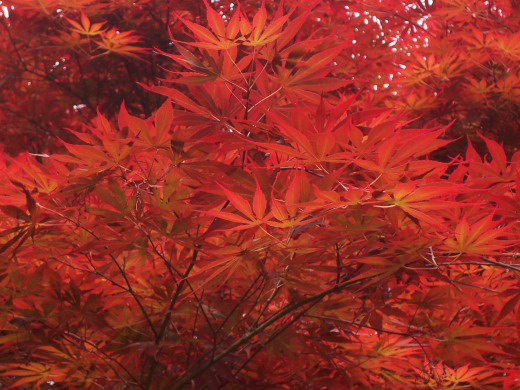
The trees are coming to the end of their autumnal transformations, many of them now a vibrant yellow, having turned deep red briefly last week. If you can get here and walk up xiang shan (fragrant hills) when the red maple leaves are out, it's well worth it but timing is both crucial and very difficult.

Getting into the office I check the notice boards for interesting talks coming up, though most of the time the notices are all in Chinese. I head up to my third floor office which I share with another postdoc sit down and spend half an hour checking e-mails, the news, my site feeds (updated blogs) and the arxiv for recent additions, both good and bad, to the sum total of our knowledge of the universe. I may spend some time reading through any interesting papers which have come on that day.

The rest of the day is a bit of a slippery beast and working out the most efficient way to plan it can depend on many factors.

Currently I'm working on three different projects, all of which deserve significant proportions of my time and so I try and juggle that sensibly. Some of the time will be spent performing calculations, with pencil and paper or on the computer. Some of it will be spent writing up my thoughts and some will be spent talking with my collaborators about our project. As I mentioned before I'm working with a Japanese researcher in Japan and a German researcher in Poland and we often spend several hours on msn battling through our brain-waves or arguing over interpretations. Sometimes I will simply go and sit in the library working through a problem or browsing books for ideas.

Reading papers and books is my main source of input at the moment because, as I've mentioned before, most of the seminars are in Chinese. This is something that I would tell people to take into account as a huge factor if you're thinking of coming to a country where English is not a language which is spoken extensively. Because people unsurprisingly also chat about physics in Chinese, this makes talking with other researchers difficult. This isn't because they're unfriendly, they clearly have a great time from the animated conversations and frequent laughter I hear rattling down the corridors but I've failed myself in integrating with this set. I think I would probably recommend more than anything else spending a couple of months before you start research in a place like this to learn the language as intensively as possible. There are many good schools where you can spend 6 hours a day in class. You won't be fluent but you will pick up enough such that learning more becomes a lot easier. If you don't do this I suspect you will constantly be stuck at the first hurdle. Please get in contact with me if you are thinking of coming out here and I can find out the best schools to attend.

So, depending on the day of the week, my time in the office will end at around six or I will stay here till ten or eleven at night. Currently because work has been so busy I've been working at the weekends too which explains the lack of exciting extra-curricular activities to talk about. Usually I spend some of that time working in a nearby cafe, reading through a text book or a paper and taking things a little more easily. This is in no way as stressful as it may sound as relaxing with a coffee and a paper is an enjoyable activity. I'm not however somebody who can do this all the time so I do take time off to watch movies and read books (more reviews coming up shortly)

Rather unusually I have just learned that I will have to write a thesis at the end of my time here. Without this I will not receive a certificate. I hope that a concatenation of my papers with sensible editing will be enough for this. I've learned today that in China the reason for getting this certificate is that without it you can only become an assistant professor and not an associate professor.

So, that's a rough idea of the day-to-day life of an English postdoc in Beijing. On top of this I have the next stage to think about and am currently behind on my applications for next years position. As life goes on for a researcher, the burden of teaching, grant applications and supervision clearly supersede the rather casual, if busy lifestyle I've outlined here but, as people are certainly not in it for the money, there must still be a fair share of highlights to life as a researcher further down the line.

Tuesday, November 14, 2006

Parcelfarce

I'm in the process of writing a lengthy post attempting to sum up what it's like to be a postdoc in Beijing. This sounds like a fairly niche market but if my advice is useful to anybody coming out here or thinking about going for a postdoc then I'd be happy.

Anyway, I'm afraid this has to be a rather more negative post than that one will be. The saga which started here, related to my computer continues.

In summary, having sent my laptop from England to China via Parcelforce, it was severely damaged in the post. Parcelforce know this because they've been given a detailed description and photos. I moaned in the original post I wrote about this that Parcelforce say it may take up to 60 days to sort this out. Well, day 84 and I haven't heard anything from them. My father, the sender of the parcel, has attempted to contact them on numerous occasions only to be met with completely ludicrous brick walls. First they said that they needed me to give them details about the state of the package when it left the UK. As the receiver of damaged goods it's pretty hard for me to say what state it was in when it left, but I have the senders word that it was in perfect order prior to its journey here.

Secondly Parcelforce said that they would need to send me a letter for me to answer their questions. When it was put to them that perhaps an e-mail would be quicker, the woman in charge said that she would not be able to send an e-mail without the permission of her boss. In the 21st century, sending an e-mail still seems to give some people problems.

So, we've now made genuine threats to send letters to the appropriate high up places to get them moving and the deadline we gave them (today) has now passed.

The reason I'm writing this post is simply to warn people that if you're going to send anything valuable long distances, DO NOT USE PARCELFORCE. If you do and you are unlucky enough for something to go wrong with the parcel in transit, the likelihood of sorting out the situation in a reasonable time seems small.

So ends the rant.

Monday, November 13, 2006

Getting Two Thumbs Up?

And another seven people know the depths to which my singing abilities can plummet. This was the culmination of a stereotypically strange but enjoyable evening.

A couple of weeks back I'd been asked to help out with the career development society of the Chinese Academy of Sciences as a native English speaker. Because many of the students will head into industry or beyond in multinational companies, it is important for them to have good experience with professional interviews. I said that though I had no experience with such interviews I was very happy to take part. Somebody else from a large company would be there interviewing with me so I wasn't too worried about my lack of experience. I was simply there as a native speaker. The first strange aspect of all this was that the rest of the career development society would be there as an audience.

I was sent the resumes of the students I'd be interviewing and had a quick look through to get some ideas of sensible questions. I was also sent a list of oft asked interview teasers. The time came around last night and I headed over to the room, only to discover that I was the lone interviewer and the professional was a no-show. I met this with mixed emotions including a mild feeling of panic but figured that I could still make this a respectable experience (speaking of which I was dressed up in my finest suit). A had expected that the other person would be leading the interview and I would simply interject when appropriate so this left me with 15 minutes to read through the resumes again and come up with something sensible. 20 minutes later having introduced myself to the audience of 20 or so I gave the first half hour interview to a student of polymer sciences, hoping to take his academic knowledge into the real world. Five seconds before I started I hadn't clearly decided what I was going to say but having composed a reasonable first question as I spoke, the rest of the interview went smoothly and was a lot of fun. I neither made my interviewee cry, nor do he have a free ride and people seemed genuinely pleased with the outcome. After each interview I gave my feedback which I expressly pointed out would simply be my 'common sense' and was in no way a professional opinion. Still, they all seemed to nod sagely as I spoke and came afterwards to give very pleasing feedback on the whole experience. Apart from the fact that the room was truly freezing and I couldn't feel my feet by the end I would definitely be happy to help out at this sort of event again.

So, in celebration of this event (having interviewed four students over a two hour period) karaoke was the order of the night. Some student qualities being universal, the fact that karaoke becomes very cheap after midnight made this the sensible time to head there. As the guest I seemed to sing considerably more than my fair share. After a shaky start and a shaky middle my singing continued on to a shaky if enjoyable end. From the three times I've been to karaoke so far there have been a reasonably large selection of Western songs to choose from. Unfortunately my knowledge of NSync, the Backstreet Boys and Boyzone isn't up to the challenge, so I spent my time mutilating Beatles classics and a few other more embarrassing numbers.

Around three in the morning my eyes lit up as I spotted one particular song on the display and, though I think the others perhaps didn't share my enjoyment, my highlight of the evening was giving a rendition of Bad Touch by the Bloodhound gang. A truly memorable experience.

Along with a great deal of rather surreal dancing, some good free food and some fine singing from the others, it was another unexpectedly enjoyable evening. Having got back at around four in the morning, I've spent today struggling to keep my eyes open while finishing off a paper which must now be checked over by the other authors, and writing a couple of talks which I'll be giving over the next week and a bit.

There was a photographer in residence to take photos of the interviews which I shall post when I get hold of them. Fortunately the karaoke was neither recorded in audio or photographic format. This, I promise is a good thing for the rest of the human race.

Wednesday, November 08, 2006

One Year On (Part 3)

I realise each time I finish a review posting that it's virtually impossible to sum up these subjects satisfactorily in a few paragraphs. I would like to add many afterthoughts to the last two postings but simply don't have time at the moment.

As an aside to today's postings I should mention something that currently fills me with some guilt. The heating in Beijing has not been turned on yet and, if last year's winter is anything to go by, the heating in the flat is simply not enough to keep my extremities much above freezing. I spent most of last year in gloves and scarf. So, with a bit of persuasion from those at home and abroad I bought an electric heater for the flat to make things more comfortable. In a nation choking itself with such atrocious pollution from the coal-burning power-stations (currently one built every week), adding another load to the system is not something I feel good about. Unfortunately because we don't have the power to control our own flat temperatures, I feel forced to do this. The fact that I currently take public transport almost all the time now makes up for this a little but I'm still left with a heavy conscience.

OK, I don't have much time today to write anything so will simply sum up a few of my favourite views from the last year. I guess I must have taken four or five thousand photos since I arrived but these are a few that sum up some of the stunning and sometimes bewildering things I've seen. Again, these miss out many important and astounding things that I've seen and done in the past year but, searching through my photo folders these are the ones that jump out most. They will be in no particular order as sorting that out will take too long for now (Mathematica is fighting back today).

The weather here may be the next posting and the storm clouds that frequented the city through the summer kept me mesmerised for hours. These ones glaring at my flat through a couple of nearby skyscrapers bought some fine fireworks with them, though I've still not managed to catch a lightning strike on film.

Sunrise in the plane flying from Munich to Beijing gave a satisfying abstract.

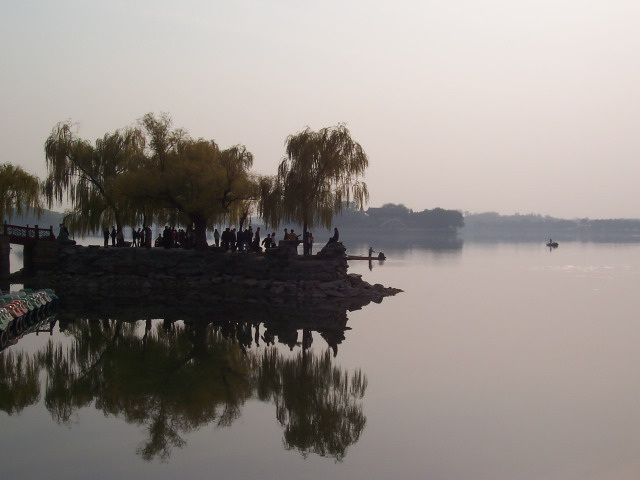
The summer palace as we headed into winter last year.


Fiery leaves in Tongli.

Happy driver in Souzhou.

Slow life on the Yangzi river.

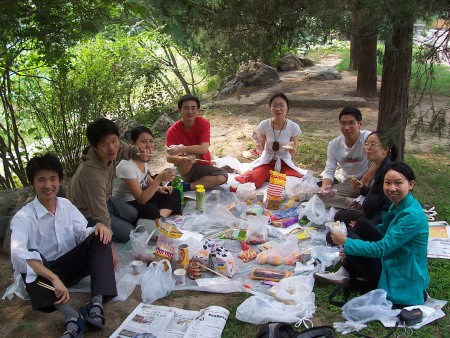
Picnic with English Corner students.

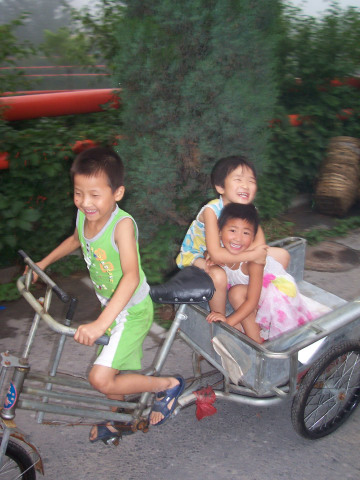
Happy kids in my neighbourhood.

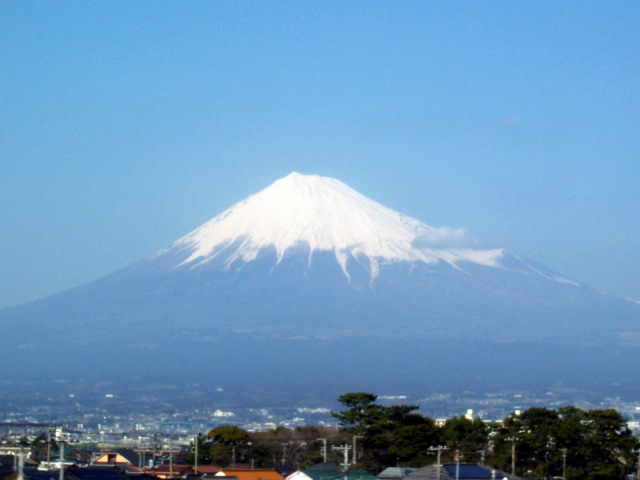
Mount Fuji in all its stunning glory.

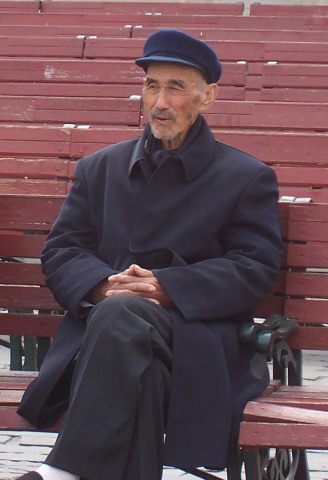
Pondering in the Forbidden City.

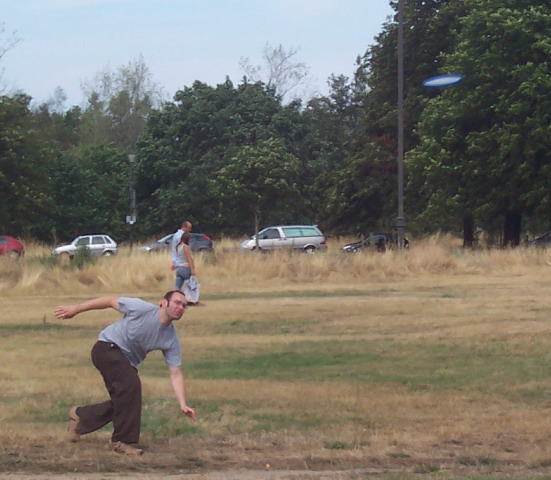
Back home in England for a few minutes of relaxation playing frisbee with friends.

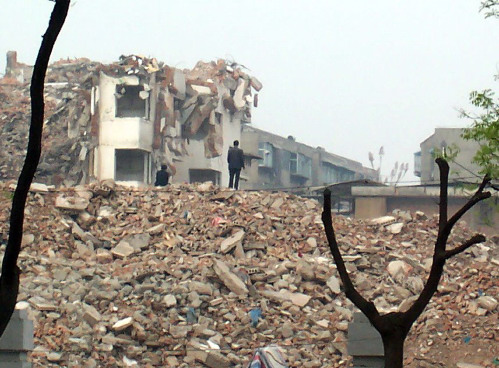
Ex-houses in Xi'an.

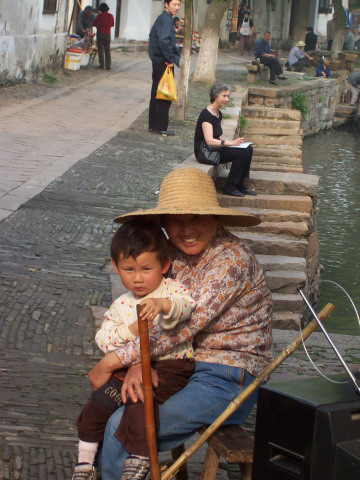
Happy families in Tongli.

Reflections from the Golden Palace in Kyoto.

Dancing man tree in Souzhou.

Hangzhou reflections.

British summer wildlife.

Boatman on the Yangtzi

Bamboo view in Souzhou.

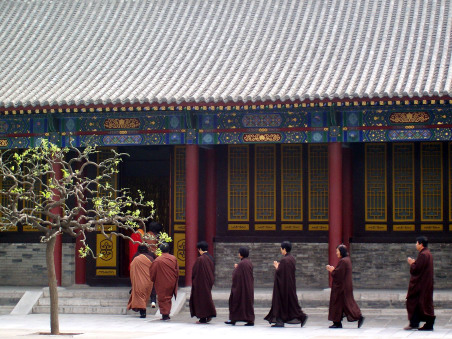
Monks in Xi'an.

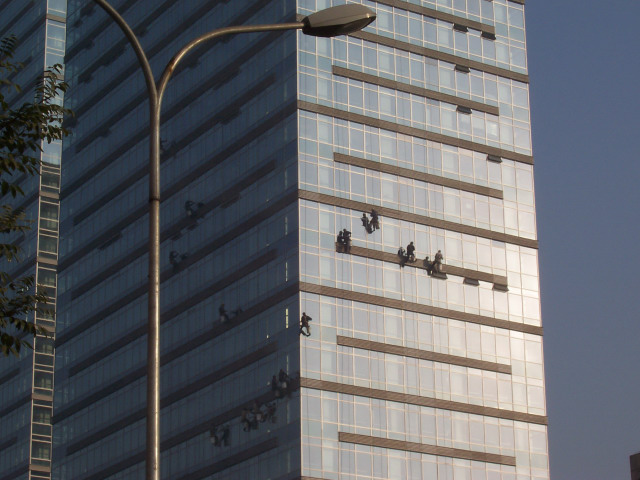
Ant-cleaners on a local office block.

Beijing Punk.

Duck tongue delicacies.

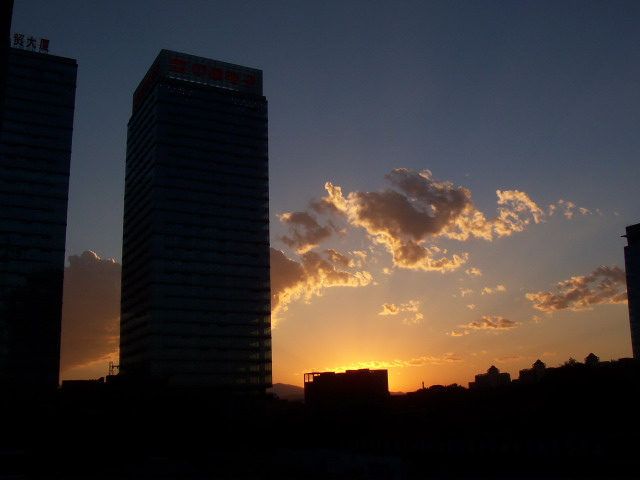
Beautiful clouds from my balcony.


From this list I can already think of many things I've missed out but this gives a cursory idea of what's been going on. Still to come I want to talk about research over the last year as well as the bizarre weather patterns, the music, cinema and literature scene and a few others. I feel that it's injustice enough to try and sum up these topics so 'the people' is certainly not a subject that I will attempt to dilute into a single posting. Coding battles to return to.

Tuesday, November 07, 2006

One Year On (Part 2)

The second installment for the year's review will be on another subject which dominates my time here. That is language, both Chinese and English.

Chinese continues to be bewildering, frustrating and, at times, enjoyable with more and more flashes of recognition all the time. As of recently I'm having lessons with two other Westerners which is making the two hours a lot more enjoyable. Previously I had found that after a 10 hour day in the office, the prospect of two hours of Chinese lessons, mimicking tones and constructing sentences from words which are individually meaningless, was not something to be savored. However, with three of us, the pressure is off and I get more time to think about what I'm learning. Unfortunately I just don't have the time to practice in between the lessons in a structured manner, though I do talk to some of my friends in Chinese now (perhaps 10% of what I say is in Chinese when talking with some people). I estimate that I now recognise two hundred or so characters and 500 spoken words. This is not a great deal though it is at least some progress.
I now get together to practice on a Sunday afternoon in a cafe with my two classmates and this extra, relaxed sessions is very helpful. Having two other learners (both of whom are substantially better than I am) to drive me on is a real boon.

I should probably start to add the odd Chinese character here and there to the blog, as most expats seem to do when they're learning the language. It would probably be good practice for me, but as this blog is predominantly for friends and family, few of whom speak Chinese, I shall attempt to alienate as few as possible.

A short, technical aside. Up until now I've been learning the speaking and writing together, learning to write a character when I use it in a dialogue from my book. This approach has missed some basic structure on the written side, which I would advise everybody whose learning Chinese, to study first. On the writing side, before getting onto building your character database, I would really advise getting a book which goes through the hundred or so most common radicals.

The basics of the Chinese written system is an interesting topic even if you don't want to learn the language. Of the 50,000 or so Chinese characters, many of them developed from pictograms. Over the last couple of thousand years they've gone through major changes, generally ending up in a form which looks nothing like the original object. The last change was a move to a simplified written system, which did make the characters easier to write, though often removed any similarity the character still had to the original picture. Modern Chinese characters are often made of two parts. One is called the radical and gives some clue about the rough subject of the character, the other part is often phonetic, giving a clue about how to say the character. This means that even if you've never seen a character before, you can often have a rough idea of the meaning and a guess at how to say it. For example, the following character is the character mama meaning mother: 妈妈. Each ma, 妈, is made of two parts. The part on the left means woman and is found in many characters: 好, hao (a combination of mother and child), meaning good, for instance. The second part of the character in 妈 is the phonetic part, which means horse and is pronounced ma (though with a different tone from the word for mother). The phonetic part itself is found in many words: 吗,ma, indicating a question, for instance (again, a different tone from both mother and horse). Other examples of radicals indicate that a word is related to movement, speaking, hearing, strength, shellfish, people, water, fire, etc. etc. and learning these to start with should make your life a lot easier. This is all really basic stuff to most Chinese learners. What I'm saying here is either for those who are about to start learning Chinese or simply for those who are interested in knowing a little about the structure of the written system.

I've only just started to learn the radicals in a structured manner, rather than just learning them as I come to a word with one in. Having started now, I've almost doubled my comprehension of the characters I see around me in just a couple of weeks. I can't pronounce what I see as my knowledge of the phonetics is not great but understanding and spotting patterns is part of what I do for a living and so is the most natural way for me to learn this bizarre language.

Often when I talk with a Chinese person about learning the language they ask me what I am learning it for. This doesn't mean that they don't think I should be but, sensibly, that one should have a goal for such a task. If I want fluency then I'm clearly not going about it the right way and, without a doubt, my research would suffer if I did aim for that. It's sad to say but I can't see myself continuing to study Chinese in any great capacity when I leave the country. The likelihood of me ending up in a non-English speaking country next is pretty high and so another language will probably take over as top priority. It would be a real joy if my Chinese was good enough to have a conversation with a stranger about topics other than where I'm from, what I do, the price of oranges and the weather. I have a year to go and by the end I hope to reach this point, especially with the added impetus from my new classmates.

I can't pretend not to think that the character system is simply inefficient though I have learned to understand the power of a large degeneracy in character meaning. Though I haven't read any Chinese poetry I have now heard some (most Chinese students it seems put in a great deal of effort to learn the classic poems and everyone seems to have not only read the classic texts but enjoyed them and continues to return to them). I've got glimpses of the power of the language from this as a short line with perhaps four or five characters can express a vast wealth of feelings and imagery that English doesn't seem to be able to do so simply. A deep knowledge of the characters would clearly make Chinese poetry a fascinating area and it is with regret that life just doesn't seem free enough to take on that challenge right now.

--------------

I continue to teach English to a private student once a week and in addition to substantial payment, I get taken to restaurants which I would never be able to afford on the Chinese salary I earn. In fact this student is already pretty good though, as is often the case, confidence is the main area which is lacking. I hope that fluent conversation in a relaxed atmosphere will be enough to make a difference.

English corner continues and is an extremely enjoyable activity for two hours on a Monday evening. Last week we had a dozen students turn up and spent the session reading through, acting and analysing Ibsen's 'The Doll's house'. Though reading is still one of my passions and I enjoy writing short criticisms of the books I read out here, I haven't sat down and really analysed a play, or short story since I was about 14, and I remember it being a real bore then. However two hours talking through the final scene from Ibsen's play was an enlightening experience and every insightful comment provided by the student added another facet to the story. It was agreed at the end of the session that we should do something similar again which I very much look forward to. Up until now we've played a lot of word games in the class and that has proved an interesting exercise for me to see what aspects of language are easy and hard for people who've grown up learning a character system.

As I mentioned previously, one of the most enjoyable days was a short trip with the English Corner group to Tsinghua University where we sat by one of the beautiful lakes, eating a picnic and chatting.

--------------

One of the biggest problems with the language is still the fact that I don't get to follow very many seminars here in the department, so it is easy to get out of the flow of any research which isn't directly related to my work. I've given up sitting through lectures for the most part as I could spend my time far more constructively reading a book on the subject rather than struggling to pick out the odd word which may mean something to me. As the first Westerner in the department of course I can't expect them to change the way they do things just for me, so I must simply try and make up for the lack of direct input via other sources.

OK, enough, more tomorrow if I have time.
Monday, November 06, 2006

A Year On (part 1)

Typing is far from easy at the moment as I currently have little to no feeling in my fingers. Eating with chopsticks is also a non-trivial task! I don't want this anniversary posting to be a negative one but it's a simple truth that I don't like being cold. The weather has turned from high 20s to a wind-chilled, howling gale in just a few days. It was a strange, sudden change as the Siberian front hit and immediately the outside world was thrown into chaos, as people leaned into the wind to stop from teetering over backwards and outdoor markets were turned upside down. It's still a couple of weeks until they turn the heating on and in the meantime my flat is virtually uninhabitable. I shall be spending the maximum possible time defrosting in the sauna in my gym.

Anyway, enough of the negative. It's been a year, half my time here, since I left England (after a slight false start) and strolled blindly into this adventure. It's been a great experience so far in many many ways and I figured now was the time to sum up a bit of what's been going on.

I just haven't had the time to blog as frequently as I was before, mostly due to work being very active at the moment. Currently most of the time that I'm not working I'm teaching English or having Chinese lessons. Socialising has sadly taken a bit of a back seat and I hope to be able to do something about that over the next few weeks.

I wrote a long post over the weekend about some of the things which have been going on recently which I still need to go through, so I thought that I would give daily installments with some of the highlights of life out here.

As it was one of the first things that I got excited about out here and something that still pleases me constantly, the delights of Chinese food seem like a good place to start so today I shall be enthusing about all things culinary from dou zhi to ku gua and everything in between.

I haven't really spoken about the summer food much but there's a lot to get excited about. The roads are littered for several months of the year with trucks and stalls selling a cornucopia of amazing fruit. The honey-sweet grapefruits the size of your head, the fantastic watermelons and the pomegranates from Chengdu without the bitter pith of those we get in the UK, are all daily treats. All around the city you see giant persimmons growing on the trees and they come straight to you with all their leady goodness for a small price.

The range of flavours of vegetables is also astounding with the bitter melon a favourite Hunan delicacy and from Yunnan the stinky fish grass proving to be one of the most unusual flavours but rather fine when your taste buds get over the initial shock. When you go into a supermarket the fruit and vegetable stalls are overwhelming with a carpet of amazing colours to match the smells which assault you as your walking around (the durian fruit with its smell of old socks being the prime example). The spectrum of fungi alone is incredible with perhaps 20 or 30 different shapes and colours available through most of the year.

...and onto the main course which was what I loved to talk about when I first got here and reveled in the exotica on the menu. The highlight was probably pig's brain which melts in the mouth and tastes subtly nutty, though you should be careful as porcine encephalitis is not uncommon. The giant snails in a spicy Szechuan dish which you eat wearing plastic gloves are also sumptuous. The Chongqing hotpot is a minefield of unusual flavours and textures with tripe and intestine being one of my favourite additions. Along with a lot of chili in this dish there is always a good handful of the infamous Szechuan pepper which numbs the mouth and, in combination with the chili, leaves you tingling for hours. Another dish dominated with the chili is the oil-boiled fish which, give or take the bones, is a stunning combination of simple, powerful flavours.

Some of the other unusual dishes which I won't be ordering again in a hurry are sea cucumber (a little like slimy bunsen burner tubing, though probably with less flavour), donkey, and camel's hoof (makes me think of eating a woolen tea-coaster soaked in gravy). Surprisingly beef lung isn't that bad and the ever popular chicken's feet and chili-oil duck's neck now make a regular appearance most times I sit down to watch a movie.

Eating from the street-vendors stalls is a bit hit and miss and I've had a couple of bad experiences with dodgy food disagreeing violently with me. That said, the pancakes and dumplings are usually a good bet. Down in Wangfujing the tourist haunt for the weird and wonderful left me thinking that silk-worm grubs are kind of cheesy while scorpion and star-fish are more crunch than taste. I wouldn't be surprised if such delicacies were on lists of endangered species so a) I won't be trying them again and b) I wouldn't recommend them simply because the novelty value is really all there is to offer.

I'm still to make my way through the true, old Beijing food but my one recent foray, trying dou zhi, fermented mung bean juice reminded me of stilton with fermented cabbage. Apparently this should not be sipped walking through the hutongs but drunk slowly over some fine pickled vegetables. I'm game if I find another vendor at an appropriate time.
I remain unconvinced that Beijing duck is much better here than elsewhere but I suppose while you're here at least it's cheap.

I still have a long list of things to try though a few dishes which I will definitely not be trying have been added to the list, most of which contain some combination of household pets. As an omnivore I recognise that this is a strange line to draw but I'd rather eat pig any day over dog or cat. Yunnan and Guandong cuisines seem to offer the highest number of the weird and wonderful so I shall try and get down South when I can. This quest to try different dishes isn't just some attempt at proving my gastronomic worth but is a genuine journey in sampling new and interesting flavours and textures. I became convinced within just a few days here that the constraints of good and bad food we have placed on our palates in the West are detrimental to the enjoyment that we can get out of a full spectrum of ingredients. I shall certainly try and look out for many of these things when I'm back home, and convince as many as possible that they're really missing out without them.

OK, lunch-break is over. Calculations to continue with so I shall call it a day for now. Questions on the above topics are welcome if any seem appropriate. I shall continue tomorrow on another aspect of the last year if time allows.

Monday, October 30, 2006

Art for Art's Sake

OK, an unusual blog post today. This is in the midsts of way too many work things going on at the moment, all of which are good and all of which deserve all of my time. However, in the name of art and all things conceptual, if ethereal I wanted to complete this now.
A little background is needed. My mother is currently enrolled on an art foundation course at Oxford and Cherwell valley College in Banbury where she goes to broaden her art experience three days a week, in between full-time roles in many guises. At Banbury they have a variety of media they are taught to use, from pencil, paint and charcoal,textiles,photography and 3D to various clever computer programs. Some of the projects last just a short time and some can last a few weeks, from the planning and researching through to the execution.

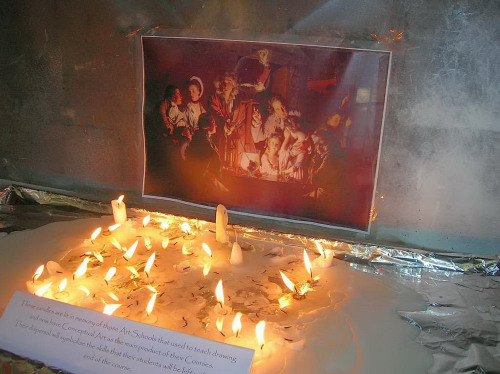
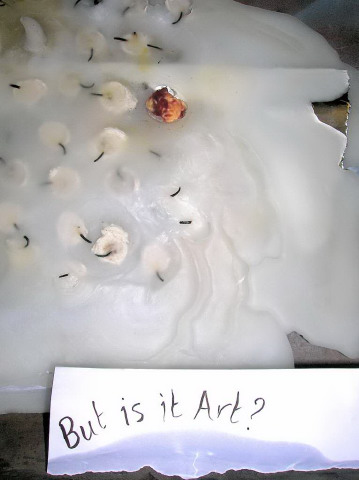
This blog post is related to one of the recent projects which came under the heading of conceptual. The brief was both strict and vague, citing that one had to use any material of volume 30cm by 10cm by 10cm, then record its dispersal. The idea my mother had was to use candles as the dispersed medium, though clearly this idea needed more depth to it. The depth came not from the structure but from the concept, in particular the symbolic representation. It was decided that the candles would represent the art colleges which have given up the teaching of fine art in place of the increasingly fashionable conceptual route that many have chosen to take. A caveat is needed at this point to note that there are still colleges and universities which do indeed teach the technical aspects of fine art and Banbury is one of them. So, this ouroboros of an idea is a memorial to fine art, slowly dying in our colleges. But there's more...

Though clearly this is not always the case, it has always seemed to me that in conceptual art the idea itself and not the construction is often the powerful element, so I made a suggestion that the term dispersal could be taken in an alternative way. Though indeed the candles are dispersing, by passing on the information about this concept to others, the information itself is being dispersed. I suggested that this project could become an international dispersal if the idea was written about and the final record of it was posted on the blog. Unwittingly you have now become part of a conceptual art project, your brains being the medium!

So, the actual setup also benefits from a little explanation. Behind the candles is a picture called "Experiment with an Air Pump" by Joseph Wright which symbolises both the art of fine drawing and the art of the experiment. This picture ties in with the project again in the use of candles, though in another form and the skull mirrors the dispersal of information from one person's brain to another. The young girl covering her eyes symbolises the lost skills burning down before her.

The text in front says: "These candles are lit in memory of all those Art Schools that used to teach drawing and now have conceptual art as the main product of their courses. Their dispersal will symbolise the skills that their students will be left with at the end of the course."

So, without further ado I give you the photographs chronicling the dispersal of skills, as the idea itself is dispersed who knows where.


Thursday, October 19, 2006

Critical Points


I seem to have reached saturation point, such that I have so many things going on right now that I have no time to write about them, until now. In the department things have been particularly hectic as I attempt to spend all hours getting some results for my boss on a project we're working on before he heads away for a while. Production of significant results has recently been invariant under temporal scalings. (symmetry broken as of this writing).

We've been having an interesting array of lecturers coming to visit recently. Yesterday Nobel Laureate Walter Kohn came to talk to the students and postdocs in a question and answer session. With his Viennese heritage he reminded me a great deal of my grandfather. Kohn was one of the developers of the density functional approach which has allowed the quantum mechanical study of an unbelievably vast range of applications. Not only are the two original papers apparently the most cited scientific papers of the last century but today the computational power that goes into calculations involving this formalism are second only to US defense computation. The idea is a relatively simple but extremely powerful one. The revolution came when it was noted that the Hamiltonian of a system of charges could be written simply as a functional of the charge density of the system. This is a function of just three variables as opposed to 3*N where N is the number of particles under consideration in the system. This may seem like an obvious statement but many of the consequences are far from trivial. In particular Kohn noted after a particularly insightful question that with this approach it's possible to show that in the groundstate of any system is encoded the information for all of the excited states. This, apparently, was not possible in the preceding formalism.


One of the reasons for Kohn's visit at the moment is that he has just completed a film about the sun, in particular its place as a source of energy and the increasingly critical dependence of the world on fossil-fuels. As a country whose main source of energy is coal, China is a key target for Kohn's video and his current aim is to get the video shown on Chinese television in as unadulterated a form as possible. Knowing people in the top ranks of the Chinese Academy of Science should help with this task. Speaking of coal-burning, in a BBC web-report today, Linfen was listed as one of the most polluted cities in the world, its main industry being coal mining. Friends of mine have told me that within just a few minutes of being in the city your skin becomes greasy and black. This is no small city and the cost of treatment for lung diseases alone must be astronomical, if indeed people are treated at all.

We also currently have a delegation of scientists from Thailand visiting and today we had a whirlwind tour of applications of Feynman integrals in condensed matter physics. The importance was clear, in particular in polymer science but the rate of slides was rather overwhelming!

-------------

Today, (having written the previous content yesterday) we've had a talk from George Atkinson on Globalisation of Science and Technology, US and International Strategies. Professor Atkinson is both a scientist, working currently on the Cassini-Huygens mission and the Science and Technology Advisor to the Secretary of State. The overall aim of the talk was to discuss the trends in globalisation of science and technology and how this can and will impact everyone. The role of science, both pure and applied as an essential driving force was emphasised but the most important point that I took away from the talk was that as a scientist it is my duty to be as involved as possible with policy making. If the scientists leave it to the politicians who are advised by just a few people, both the directions of academia and the impact of research on the world will most likely not take the most efficient or helpful route.

Atkinson spoke about the Jefferson Science Fellowships, whereby academics spend a year as scientific advisers followed by 5 years back in their institutes continuing to drive policy. This seems like a great scheme and from the diversity of the current fellows it looks to have an impressively global view.

The other main point was the importance of international collaboration which is again clearly a vital theme. With 70,000 Chinese students currently in America, the partnership between the two nations is clearly an important one. When the younger members of the audience were asked why they had not been to the States a unified echo of 'visas' was the response. Several members had applied and been rejected. Atkinson said that this was a known issue and things were being done about it.

I was recently contacted by an American academic who was over here on a conference. He wanted to meet up and have a chat and although I had no time to get away from the office we did exchange a few e-mails. I was interested to learn his perspective on the state of science in China in the short time he was here. One thing which shocked him and unfortunately undermines several of the above statements was that most of the researchers from China at the conference he was at were unaware of his work, even though he is from a leading institution in his field. The reason for this was a simple one. The campus on which he was staying had internet access to Chinese websites only. To get hold of material from non-Chinese research departments was not a simple task and consequently they were working in a strange sort of research vacuum. Until such basic requirements such as ease of communication are tackled, there will always be a gap between the Chinese and non-Chinese scientific community. The transfer of knowledge, even if it is second-hand is clearly vital to a globalisation of science and technology - this is a really basic step that must be taken.

The talk was driven by statistics and graphs and though his overall arguments seemed reasonable it's difficult to come to quantitative conclusions. He's an impressive speaker and this leaves me wondering whether I was impressed by what he was saying or by the way he was saying it. My conclusion is that it's a bit of both.

At the end were some nice quotes, related to what politicians actually want from their advisers. I'd forgotten George Bernard Shaw's quote that "If all the economists were laid end to end, they would not reach a conclusion". In fact Atkinson was paraphrasing and this was not his slight on economists by any means.

If I can get hold of this talk I will try and put it online.

-----------

At some point this week I should be getting a couple of British couchsurfers, coming over from Korea, though currently their communications have stopped. Couchsurfing really seems to be taking off and I generally get one or two requests a week to stay at my place. I'm very much looking forward to using this when I next go traveling independently.

Saturday afternoon I have a meeting with a British school party to tell them about life in China which should be fun. I'll report back on that soon I hope.

Because of so much work, reading and movie watching have been kept to a minimum recently though I have continued to take English corner for the Chinese students and teaching English once a week to a private pupil. All in all things are a bit ridiculous now. Of the three projects I'm working on, two are in relatively late stages of maturation and I hope to be able to finish them in the next few weeks.

----------

I did make it to a friends birthday last weekend and we headed to one of the big clubs to go and see Mr Thing, formerly a member of the Scratch Perverts and former DMC world champion. The transformation from the slightly chubby mid-thirties guy who could quite easily have been the bloke who ran the terrible disco nights in my hall as an undergraduate, to a kid, absolutely on top of the world, stunning the audience was awesome. Scratch DJing as I've seen it comes in two categories, one of which is scratching and one of which is making music. There's a superb movie called 'Hang The DJ' which includes Q-Bert, very definitely filling the latter category. Along with MC Yung Gun (don't blame me!), Mr Thing whipped up the crowd into a frenzy and while we weren't dancing like crazy we were staring open-mouthed at the speed and skill with which he created the sounds. I've also never seen an MC who has managed to get the audience on his side so quickly. Several times I've seen them crash and burn in a sweat of awkward looks and a silent audience but this time he knew exactly what he was doing and got everyone shouting along. A great night and, with the winter nights coming in quickly, I expect to be spending less nights out at the outside bars and more in the great clubs.

OK, quite enough for now. More work to finish before the weekend.

Tuesday, October 10, 2006

Reversibility

In contrast to my complaints of research descending into mathematical contortionism last time, I had a four hour conversation on msn with my collaborator in Poland yesterday which was entirely related to the concepts of the problem we're solving. After many hundreds of lines of toing and froing we had decided on the important definitions in our work and, by studying the mathematics which we've been playing with for some time were able to convert this into concepts about the physics. Leaving some things to mull over and with rather sore typing fingers from frantic conversing we left it for the evening. Rather fuzzy minded as I did some tidying in the flat I realised the final steps to the problem and managed to program it up this morning. We seem to be reaching the final steps of the project which is clearly a dangerous thing to say but may just be true. Anyway, a good day for breakthroughs.

Anyway, I promised some photos which follow shortly. First a review of a couple of very strange films which I watched in between food poisoning affecting my schedule this weekend. I'm much better now but whatever disagreed with me came to visit with friends in tow.

David Lynch is known for making films which leave you thinking, often wondering whether there really are answers to the question he poses or whether he's just playing with you. Mullholland Drive I've seen many times now and slowly but surely either bits make sense or I fool myself into thinking they do. I'm convinced that the strange tramp is the same tramp as is found in the Hellraiser movies, but I don't know the link other than the obvious one of both films being about dreams.

Anyway, I didn't watch Mullholland Drive again but I did watch Dumbland, a series of cartoons from David Lynch. This doesn't leave much to the imagination and didn't leave me pondering much at all, just a little disturbed. It's no surprise that the maker of Eraserhead would write something like this, a visceral, cynical view of the worst waste-of-space side of society mixed with some bizarre surreal ideas. Some moments of genius that leave you open-mouthed at the stupidity/abstractness/barbarity of it.

A DVD of Peter Greenaway's early short, experimental films including "A walk through H, the reincarnation of an ornithologist" are interesting ideas though mostly rather overplayed. In fact the highlight of the DVD is Greenaway's post-film commentary where suddenly, unlike Lynch's movies, light is shed on what we've just witnessed making it infinitely more meaningful for those poor souls among us who didn't get the symbolism the first time. I'm not sure if I'd recommend these movies. Greenaway calls them moments of juvenility and although they may be important moments in the history of experimental cinema, I fear that that's all they are and their merits as pieces of entertainment are now lost.

OK, so some pictures from recent adventures.

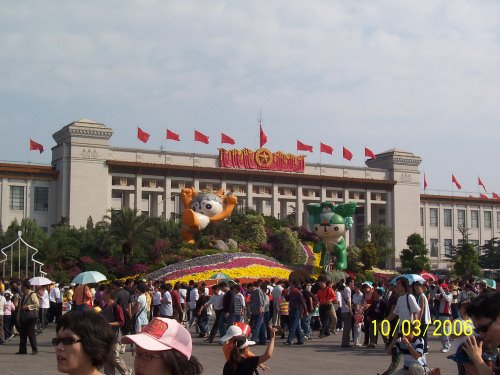
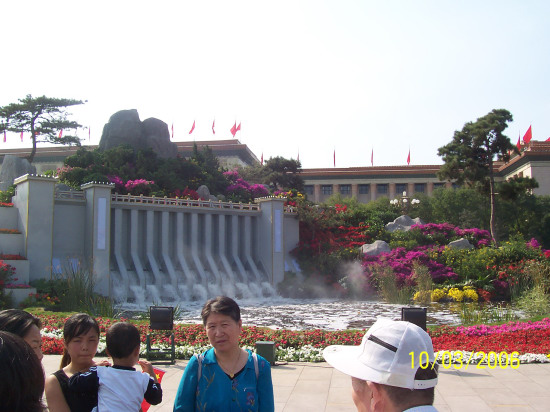
Tiananmen square during the national holiday was a floral sculpture park with the recent headline grabbers from Chinese achievements:

First the upcoming Olympics are not complete without the overly colourful mascots. They have names, but I've chosen to forget them every time I see them peppering all shop windows from here to Lhasa.

The finishing touches of the three valleys project is another cause for celebration. I remain unsure about how the difficult balance ends up on this one.

While I was in Japan, it was remarked upon that since Sumo has been opened to the rest of the world, Japan has become somewhat less dominant in the sport with Bulgarians, Mongolians and Americans suddenly filling many of the top rankings. It seems that the Chinese also want to get in on the act.

The train to Lhasa is both a trade route and an international symbol by which China can claim firmer ownership of its land. With various details about the construction being in the Guinness book of records, the completion of this filled TV channels for days.

Sunset over Houhai lake.

A trip to the lake in the holiday left us the other side of the bright lights, such that we could admire without being deafened or hassled.

Another trip to Dashanzi to see this months installations had both powerful works and some disturbing installation art, see previous post.

Thursday, October 05, 2006

Merry Moon Day

This week is the Chinese National Day holiday, signifying the creation of the People's Republic back in 1949. For me the holiday means that I get to sit in pleasant cafes and do my work rather than sit in the office. A relaxed change of pace for the week, though somehow it seems almost over before it's begun. This is partly due to the fact that I was called into the office on Sunday, when I'd planned to make a Beijing excursion, to discuss progress on one of the current projects. The outcome of the meeting was that we're still attempting many different avenues for the problem we're tackling but as is often the case in such research, we just can't get solutions to our equations yet. This is one of the frustrating times of such research. We've taken some physical principle which we understand, even if in a slightly abstract way, and translated it into mathematics. The problem then is to manipulate the mathematics until you get an answer which can then be analysed and reinterpreted in the language of physics. The intermediate step is a frustrating one because you're often not learning anything new about the physics, simply manipulating equations. Still, in such cases it's got to be done and we seem to be moving in the right direction.

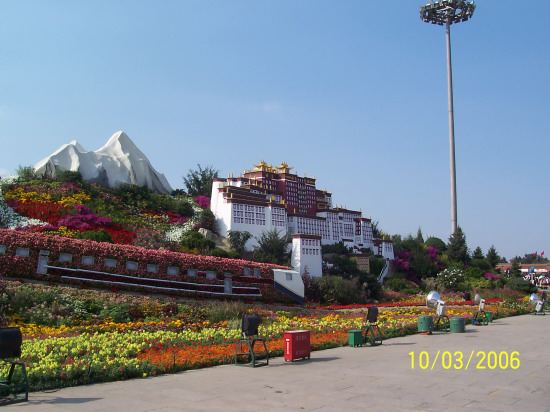
In fact, in between the work this week I've managed to take in a few holiday sights. Tiananmen is currently awash with flowers and fountains in celebration of the foundation and these flowers are part of several sculptures, this year marking the coming of the Olympics, the completion (or near completion) of the three valleys dam project and finally a reproduction of the palace at Lhasa to mark the completion of the Beijing-Lhasa train. Wherever there were no flowers on Tiananmen there were people, out with their families and snapping photos at all possible angles, a few with me in to contrast my height with that of various women who wanted a picture with the lanky foreigner.

From there, via a three hour, five bus tour unsuccessfully going to an outdoor music festival we ended up at Houhai lake, drinking beer, eating spicy duck neck and dangling our feet over the embankment. Photos from this and Tiananmen to follow when I'm not in such a rush. On our way back we stopped off at one of the few restaurants serving true old-Beijing style food and gave dou zhi a go. This is probably Beijing's most famous old-style snack though few who aren't real Beijingers will go near it. It's a grey/green warm liquid with the consistency of slightly gone off cream and the smell of stilton mixed with a light vinegar. It's fermented mung bean milk and some love it. It's pretty hard to swallow as it tastes a lot stronger than it smells, stimulating several areas of the mouth which rarely get tickled. Though I could only manage a few sips it was actually quite tasty, just a bit too overpowering on a first attempt. I'm told that it should be accompanied with pickled vegetables which I can imagine would make the whole thing a bit easier. It did make me yearn for some good strong cheese which I plan on getting as soon as I can find a good source.

--------

I'm still a member of several forums for foreigners here which I joined when I first arrived, having no other way to meet people of similar interests. Though I haven't been on them for a good six months I get the occasional message through them and last week an Indian woman got in contact with me, asking for some advice on the city. Having guided her via the web through a few Beijing hotspots, we met up on Friday evening in Houhai and spent a fun few hours talking about everything from mingling with the stars (she used to look after bands, Sting, Michael Jackson, etc. when they came to Bombay) to string theory to couch surfing and more, over some fine Beijing beer and stewed frog. She's in Beijing training people in a computer company in communication skills which turns out to offer some interesting insights into the thought processes of those working in the company. A good change for me as at the moment I'm generally pretty snowed under with work to meet new people other than through hosting them in my apartment.

-----------

Yesterday was another surprise which made me even more impressed with the Dashanzi art district, which I spoke about in detail here. Not only are there 50 of the most exciting galleries I've ever visited in this amazing site but I now find that the turn around time for the artists is very quick, meaning that if you go back to the area one month later, you're likely to see a completely different selection. I believe that many of the artists live in or around Dashanzi and the exhibitions roll round once every few weeks. Some really fine work this time from highly abstract to super-realist via a performance artist in a small room, alone who wanted people to sit next to her while she put a small drop of blood on a stamp and put the blood on whoever wanted to take part in the performance. We were the only people in the room, my friend declined the offer but I wanted to know more and so asked her what the significance of it all was. The answer unfortunately was lost on me (though she was a native English speaker) and so without knowing what it was all for, I too declined, feeling that such conceptual art is often, though not always, just as powerful in the concept as the action. Indeed my friend was rather shaken by the whole thing despite the fact that we'd seen no blood and everything had been discussed rationally and calmly. There may at some point in the near future be some concept art on this site, via my mother who is currently part way though an art degree. (There's a fine report of a video installation in Hull over at Trouble On Westbourne from September 22, worth a read too.)

OK, I'm in the office because I have no internet at home these days so I shall take a wonder to a local cafe and mull over those equations some more...

Friday, September 29, 2006

The Trouble With Physics

A couple of weeks ago I was sent a review copy and probably the only copy of The Trouble with Physics by Lee Smolin, in China. For those who don't know, this is one of two books recently released which some members of the media and blogosphere have picked up on and claimed as some sort of death knell for string theory. Peter Woit's book I can't comment on but having read the hype and occasional bitter comment about Smolin's book I was pleasantly surprised by the content.

Firstly, it's a well written account which is clearly a personal viewpoint on a controversial issue. The fact that Smolin makes it clear throughout that these are his views is an important one. He also points out that his aim isn't to stop all research into string theory but to allow more ideas which aren't string theory into the picture. Clearly there's a bias in everything which is said but that's because Smolin is a human being and will be affected by his personal experiences as well as his belief in what is real science. As has been stated many times all over the blogosphere and should be noted immediately is that string theorists will stop working on the theory when one of them, or someone else comes up with a promising alternative. Smolin's point is that the current socio-political structure of science is not conducive to such alternatives.

The book starts with a history of unification in physics showing that every revolution has been due to taking two, seemingly unrelated ideas and showing that they are really one. He follows this with a list of some of the remaining questions which we may need to answer in order to 'understand' the universe. This is a preemptive list which, having explained string theory in a concise but clear way, he goes on to explain how he feels that string theory has failed on most of these points. His problems with string theory are clear and although I agree with some of his comments, many I'm not convinced about. Unsurprisingly, as a physicist working in the domain of background independent theories, the fact that string theory is currently a background dependent formulation doesn't get his vote of confidence. So, here's a physicist who doesn't agree with string theory (in its current form) - big deal thus far!

One of his concerns is that the theory hasn't been "solved" yet. Indeed it has been stated many times by people both inside and outside string theory that we don't really know what string theory is yet. His point is that we've been working on this for over 20 years and we don't seem to have answered many of the fundamental questions which are quickly raised.

My personal feelings on this subject are that any truly fundamental theory which contains both QM and GR (or something like them as Smolin would like to believe) is going to be far more mathematically rich than theories which have been developed previously. The idea of understanding the structure of highly curved space-times requires us to go beyond what we can conceive by several orders of magnitude. Such a vast increase in complexity, even if it does come in the form of an 'elegant' theory is surely something which will also take us much longer to understand. If we come to the point where string theory is no longer progressing I can see this as a much stronger criticism but since the second superstring revolution there has been major progress in many areas.

KKLT type approaches and the landscape usher in a new kind of science whereby the theory may in many ways be far less predictive than previously thought (predictive in terms of the constants of the standard model), however, Smolin argues that this work has its origins in simplifications and unknown assumptions. If this is the case then surely this is a prime area to be studied in more detail in order to really understand what the landscape means. Secondly the idea that if the landscape is truly a result of string theory then just because we don't like it we should throw it, and the rest of string theory away seems ludicrous.

At this year's Strings conference there were talks on brane-induced inflation (KKLMMT) which offered falsifiable predictions. This will not falsify string theory if the signatures aren't found but if they are then it's certainly compelling evidence. You can read my former posts on the talks from the string theory conference as to what other progress has been made in the last year.

I think that it's also important to note that the claims that string theorists aren't concerned with experimental particle physics (something which Smolin admits is a generalisation) should be contrasted with the fact that a call was made at this years conference for people to get involved more and more in the LHC. This order from the more senior ranks is an encouraging sign which I hope will make more string theorists aware of what is going on in the wider community. At TASI 2005 a significant number of lectures were dedicated to collider physics, the supersymmetric standard model and calculations of multigluon amplitudes from twistor theory.

So, Smolin criticises string theory though I don't feel that he rubbishes it - he claims that he doesn't think everyone should stop string theory and start something new. I think that it's vital for people to raise questions about a topic which has such a proud community. From my perspective, string theory is an exciting, promising theory but it's healthy to be accountable. I think that currently it has a strong argument for many people to be researching it.

He talks in detail about this community and talks about its structure and politics, and the fact that very often directions of research are dictated strongly from the top and that people who want to work in other areas may find it harder to get positions at the end of it.He also points out the two of the greatest steps forward in the last ten years have come form two young researchers, Bousso and Maldacena. I don't know what sort of pressure was laid on them to work in particular directions but clearly there is room in the community for exceptional people to make breakthroughs. As I'm somewhat detached from the bulk of the community of which he speaks, I don't know how much dictation there really is from these 'higher authorities'. Having spoken to many young US researchers at TASI, they all seemed to have ideas and directions of their own.

He speaks briefly about the concept of groupthink, though he quickly acknowledges that this is a simplification. Any social commentary is going to be up for criticism simply because such self-examination will have biases due to very many factors. I feel that with all of Smolin's book, as long as one acknowledges that this is the view of one man, be it a man who has been on both the inside and outside of the community, and not a sudden realisation of the particle physics community that it has completely failed itself, that this book has some interesting messages. Whether or not you believe Smolin's particular ideas about quantum gravity, evolving universes or the foundations of quantum mechanics, my own opinion is that it is clearly vital to have some new and perhaps radical ideas thrown around, and not just by the 'outcasts' who come up with them. Unless the community accepts and rationally discusses the views of outsiders and alternative insiders the chances of breakthroughs from surprising directions will surely be less likely. The contrast in the book between craftsmen and seers is a nice one and the handwaving budget estimates whereby a larger percentage of more unusual ideas are allowed on the table is a low risk, high yield exercise.

From my own point of view as one who straddles the boarders of the string theory landscape and QCD phenomenology I feel somewhat distanced from the core of the community (also because of my geographical location). The subject I work on is one that seems to be progressing year on year and for this reason I don't feel any hesitation in continuing this line of work. I feel I can make genuine steps towards a goal that is easily stated.

Just as Smolin intimates, there are more foundational questions which I would love to delve into and play with but the current pressure to publish papers in areas in which you will be noticed and the competition for the next position simply doesn't allow the time or freedom to do this.

This is a book written by a scientist about a subject from which he appears to have been excluded, initially by himself and then the community (by some but not all). This makes an unbiased view of the current climate difficult but I think that Smolin has done a good job given the pressures. This doesn't mean that I agree with everything he says but there are bits in the book which are genuinely inspiring. I doubt that this book will change the politics of peer review or even the decision of a recent graduate to go into string theory or not, but I think that an opinionated view of the current situation must be a healthy thing for the community (not just of string theorists) to take into account. If the string theorists can't take criticism then there is clearly something deeply worrying. There is a flip-side to this argument which says that the string theorists have answered these questions before and this is just another embittered outsider trying to rock the boat. Being outside the US means that I just don't know the answer to this question but my feeling is that within this book are a number of important issues which should be addressed.

Don't take my word for it, have a read but for those outside the scientific community I think that it is important to take into account the personal situation from which Smolin argues. All in all a worthwhile read.